
Palaeodiet and palaeoecology of a Late Pleistocene cave bear population in the Romanian Carpathians
MARIUS ROBU, IONUȚ-CORNEL MIREA, ALEXANDRU PETCULESCU, MARIUS KENESZ, LUCHIANA-MARIA FAUR, WILLIAM PESTLE, PETER K. SWART, and SILVIU CONSTANTIN
Robu, M., Mirea, I.-C., Petculescu, A., Kenesz, M., Faur, L.-M., Pestle, W., Swart, P.K., and Constantin, S. 2026. Palaeodiet and palaeoecology of a Late Pleistocene cave bear population in the Romanian Carpathians. Acta Palaeontologica Polonica 71 (3): 461–473.
Over the last decades, analysis of the stable isotopes of C and N has been extensively used for palaeodietary reconstruction of the MIS 3 fauna from the Romanian Carpathians. The faunal assemblages from the majority of the well-known cave sites from this region are dominated by bears, thus leaving fewer opportunities for stable isotopic analyses on other taxa. Muierilor Cave (Southern Carpathians), however, is an exception and has sedimentary deposits that yielded a taxonomically rich Late Pleistocene palaeofauna including red deer, cave bears, cave lions, wolves and hyaenas. δ15N and δ13C values derived from the bone collagen of 40 mammal individuals from this cave indicated a clear delimitation of dietary behaviors among studied faunas. In addition, red deer and carnivores from the same bone assemblages display δ15N and δ13C values similar to those of the Central and Western European MIS 3 populations. The richness of the large mammal fauna and the large sample size allowed for a better understanding of the palaeoecological relationships among these species. This study demonstrates the usefulness of δ15N and δ13C analysis in sites with a complex fossil faunal context and shows a good agreement between the newly obtained data and those reported for other European Late Pleistocene large mammals.
Key words: Marine Isotope Stage 3, large mammal fauna, cave bears, stable isotope analyses.
Marius Robu* [marius.robu@iser.ro; ORCID ID: https://orcid.org/0000-0003-0993-6473 ], Research Institute of the University of Bucharest, The Earth, Environmental and Life Sciences Division, 1 B.P. Hașdeu St., 50567, Bucharest, Romania. “Emil Racoviţă” Institute of Speleology, Department of Karstology, Karst Inventory, Bucharest and Cave Protection and Romanian Academy - Cluj-Napoca Branch, Cluj-Napoca, Romania.
Ionuț-Cornel Mirea* [ionut.mirea@iser.ro; ORCID ID: https://orcid.org/0000-0002-2970-6635 ], Alexandru Petculescu [alexpet@gmail.com; ORCID ID: https://orcid.org/0000-0001-5060-4986 ], and Luchiana-Maria Faur [luchiana.faur@gmail.com; ORCID ID: https://orcid.org/0000-0002-7098-8873 ], “Emil Racoviţă” Institute of Speleology, Center for Geochronology and Paleoclimate, Frumoasă 31, 010986 Bucharest, Romania.
Marius Kenesz [marius_kenesz@yahoo.com; ORCID ID: https://orcid.org/0000-0003-0371-0561 ], “Emil Racoviţă” Institute of Speleology, Cluj Department, Clinicilor 5, 400006 Cluj-Napoca, Romania.
William Pestle [w.pestle@miami.edu; ORCID ID: https://orcid.org/0000-0002-6257-7900 ], Department of Anthropology, University of Miami, PO Box 248106, Coral Gables, FL 33124, USA.
Peter K. Swart [pswart@miami.edu; ORCID ID: https://orcid.org/0000-0002-6743-6162 ], Stable Isotope Laboratory, Department of Marine Geosciences, University of Miami, RSMAS, 4600 Rickenbacker Causeway, Miami, FL 33149, USA.
Silviu Constantin* [silviu.constantin@iser.ro; ORCID ID: https://orcid.org/0000-0003-3737-2652 ], “Emil Racoviţă” Institute of Speleology, Center for Geochronology and Paleoclimate, Frumoasă 31, 010986 Bucharest, Romania; Neptune Isotope Laboratory, Department of Marine Geosciences, University of Miami, RSMAS, 4600 Rickenbacker Causeway, Miami, FL 33149, USA; Centro Nacional de Investigación sobre la Evolución Humana, CENIEH, Paseo de Atapuerca s/n, 09002, Burgos, Spain.
* These authors had an equal contribution.
Received 17 September 2025, accepted 4 May 2026, published online 18 August 2026.
Copyright © 2026 M. Robu et al. This is an open-access article distributed under the terms of the Creative Commons Attribution License (for details please see http://creativecommons.org/licenses/by/4.0/), which permits unrestricted use, distribution, and reproduction in any medium, provided the original author and source are credited.
Introduction
The best-known Ice Age fauna is of Late Pleistocene age (ca. 126–11.5 ka), a period of extreme climatic fluctuations that featured a succession of abrupt, centennial-scale climate events superimposed on the long-term glacial and interglacial climatic cycles (Staubwasser et al. 2018). Of great palaeoecological and palaeoclimatic importance is the Marine Isotopic Stage (MIS) 3 period (~57–29 ka), whose climate allowed for the blooming of some of the richest terrestrial ecosystems on Earth, a phenomenon with no modern analogue (Bocherens 2015). After this period, Pleistocene climatic fluctuations had dramatic effects on large mammals, leading to widespread megafaunal extinctions including those of cave bears (Ursus spelaeus Rosenmüller, 1794, sensu lato), cave lions (Panthera spelaea Goldfuss, 1810), cave hyaenas (Crocuta crocuta spelaea Goldfuss, 1823), woolly mammoths (Mammuthus primigenius Blumenbach, 1799), irish elk (Megaloceros giganteus Blumenbach, 1799), woolly rhinoceros (Coelodonta antiquitatis, Blumenbach, 1799), etc., particularly during the Last Glacial Maximum (LGM) and subsequent deglaciation (Hofreiter 2007; Price et al. 2018; Smith et al. 2018; Lister and Stuart 2019; Kosintsev et al. 2019).
In this context, the MIS 3 cave bear represents a key-species for the understanding of the onset of the Late Pleistocene extinction, as it is one of the first species of the megafauna that vanished at the beginning of the LGM (Pacher and Stuart 2009; Baca et al. 2016). Furthermore, the high abundance of cave bear fossils within karst deposits across Europe makes them one of the best-studied Late Pleistocene extinct mammals. Baca et al. (2016) suggested that their demise may largely be explained by a sum of multiple changes throughout ecosystems (niche partitioning, climate changes, genetic depletion, human and carnivore/hypercarnivore predation, etc.). The cave bear’s extinction was followed by cascading events in the trophic chain that led to further extinctions of other carnivore and hypercarnivore mammals of the MIS 3 faunal associations (Stuart and Lister 2011; Lister and Stuart 2019).
An important piece in understanding cave bear extinction is their sometimes-puzzling dietary behaviours, a phenomenon that has preoccupied many scientists over the last decades. Based on traditional stable isotope analyses and dental/mandibular/cranial morpho-osteometry, most European cave bears have been linked to a purely herbivorous diet (e.g., Bocherens 2015, 2019; Krajcarz et al. 2016; Wißing et al. 2019; Van Heteren et al. 2016; Van Heteren and Figueirido 2018; Van Heteren and Germonpré 2023; Charters et al. 2022, 2025). However, omnivory was inferred for several MIS 3 populations from Romania, France, Spain and Belgium, based on the variability of δ13C, δ15N, δ44Ca values and microwear data (Richards et al. 2008; Peigné et al. 2009; Robu et al. 2013, 2018b; Martin et al. 2017; Ramírez-Pedraza et al. 2020, 2022; Duño-Iglesias et al. 2024, 2025). To add to the ongoing debate on the cave bear dietary behaviors, Naito et al. (2020) have used the novel approach of single compound amino acid nitrogen isotopes on a small sample of Romanian cave bears to conclude that these bears were herbivores despite their δ15N variability. Overall, in spite of great advances in our understanding of this taxon, the palaeoecology and the causes of their extinction are still under debate.
One of the constraints in the interpretation of the isotopic patterns observed in adult cave bears is that these are not perfectly predictable at any level, because of: (i) climate variability in time and space; (ii) the vagaries in available food over time; (iii) the isotope ratio that reflects an average value of the different provenances of ingested food/water; (iv) the small sample size and (v) the Ursus spelaeus monospecific bone assemblages. Such constraints can be circumvented by analyzing different species belonging to local associations, which can provide a better perspective of the range of local palaeodietary behaviours and palaeoecology.
Characterised by the high diversity of bioregions featuring a complex climatic context and reflecting the short-term interplay of Atlantic, Mediterranean and continental hydroclimatic influences (Botti 2018), the Carpathian Mountains are a heterogeneous natural laboratory bearing large fossil populations with intriguing ecological variability (e.g., Robu et al. 2013, 2018a, b). Most of the MIS 3 fossil remains of cave bears and associated fauna from the Romanian Carpathians are derived from karst settings (Constantin et al. 2014). Past studies of Carpathian cave bears have yielded different stable isotope compositions which were interpreted as possibly reflecting both herbivorous and omnivorous diets. The Romanian Carpathians is arguably the most isotopically investigated area in Eurasia for cave bears, accounting for ca. 300 MIS 3-dated adult specimens out of ca. 500 analysed from across Europe. Therefore, we considered the fossil deposits in caves of this region as the perfect candidates to address the dietary habits and overall palaeoecology of the MIS 3 Carpathian cave bears and the associated mammals. Muierilor Cave was identified as one of such key sites in Romania, as it produced an impressive and complex, from a taxonomic perspective, MIS 3 bone assemblage (Bombiță 1954; Doboș 2008; Mirea et al. 2021). Among the numerous notable palaeontological finds from the Hades Passage, several nests/beds were documented, some of them with fully or partially wolf (Canis lupus Linnaeus, 1758) skeletons (Mirea et al. 2021; Robu et al. 2024).
Until now, in Muierilor Cave only few Late Pleistocene samples [cave bears (N = 4), a cave lion (N = 1) and an Irish elk (N = 1)] have been isotopically analysed (Doboș et al. 2009, 2010). Following a systematic excavation performed during the last ten years, we accessed a rich fossil deposit that allowed us to analyse a larger sample size than previously available and to better interpret the palaeoecology of the cave bear population. Moreover, this deposit contains a diverse fauna, including both herbivorous and carnivorous large mammals. This prompted us to carry out an isotopic analysis aiming at deciphering the trophic relationships among several species.
Institutional abbreviations.— ERIS, “Emil Racoviță” Institute of Speleology of the Romanian Academy, Bucharest, Romania.
Other abbreviations.—GI, Greenland Interstadial; GS, Greenland; LGM, Last Glacial Maximum; MIS, Marine Isotopic Stage; MNI, minimum number of individuals.
Material and methods
The sampling site.—Muierilor Cave (hereafter Muierilor; Fig. 1) is a ca. 8000 m cave system, developed across five levels (80 m vertical development; with Level 4 being the uppermost and Level 0 the lowermost) and one of the most popular show caves in Romania. It is located in south-eastern Romania, on the right (western) side of Galbenul Gorge, at 650 m a.s.l. (45°11’31.78” N; 23°45’14.07” E). Muierilor was formed by dissolution along the local fracture systems, simultaneously with the incision of the Galbenul River (see Mirea et al. 2021 and references therein). The investigated specimens are housed in the palaeontological collection of the ERIS.
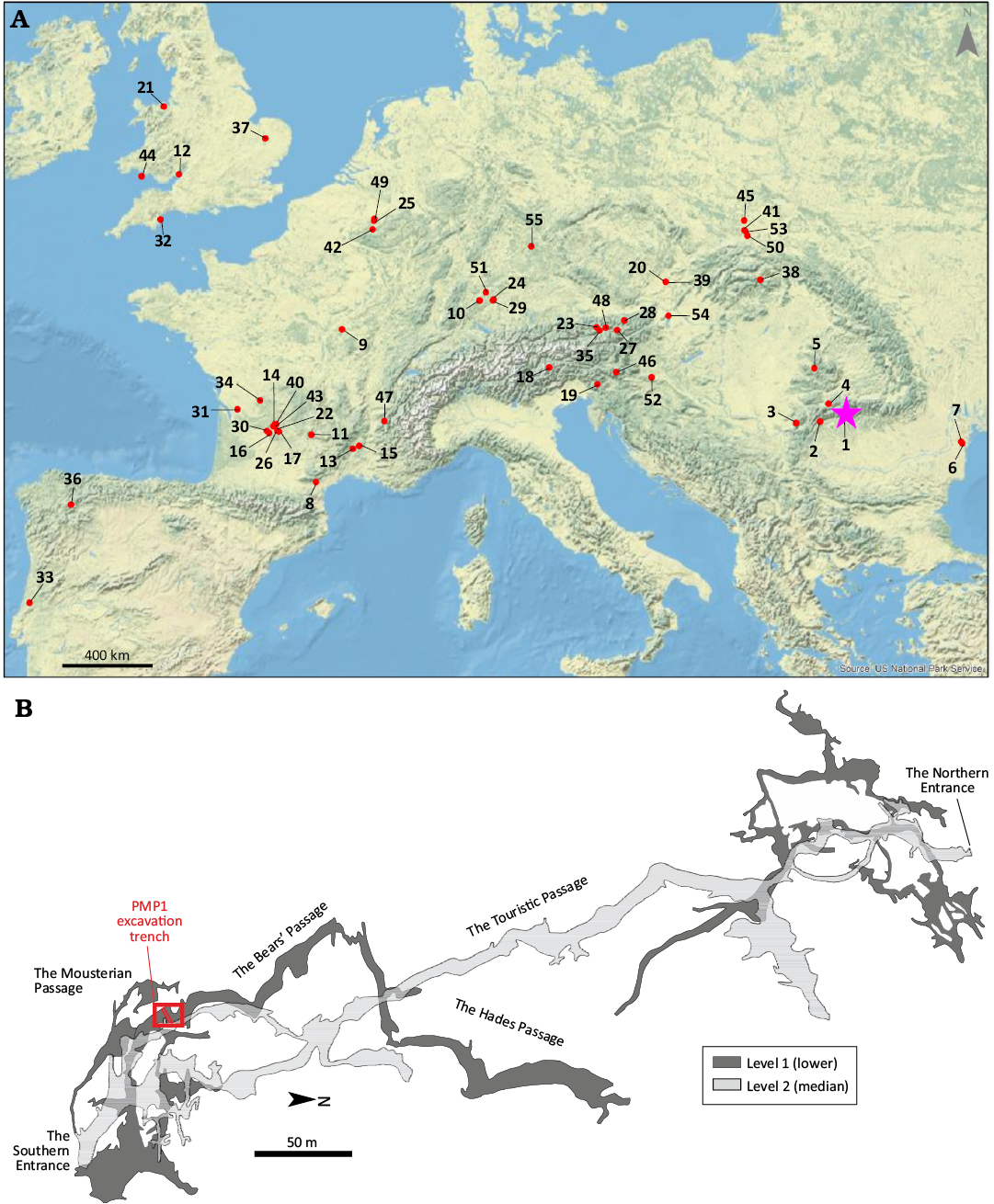
Fig. 1. A. Location of the Muierilor Cave and other European MIS 3 cave sites. Pink star: Muierilor Cave (1); Romanian cave sites: 2, Cloșani area; 3, Oase Cave; 4, Cioclovina; 5, Urșilor; 6, La Adam; 7, Chilingic. Other MIS 3 European sites (non-Romanian): 8–55 (see SOM: table 3). B. The simplified map of Muierilor Cave, showing location of the study site (PMP1 excavation trench) (surveyed by the “Hades” Caving Club, courtesy of Grigore Stelian, and by ERIS).
The Scientific Reserve (ca. 25 m elevation from the riverbed) includes horizontal passages (Bears, Hades, and Electricians), with several large chambers and side passages (ca. 3500 m in length). The Bears Passage (ca. 800 m in length) is a quasi-horizontal passage, with narrow segments that connect the large chambers. The cave deposit is characterized by an abundance of fossil remains, clastic sediments, and speleothems. These materials were primarily deposited during the pre- and post-LGM periods. However, it should be noted that the sedimentary sequence exhibits clear evidence of reworking, suggesting complex post-depositional processes that have likely redistributed some of the original stratigraphic components (Mirea et al. 2021; Robu et al. 2024, 2025, 2026). The abundance of fossil remains and their taphonomic context have led us to choose the Bears Passage for palaeontological excavation, which produced the samples analysed here.
The minimum number of individuals (MNI) for the cave bears extracted from the palaeontological excavation is at least 82 but ongoing work could increase this number to more than 100 individuals. The radiocarbon age of the cave bear population from the entire karst system ranges from ca. 47–44 to 36–34 ka (Robu et al. 2024). The bears left many traces of their existence in the cave: from scattered bones to fully articulated parts of their skeletons, such as hibernation nests, claw marks, among else.
The MNI for the wolves from the palaeontological excavation is 25, one of the highest densities recorded for this species, from a Late Pleistocene cave site. The wolf radiocarbon ages obtained so far from the excavation and the nearby passages range from 53–44 to 29 ka (Robu et al. 2024). As in the case of the cave bears, after ca. 32 ka, a decrease in the size of the wolf population appears to have occurred.
Other species found within the palaeontological excavation include Panthera spelaea (MNI = 4), Crocuta crocuta spelaea (MNI = 3), Vulpes vulpes Linnaeus, 1758 (MNI = 3), Cervus elaphus (MNI = 6), Lagurus lagurus Pallas, 1773 (MNI = 2), Microtus nivalis Linnaeus, 1758 (MNI = 8), Microutus arvalis Pallas, 1778, Microutus agrestris Lataste, 1884 (MNI = 24), Eolagurus luteus Eversmann, 1840 (MNI = 4), Arvicola terrestris Linnaeus, 1758 (MNI = 8), Clethriomomys glareolus Schreber, 1780 (MNI = 2), Cricetus cricetus Linnaeus, 1758 (MNI = 14) (Robu et al. 2024).
The sampled material.—The newly generated data on the MIS 3 palaeofauna from Muierilor (N = 40 adult individuals) consist of bone collagen retrieved from mandibles and metapodials of red deer (N = 6), cave bears (N = 24), cave lions (N = 2), wolves (N = 6) and cave hyaenas (N = 2) (Table 1). In addition, other data from the Muierilor Cave (Doboș et al. 2010; Robu et al. 2013, 2024; Meleg et al. 2025; SOM: table S1, Supementary Online Material available at http://app.pan.pl/SOM/app71-Robu_etal_SOM.pdf) were pooled and analysed together with our new results.
Table 1. MIS 3 cave bear and large-bodied mammal carbon (δ13C) and nitrogen (δ15N) stable isotope samples from Muierilor Cave.
|
N |
Lab # |
Species |
Ontogenetic stage |
Bone/tooth |
%C |
%N |
C:N ratio |
δ13C (PDB) |
δ15N (AIR) |
Source |
|
6 |
L-8 |
Cervus elaphus |
adult |
metapodial |
41.3 |
15.1 |
3.2 |
-19.8 |
5.2 |
this study |
|
L-4 |
Cervus elaphus |
adult |
tibia |
43.7 |
14.4 |
3.5 |
-21.2 |
4.0 |
this study |
|
|
L-6 |
Cervus elaphus |
adult |
metapodial |
45.4 |
16.6 |
3.2 |
-21.1 |
4.2 |
this study |
|
|
L-1 |
Cervus elaphus |
adult |
metapodial |
33.4 |
11.9 |
3.3 |
-20.0 |
7.6 |
this study |
|
|
L-2 |
Cervus elaphus |
adult |
metapodial |
39.9 |
14.0 |
3.3 |
-19.7 |
3.5 |
this study |
|
|
L-3 |
Cervus elaphus |
adult |
metapodial |
44.2 |
15.7 |
3.3 |
-19.8 |
3.5 |
this study |
|
|
41 |
K-86 |
Ursus spelaeus |
adult |
mandible |
36.8 |
12.9 |
3.3 |
-21.1 |
3.3 |
this study |
|
L-13 |
Ursus spelaeus |
adult |
mandible |
38.9 |
12.7 |
3.6 |
-21.5 |
2.4 |
this study |
|
|
L-15 |
Ursus spelaeus |
adult |
mandible |
36.9 |
12.7 |
3.4 |
-21.6 |
3.7 |
this study |
|
|
K-85 |
Ursus spelaeus |
adult |
mandible |
42.8 |
14.9 |
3.4 |
-21.3 |
2.8 |
this study, Robu et al. 2024 |
|
|
L-18 |
Ursus spelaeus |
adult |
mandible |
39.2 |
14.3 |
3.2 |
-21.4 |
3.9 |
this study |
|
|
K-89 |
Ursus spelaeus |
adult |
mandible |
43.6 |
14.5 |
3.5 |
-21.5 |
3.4 |
this study, Robu et al. 2024 |
|
|
L-24 |
Ursus spelaeus |
adult |
mandible |
40.2 |
14.4 |
3.3 |
-20.9 |
4.0 |
this study |
|
|
L-21 |
Ursus spelaeus |
adult |
mandible |
37.5 |
13.7 |
3.2 |
-20.9 |
3.1 |
this study, Robu et al. 2024 |
|
|
L-19 |
Ursus spelaeus |
adult |
mandible |
35.8 |
12.8 |
3.3 |
-21.7 |
4.2 |
this study, Robu et al. 2024 |
|
|
L-20 |
Ursus spelaeus |
adult |
mandible |
35.1 |
11.8 |
3.5 |
-22.2 |
3.4 |
this study, Robu et al. 2024 |
|
|
L-25 |
Ursus spelaeus |
adult |
mandible |
36.1 |
12.8 |
3.3 |
-22.1 |
2.2 |
this study |
|
|
L-26 |
Ursus spelaeus |
adult |
mandible |
35.2 |
12.1 |
3.4 |
-22.2 |
2.3 |
this study, Robu et al. 2024 |
|
|
K-87 |
Ursus spelaeus |
adult |
mandible |
31.2 |
10.6 |
3.4 |
-21.3 |
2.9 |
this study |
|
|
K-90 |
Ursus spelaeus |
adult |
mandible |
39.5 |
13.7 |
3.4 |
-20.8 |
3.5 |
this study |
|
|
L-16 |
Ursus spelaeus |
adult |
mandible |
34.1 |
11.8 |
3.4 |
-21.8 |
3.6 |
this study, Robu et al. 2024 |
|
|
K-92 |
Ursus spelaeus |
adult |
mandible |
31.3 |
10.6 |
3.4 |
-21.2 |
4.2 |
this study |
|
|
L-14 |
Ursus spelaeus |
adult |
mandible |
40.9 |
14.8 |
3.2 |
-21.2 |
3.4 |
this study, Robu et al. 2024 |
|
|
K-88 |
Ursus spelaeus |
adult |
mandible |
22.0 |
7.5 |
3.4 |
-21.5 |
4.4 |
this study |
|
|
L-28 |
Ursus spelaeus |
adult |
mandible |
41.4 |
15.0 |
3.2 |
-21.3 |
4.3 |
this study, Robu et al. 2024 |
|
|
L-22 |
Ursus spelaeus |
adult |
mandible |
40.1 |
14.3 |
3.3 |
-21.4 |
5.9 |
this study, Robu et al. 2024 |
|
|
L-12 |
Ursus spelaeus |
adult |
mandible |
36.8 |
12.0 |
3.6 |
-21.6 |
4.7 |
this study, Robu et al. 2024 |
|
|
L-9 |
Ursus spelaeus |
adult |
mandible |
35.3 |
11.6 |
3.6 |
-21.7 |
4.9 |
this study, Robu et al. 2024 |
|
|
L-29 |
Ursus spelaeus |
adult |
mandible |
40.4 |
14.1 |
3.3 |
-21.0 |
3.7 |
this study |
|
|
L-10 |
Ursus spelaeus |
adult |
mandible |
39.6 |
13.2 |
3.5 |
-21.2 |
3.8 |
this study, Robu et al. 2024 |
|
|
OxA-16382 |
Ursus spelaeus |
adult |
metapodial |
46.9 |
17.2 |
3.2 |
-20.2 |
3.4 |
||
|
OxA-16381 |
Ursus spelaeus |
adult |
metapodial |
47.5 |
17.5 |
3.2 |
-20.3 |
3.7 |
||
|
OxA-15530 |
Ursus spelaeus |
adult |
metapodial |
43.4 |
15.1 |
3.3 |
-20.3 |
6.0 |
||
|
OxA-16383 |
Ursus spelaeus |
adult |
metapodial |
44.9 |
16.4 |
3.2 |
-20.7 |
7.3 |
||
|
USR-55 |
Ursus spelaeus |
adult |
metapodial |
32.7 |
11.2 |
3.4 |
-21.0 |
2.9 |
||
|
USR-56 |
Ursus spelaeus |
adult |
metapodial |
36.5 |
12.8 |
3.3 |
-20.9 |
2.7 |
||
|
USR-57 |
Ursus spelaeus |
adult |
metapodial |
34.3 |
11.9 |
3.4 |
-21.4 |
6.7 |
||
|
USR-58 |
Ursus spelaeus |
adult |
metapodial |
40.7 |
14.1 |
3.4 |
-20.7 |
3.7 |
||
|
USR-59 |
Ursus spelaeus |
adult |
metapodial |
33.6 |
11.2 |
3.5 |
-20.8 |
1.1 |
||
|
USR-60 |
Ursus spelaeus |
adult |
metapodial |
39.8 |
14.1 |
3.3 |
-20.8 |
2.1 |
||
|
USR-61 |
Ursus spelaeus |
adult |
metapodial |
33.7 |
11.8 |
3.3 |
-20.8 |
2.5 |
||
|
USR-62 |
Ursus spelaeus |
adult |
metapodial |
42.7 |
15.0 |
3.3 |
-21.1 |
4.9 |
||
|
USR-63 |
Ursus spelaeus |
adult |
metapodial |
40.4 |
14.4 |
3.3 |
-20.7 |
5.3 |
||
|
S-EVA-11149 |
Ursus spelaeus |
adult |
humerus |
43.2 |
15.5 |
3.3 |
-21.0 |
3.8 |
||
|
S-EVA-11151 |
Ursus spelaeus |
adult |
humerus |
43.1 |
15.6 |
3.2 |
-20.8 |
4.4 |
||
|
S-EVA-11152 |
Ursus spelaeus |
adult |
humerus |
43.7 |
15.4 |
3.3 |
-21.1 |
3.6 |
||
|
S-EVA-11153 |
Ursus spelaeus |
adult |
humerus |
42.4 |
15.5 |
3.2 |
-21.0 |
4.0 |
||
|
3 |
K-112 |
Panthera spelaea |
adult |
mandible |
38.6 |
13.8 |
3.3 |
-19.3 |
7.7 |
this study |
|
K-114 |
Panthera spelaea |
adult |
mandible |
29.9 |
10.2 |
3.4 |
-19.3 |
9.8 |
this study |
|
|
OxA-16380 |
Panthera spelaea |
adult |
metapodial |
48.8 |
17.5 |
3.2 |
-19.1 |
8.2 |
||
|
6 |
K-106 |
Canis lupus |
adult |
mandible |
24.5 |
8.4 |
3.4 |
-19.5 |
10.3 |
this study, Robu et al. 2024 |
|
K-110 |
Canis lupus |
adult |
mandible |
39.1 |
13.9 |
3.3 |
-19.2 |
9.2 |
this study, Robu et al. 2024 |
|
|
K-102 |
Canis lupus |
adult |
mandible |
26.9 |
9.1 |
3.4 |
-19.0 |
10.9 |
this study, Robu et al. 2024 |
|
|
K-103 |
Canis lupus |
adult |
mandible |
30.6 |
10.9 |
3.3 |
-18.7 |
11.5 |
this study, Robu et al. 2024 |
|
|
K-107 |
Canis lupus |
adult |
mandible |
33.1 |
10.8 |
3.6 |
-19.3 |
11.0 |
this study, Robu et al. 2024 |
|
|
K-108 |
Canis lupus |
adult |
mandible |
18.4 |
6.3 |
3.4 |
-19.2 |
9.6 |
this study, Robu et al. 2024 |
|
|
3 |
K-116 |
Crocuta crocuta spelaea |
adult |
bone |
35.0 |
12.4 |
3.3 |
-19.3 |
8.8 |
this study |
|
K-115 |
Crocuta crocuta spelaea |
adult |
bone |
33.2 |
11.5 |
3.4 |
-19.2 |
11.4 |
this study |
|
|
PM/034 |
Crocuta crocuta spelaea |
adult |
tooth |
19.6 |
7.6 |
3.2 |
-18.6 |
13.4 |
For the dietary inter-site comparison, isotopic data for samples of mature cave bears (SOM: table S1) were pooled together. Additionally, already published (e.g., Richards et al. 2008; Doboş et al. 2010; Robu et al. 2013, 2018b, 2024; Trinkaus and Richards 2013; Meleg et al. 2025) adult MIS 3 cave bear data from other Romanian key sites were added: e.g., Oase (N = 71), Urşilor (N = 35), Cioclovina (N = 39), and Muierilor (N = 17). The Romanian MIS 3 non-ursid data plotted here, from other sites than Muierilor consists of cave lions (N = 5), cave hyaenas (N = 5), wolves (N = 5), red deer (N = 2) (SOM: table S1).
To provide a broader framework for the Carpathian MIS 3 large mammals, isotopic data from large-bodied MIS 3 mammals were pooled together for European sites (excluding Romania) from central or western Europe (SOM: tables S2, S3). These comparative samples, published previously (e.g., Bocherens 2015; Krajcarz et al. 2016), include data for red deer (N = 19), cave bears (N = 211), cave lions (N = 22), wolves (N = 22) and cave hyaenas (N = 44) (SOM: tables S2, S3).
The reliable radiometric ages obtained for the cave bear bone assemblages, Muierilor (N = 12; Doboş et al. 2010; Robu 2015; Mirea et al. 2021), Urşilor (N = 27; Constantin et al. 2014; Robu 2015; Duño-Iglesias et al. 2024), Oase (N = 16; Higham and Wild 2013; Robu et al. 2019), and Cioclovina (N = 8; Soficaru et al. 2007; Petrea 2009; Robu et al. 2019; Meleg et al. 2025), indicate a MIS 3 occupation (N = 63; SOM: table S4). Therefore, these populations were analysed and plotted together. Only samples with a minimum of 0.8% collagen yield were included in the plot. All ages were calibrated using the OxCal 4.4 program (Bronk Ramsey 2021) and the IntCal20 calibration curve (Reimer et al. 2020).
The isotopic analyses.—Values of the ratio of stable isotopes of carbon and nitrogen (δ13C and δ15N) were measured in collagen extracted from well preserved Late Pleistocene mammal bone to determine the main sources of dietary protein. Delta (δ) values represent the deviation of isotopic ratios (expressed in parts per mil [‰]) with respect to an international standard reference material using the equation: δ = [(Rsample/Rstandard) − 1] ×1000, where Rsample is the 13C/12C or 15N/14N ratio of the analysed sample and standard following the International-System-of-Units-compliant definition of Coplen (2011).
For the fossil material analysed in this study, bone collagen was extracted using a modified version (Pestle 2010) of the method developed by Longin (1971) and refined by Ambrose (1990). Collagen isotopic analysis was performed in the Marine Geology and Geophysics Stable Isotope Laboratory at the Rosenstiel School of Marine and Atmospheric Science, University of Miami, USA, following the methods detailed in Mackenzie et al. (2015). In brief, collagen samples were packed into tin capsules and analysed using a Costech elemental analyser interfaced to a Thermo Delta Advantage (IRMS). This analytical process yields information on elemental carbon and nitrogen composition (wt % C, wt % N and atomic C:N) as well as δ13C and δ15N values. Only those samples meeting published quality standards (extracted collagen yield >0.5 wt %, carbon yield >4.5 wt %, nitrogen yield >0.9 wt %, atomic C/N ratio between 2.9–3.6) are considered below. Collagen results were calibrated using acetanilide and glycine standards. Standards were analysed in every sample set at the beginning and end of the run, as well as in-between the analysed samples to ensure instrumental stability. Check samples of all three standards were also run as unknowns in every run to verify measurement accuracy (Szpak et al. 2017). Precision (as determined by replicate analysis of samples included in the present study) averaged 0.1‰ for δ13C and 0.2‰ for δ15N. The carbon isotope ratio measurements (δ13C) were reported relative to the VPDB (Vienna Pee Dee Belemnite) standard, while the nitrogen isotope ratio measurements (δ15N) were performed relative to the AIR (atmospheric nitrogen) standard.
Statistical analyses.—Data distribution was visualized using box plots, displaying the median, interquartile range (IQR), whiskers (1.5 × IQR), and outliers. Due to non-normal distributions, small sample sizes for MIS 3 species, and the pooled nature of the European samples, non-parametric methods were utilized for all statistical analyses. Species-specific comparisons between Muierilor, Romanian Carpathians and European samples were conducted via Wilcoxon rank-sum tests with a post-hoc sequentially rejective Bonferroni correction. Kruskal-Wallis tests (corrected for ties) were used to evaluate the δ13C and δ15N variations across species and sites. Pairwise site comparisons were further analysed using Mann-Whitney test, with Bonferroni corrected p-values. Analyses were performed in Past software 5.3 (v. 2025; Hammer et al. 2001); p-values are presented as supplements to graphical data, acknowledging their inferential limitations, particularly regarding sample size, as highlighted by Wasserstein and Lazar (2016).
Results
Red deer.—The red deer (from the Muierilor bone assemblage), a typical browser, yielded values, for both δ13C and δ15N (median; -19.9‰ and 4.1‰, respectively; Table 1) far lower than those obtained for carnivores (e.g., Fig. 2; SOM: table S1). The difference of median values of δ13C and δ15N values between the red deer and the carnivorous species (cave lion, wolf and cave hyaena) ranged between 0.6–0.7‰ and 4.1–7.3‰, respectively. The δ13C isotopic values for the pooled Muierilor MIS 3 red deer (Table 1; Fig. 2) largely overlapped with values from both Romania (median -19.3‰) and Europe (median -19.9‰), for the same species (Fig. 3; Table 2; SOM: tables S1–S3). Overall, there is no significant difference between the samples’ median, for both δ13C and δ15N, between the analysed datasets (Table 2).
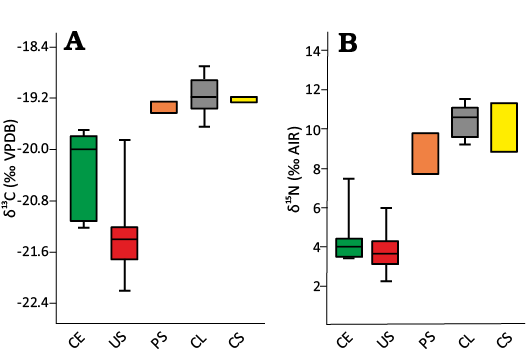
Fig. 2. Box plots of δ13C (A; ‰ with respect to VPDB standard) and δ15N (B; ‰ with respect to AIR standard) from bone collagen for the Marine Isotope Stage (MIS) 3 fauna from Muierilor Cave (N = 40; only this study): red deer (CE, Cervus elaphus; N = 6), cave bear (US, Ursus spelaeus; N = 24), cave lion (PS, Panthera spelaea; N = 2), wolf (CL, Canis lupus; N = 6) and cave hyaena (CS, Crocuta crocuta spelaea; N = 2).
Carnivores.—The Muierilor cave lions had slightly lower δ13C values (N = 2 + 1 sample added from Doboș et al. 2010; median -19.3‰) than the Romanian and European samples (median -18.7‰ for both), while the δ15N values from Muierilor (median 8.2‰) largely overlap with the Romanian and European samples (median 8.7‰ and 8.3‰, respectively; Fig. 3; Table 1; SOM: tables S1–3). Moreover, between the Muierilor and the Romanian/European cave lions, there are no significant differences for both δ13C and δ15N datasets (p = 0. 2518 and p = 0.1493, respectively; Table 2).
The δ13C values of wolves from Muierilor (N = 6; median -19.2‰) fit well within the Romanian and European data (-19.4‰ and -19.0‰, respectively). The δ15N values from Muierilor (median 10.6‰) place the wolves, in terms of median values, slightly higher than samples from the Romanian and European sites (median 9.3‰, and 9.5‰, respectively). However, between the Muierilor and the Romanian/European MIS 3 wolves, there are no significant differences for both δ13C and δ15N datasets (p = 0.9528 and p = 0.1737, respectively; Table 2).
Table 2. Wilcoxon rank-sum tests (corrected for ties; Kruskal-Wallis procedure) of Muierilor (M), Carpathian (RO) and comparative European (EU) MIS 3 large-bodied mammal δ13C and δ15N distributions. Abbreviations: EU N, European dataset sample count; HC, Chi-square test/H-corrected statistic; M N, Peștera Muierii sample count; P-value, significance level; RO N, Romanian comparison dataset sample count.
|
Species |
δ13C HC |
δ13C P-value |
δ15N HC |
δ15N P-value |
M N |
RO N |
EU N |
|
Cervus elaphus |
4.148 |
0.1257 |
0.8276 |
0.6611 |
6 |
2 |
19 |
|
Ursus spelaeus |
37.15 |
< 0.001 |
167.3 |
< 0.001 |
41 |
218 |
211 |
|
Panthera spelaea |
2.758 |
0.2518 |
3.804 |
0.1493 |
3 |
5 |
22 |
|
Canis lupus |
0.0967 |
0.9528 |
3.501 |
0.1737 |
6 |
5 |
22 |
|
Crocuta crocuta spelaea |
9.537 |
0.008493 |
14.25 |
0.0008035 |
3 |
5 |
44 |
The hyaena δ13C values (median -19.2‰) obtained for Muierilor (N = 2+1 from Robu et al. 2013) and δ15N data (median 11.4‰) are slightly higher than at the European sites (median -19.4‰ and 9.3‰, respectively) and lower when compared to the Romanian sites (median -17.8‰ and 13.3‰, respectively; Figs. 2‒3; Table 1 and SOM: tables S2, S3). Overall, there are no significant differences between both δ13C and δ15N datasets when compared the MIS 3 cave hyaenas from Muierilor to the Romanian (p = 0.5313 and p = 1, respectively) and European sites (p = 0.6652 and p = 0.4516, respectively).
Cave bears.—The results of the Mann-Whitney pairwise test indicate that the δ13C values recorded for MIS 3 Muierilor cave bears (N = 24 + 17 previous data) are in agreement with the coeval European Late Pleistocene bear populations (p = 1; Figs. 2‒4; Tables 1, 2; SOM: table S1, S2). On the other hand, a statistically significant difference between the δ13C distribution between the Muierilor and the other MIS 3 cave bear sites from the Romanian Carpathians (p = 0.01256) was observed. The δ15N distribution of Muierilor bears are not in agreement with previously reported overall Romanian (N = 218) and European (N = 211) MIS 3 cave bears (p < 0.001 for both comparisons; Figs. 2‒4; Tables 1, 2; ; SOM: tables S1–S3). On the other hand, inside the MIS 3 cave bears from the Romanian Carpathians, when comparing several key-sites, one can observe that Muierior δ13C and δ15N datasets are significantly similar with the Cioclovina population (p = 1 and p = 0.05779 for both comparisons, respectively) and very different from the Urșilor and Oase populations (p < 0.001 for both comparisons, respectively; Table 3).
Table 3. Comparisons across several key-sites from the Romanian Carpathians of adult MIS 3 Ursus spelaeus samples, based on multiple pairwise comparisons, using Mann-Whitney procedure (with Bonferroni corrected p-values). δ13C: upper right; δ15N: lower left.
| |
Cioclovina |
Muierilor |
Oase |
Urşilor |
|
Cioclovina |
– |
1 |
0.3827 |
0.2138 |
|
Muierilor |
0.05779 |
– |
0.01022 |
0.005278 |
|
Oase |
< 0.001 |
< 0.001 |
– |
0.6946 |
|
Urşilor |
< 0.001 |
< 0.001 |
0.1968 |
– |
Discussion
MIS 3 Carpathian and European palaeo-faunistic and chronological context.—In Eurasia, during the GI 12‒3 interval (ca. 46.8‒27.8 ka; Rasmussen et al. 2014; Andersen et al. 2006), despite many abrupt shifts in temperature, the large terrestrial mammalian fauna had a wide distribution and significant taxonomic diversity. Towards the end of this period, the range of some of these taxa contracted, or the taxa even vanished. For the Romanian Carpathians, the MIS 3 data for taxa other than cave bears are scarce and an overall assessment of the dietary framework, at the level of the entire region, is not yet possible. There are four cave sites from this region that have undergone systematic stable isotope analyses: Oase, Urșilor, Cioclovina, and Muierilor (Figs. 4 and 5). Except for Oase (Parfit and Lister 2013), the other two cave sites have cave bear dominant fossil populations, with only a few individuals belonging to other associated species (e.g., cave lion, wolf, cave hyaena).
Several studies (Stuart and Lister 2011, 2013) indicate that cave hyaenas survived in the Southern Carpathians until, at least, ca. 41 ka (roughly corresponding with the Greenland Stadial (GS) 10‒9: ca. 41.4–40.2 ka; Fig. 6) and cave lions until ca. 32.5 ka (GI 5) (Andersen et al. 2006), while the cave bears survived until, at least, 34 ka in the Muierilor area (Robu et al. 2024; Figs. 5, 6).
By adding previously published stable isotope data from the Muierilor MIS 3 bone assemblage (e.g., Doboș et al. 2010) to the ones obtained for this study, it seems that the range of the δ15N values obtained for the cave lions (7.7–9.8‰) from Muierilor suggest a relatively diverse prey choice (Robu et al. 2024). A similar situation was recorded also for cave hyaenas (8.8–11.4‰; if we exclude the value of 13.4‰ obtained by Robu et al. 2013, from tooth tissue) and wolves (9.2–11.5‰; Robu et al. 2024), both species indicating a different isotopic signature when compared to the lions.
Red deer was widespread across the boreal hemisphere during the Late Pleistocene. Its presence at Muierilor, at ca. 40 ka, indicates a forested environment and rich biodiversity. Both carbon and nitrogen isotopic values from Muierilor are in the range of the MIS 3 European data (Bocherens 2015) and suggest a similar herbivorous diet, although the mean δ15N values are slightly different (Fig. 3; Tables 1, 2).
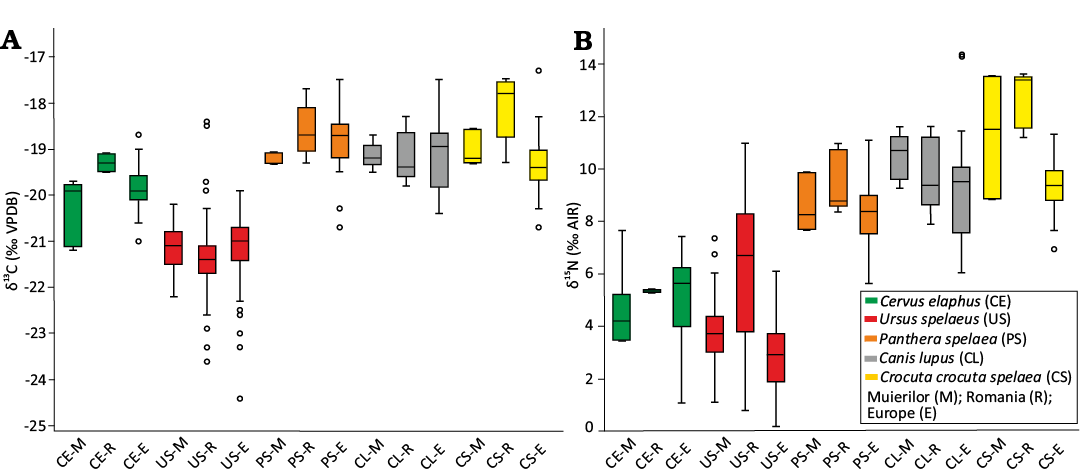
Fig. 3. Boxplots of bone collagen δ13C (A) and δ15N (B) (‰ with respect to VPDB and AIR, respectively) for Marine Isotope Stage (MIS) 3 Late Pleistocene cave bear association (CE, Cervus elaphus; US, Ursus spelaeus; PS, Panthera spelaea; CL, Canis lupus; CS, Crocuta crocuta spelaea) from Muierilor Cave (M; this study and previous data), Romania (R; excluding Muierilor) and Europe (E; respectively). CE-M (N = 6), CE-R (N = 2), CE-E (N = 19); US-M (N = 41), US-R (N = 218), US-E (N = 211); PS-M (N = 3), PS-R (N = 5), PS-E (N = 22); CL-M (N = 6), CL-R (N = 5), CL-E (N = 22); CS-M (N = 3), CS-R (N = 5), CS-E (N = 44).
Although, according to Stuart and Lister (2011), cave lions become extinct during the LGM, for the Romanian Carpathians, the youngest radiocarbon available data point is ca. 37.4 ka (Constantin et al. 2014), from Urșilor Cave, north-western Romania. Two cave lions from the Muierilor Cave provided much older ages, close to the radiocarbon limit (ca. 51.3 and 50.5 ka; Doboș et al. 2010 and Mirea et al. 2021, respectively; Table 1 and SOM: table S4). However, Fosse et al. (2017) reported younger radiocarbon ages for the Eurasian cave lions than Stuart and Lister (2011), especially one as young as 12 ka, from the site of Peyrat in France.
Published isotopic data for the western European cave lions have revealed a focus on two quite distinct types of prey species, herbivores and cave bears, especially when cave hyaenas were present and competing with lions, for food resources (Bocherens et al. 2011; Bocherens 2015). Therefore, based on the similar mean values for both carbon and nitrogen between lions from Muierilor and the European Late Pleistocene cave lions, we infer a similar dietary behaviour for the Pleistocene cave lions of Muierilor. In Muierilor, the analysed cave lions may have subsisted mainly on herbivores (e.g., red deer) as in the rest of the European sites), while a few individuals specialized in preying on cave bears, especially in competition with cave hyaenas and wolves. Nonetheless, the cave hyaenas and cave lions seem to have been outcompeted by wolves, who, after ca. 32.5 ka, became the main predator in the region.
Given their resilience until the present day, it seems that wolves were among the most successful gregarious medium predators from the Middle Pleistocene to Holocene (Pilot et al. 2010). The prey contribution in the diet of pre- and post-LGM wolves from Western Europe, reconstructed using MixSIR analysis (Bocherens 2015) points to Cervus, Bison, and Rupicapra. When compared with the European wolf population, the median δ13C value of the Muierilor samples is similar (Table 2 and SOM: table S2), whereas a slightly different situation is recorded for the δ15N values between the two datasets (+1.1‰ for Muierilor wolves; SOM: table S2). This may indicate a slightly different set of prey choices. However, the Muierilor values are still in the range of the European values (Table 2 and SOM: table S2). The presence of nests/beds with fully or partially articulated wolf skeletons and the considerable number of wolf individuals from other cave passages suggest a gregarious behaviour for both hunting/scavenging and denning.
The high number of wolf fossils discovered in Muierilor, both on the surface and within the palaeontological excavation (MNIexcavation = 25), together with a majority of medium sized bite marks on the cave bear bones, coupled with the radiocarbon data, suggest a long and persistent presence. Moreover, given the morpho-osteometry of the bite marks found on the cave bear and red deer bones, one can ascertain that the wolves were preying/scavenging on both (Robu et al. 2024).
The δ13C and δ15N values obtained for Muierilor are within the ranges of the European Late Pleistocene cave hyaenas, suggesting generally similar prey choices (Fig. 3; Table 2 and SOM: table S2) to include cave bears and cervids, along with other species such as bovids (Bocherens 2015).
MIS 3 cave bears—a problematic species.—For the Romanian Carpathians, this multi-species comparative study is the first to show that in the same mammal association, the adult cave bears have lower nitrogen values than the typical herbivores (browsers), such as red deer. Nitrogen values from a previous study (Doboș et al. 2010), reported higher values (up to 7.3‰) suggesting a potential dietary flexibility for the Muierilor cave bear population (Fig. 4B). However, considering the overall nitrogen data from the Romanian Carpathians, two of the best-studied sites of Romania (Robu et al. 2013, 2018b), Muierilor and Cioclovina form a distinct cluster when comparing to Urșilor and Oase (Fig. 4; Table 3), indicating different dietary habits among the bears in these sites.
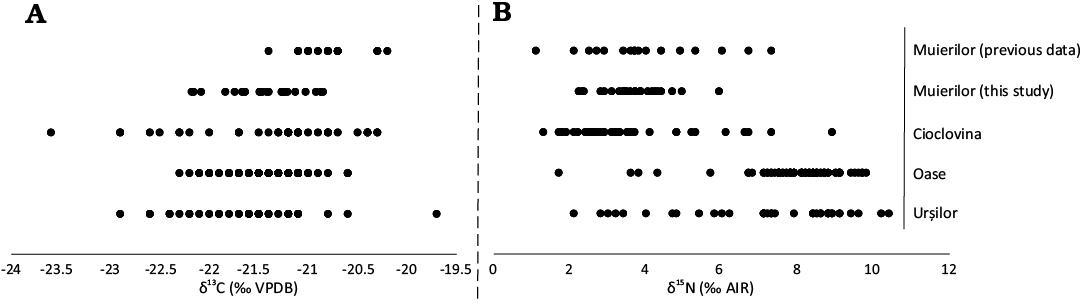
Fig. 4. Plot of (A) δ13C and (B) δ15N (‰ with respect to VPDB and AIR, respectively) from bone collagen for Marine Isotope Stage (MIS) 3 adult cave bears, from several key-sites from the Romanian Carpathians (N = 186): Muierilor previous data (N = 17); Muierilor this study (N = 24); Cioclovina (N = 39); Oase (N = 71); Urșilor (N = 35).
The metabolism of modern bears undergoes significant shifts during hibernation, characterized by the absence of food and water intake and a reliance on fat storage and urea recycling (Nelson et al. 1975; Floyd et al. 1990; Barboza et al. 1997; Pérez-Rama et al. 2011). In cave bears, this unique physiology might have influenced bone collagen isotope ratios, which integrate several years of the animal’s life. While previous studies suggest that hibernation can elevate δ15N values and decrease δ13C values in adults (Nelson et al. 1998; Pérez-Rama et al. 2011), physiological fractionation alone, or potential variations in hibernation length due to fluctuating MIS 3 climates, does not sufficiently account for the isotopic similarities observed between cave bears and red deer at Muierilor. While differing climatic conditions across various time periods could theoretically impact hibernation duration and, consequently, isotopic signatures, the extensive range of δ13C and δ15N values identified in the Romanian Carpathian populations points toward dietary plasticity. Despite a shared ethology (i.e., hibernation), the isotopic variance observed is more consistent with diverse foraging strategies than with purely metabolic or climatic drivers. Consequently, while some authors advocate for an obligatory herbivorous diet (Bocherens 2015), our data support a more flexible dietary model that may include varying levels of animal protein consumption (Robu et al. 2013, 2018b).
Out of the 259 analysed adult MIS 3 cave bears from the Romanian Carpathians (Muierilor + the rest of the Romanian sites; median δ15N = 5.8‰; SOM: table S2; Richards et al. 2009; Robu et al. 2013, 2018b, 2024; Naito et al. 2020; Meleg et al. 2025; this study), 97 individuals (37.5%) have higher values than 7.2‰ for δ15N (as a reference, a cave lion from Urșilor provided a value of 7.2‰ for δ15N, from bulk collagen). Given the unusual large variability of the δ15N values obtained for the MIS 3 cave bears from the Romanian Carpathians, Naito et al. (2020) investigated the Romanian MIS 3 cave bears by using a new method. The proposed isotopic approach was based on the fact that the δ15N values of individual amino acids (AA) allow to be largely classified into several categories, “trophic” and “source”. The comparison of the “source” AAs like phenylalanine (Phe) with the “trophic” AAs like glutamate (Glx) enabled the evaluation of animal trophic position regardless of baseline fluctuations in δ15N values in ecosystems. Based on this framework, Naito et al. (2020) examined several Carpathian cave bears (N = 6), from three sites (Răsuflătoare, Cioclovina Uscată, and Măgura), with low (5.2‒6.3‰; N = 3) and high nitrogen values (8.1‒9.8‰; N = 3), by using the δ15N values of individual amino acids from collagen. The results suggested that the high variability in bulk collagen δ15N values observed among cave bears in Romania reflected niche partitioning but in a general trophic context of herbivory. However, given the pure mathematic and statistic nature of the method, there are two parameters used in the equation: TP = [(δ15NGlx−δ15NPhe − β)/TDF] +1; the Trophic Discrimation Factor (TDF; obtained from Blanke et al. 2017, based on a study on fish and the isotopic offset between glutamate and phenylalanine [δ15NGlx − δ15NPhe value] in primary producers β; calculated for terrestrial C3 vascular plants Naito et al. 2016) the results obtained have a large margin of error when estimating the trophic position (TP) for the analysed cave bear specimens. Taking into account the complex settings of the Carpathians (e.g., climate, vegetation cover, geographic position etc.) and the time span of the cave bears in this region (from >50‒27.1 ka; Duño-Iglesias et al. 2024, 2025) it is difficult to state a heavy reliance on herbivory for a species with extremely numerous individuals, in a such heterogenous environment. Moreover, the reference materials used by Naito et al. (2020), a MIS 3 horse and cave lion (sampled from western Germany and North Sea, respectively), were not excellent comparison choices. In addition, the results ruled out at least the following possibilities: (i) significant contribution of aquatic resources such as fish to their diets; and (ii) carnivory as the main feeding behaviour. In fact, based on the high values of the δ15N bulk collagen of the MIS 3 cave bears from the Carpathians, Robu et al. (2013, 2018) did not state otherwise. An estimation of a highly plant-dependent feeding behaviour does not necessarily support a purely herbivorous diet, nor it excludes a variable diet as previous contributions stated (e.g., Richards et al. 2009).
Recent contributions based on the microwear features of the cave bear lower first molars (Duño-Iglesias et al. 2024, 2025), of almost 250 individuals (N = 246) from the Romanian Carpathians, indicated undoubtedly an omnivorous nature of their diet, with a preference for the consumption of hard matter. As stated before in Richards et al. (2009) and Robu et al. (2013, 2018b), the cave bear individuals from Oase and Urșilor (and overall, from the Carpathians) displayed a variable dietary profile, a unique feature for this species in Europe (Duño-Iglesias et al. 2024, 2025).
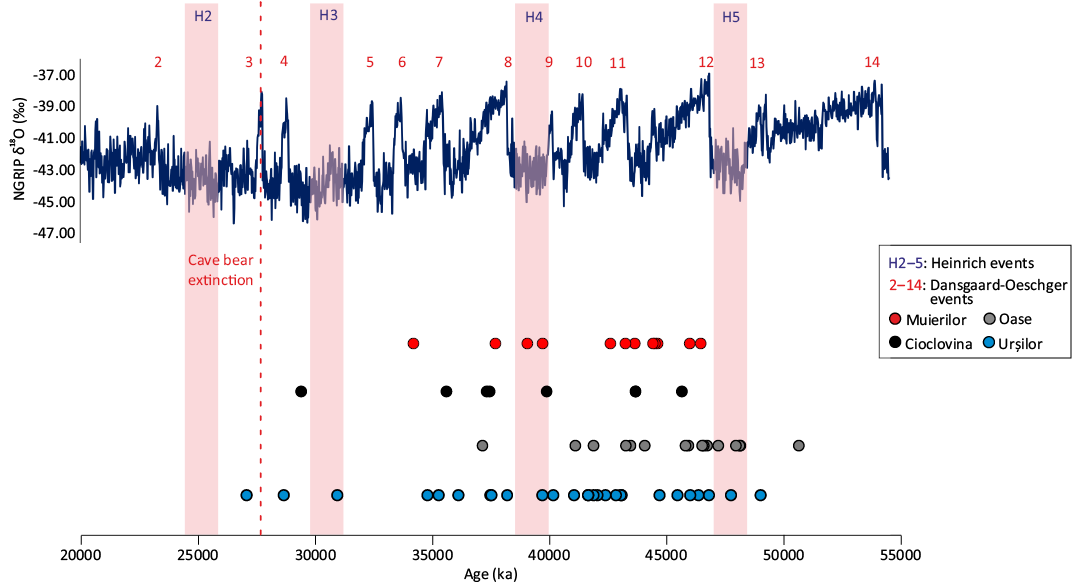
Fig. 5. Romanian Carpathian MIS 3 cave bear radiocarbon data (N = 63; from bone and teeth; with collagen yield ≥ 0.8%), from the four key-sites of Romania: Muierilor (N = 12), Urșilor (N = 27), Oase (N = 16), Cioclovina (N = 8). Red dashed line: cave bear extinction (Pacher and Stuart 2009). NGRIP, North Greenland Ice Core Project.
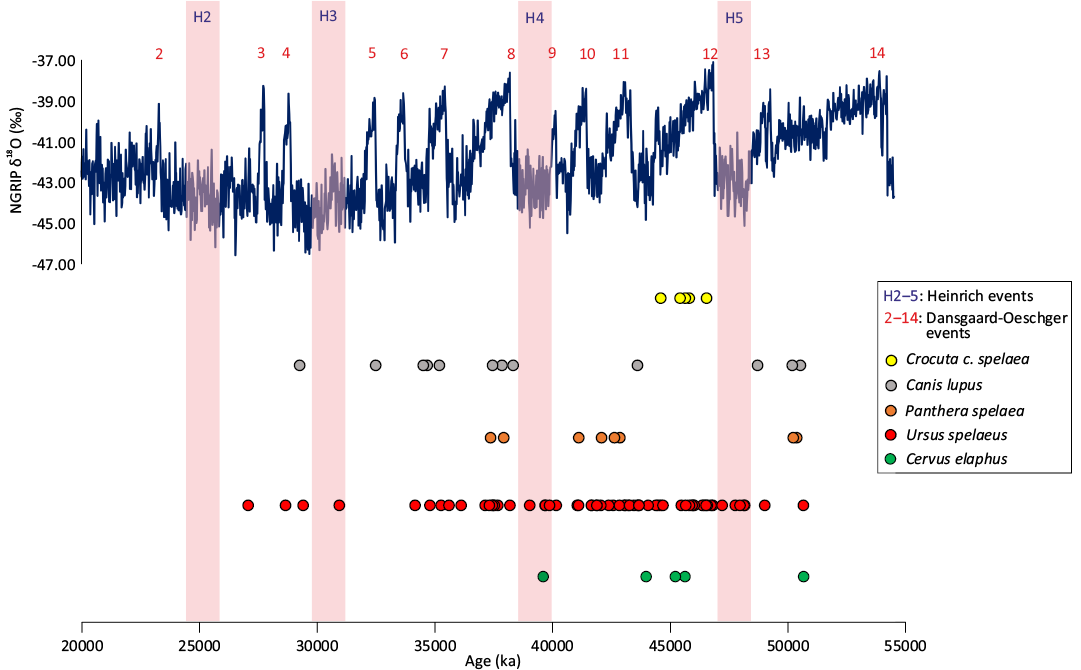
Fig. 6. Calibrated AMS 14C data of the MIS 3 palaeofauna from the Romanian Carpathians: Cervus elaphus (N = 5), Ursus spelaeus (N = 63), Panthera spelaea (N = 8), Canis lupus (N = 12), Crocuta crocuta spelaea (N = 5). NGRIP, North Greenland Ice Core Project.
The newly obtained data for the MIS 3 cave bear population from Muierilor show lower δ15N values, suggesting herbivory, although Doboș et al. (2008) published a δ15N value higher than 7‰ from the same site. However, the overwhelming majority of the δ15N values for the cave bears individuals from Muierilor are lower than 4‰. It is worth noticing that the cave bears from Muierilor have some of the lowest nitrogen isotope values published yet for the Romanian Carpathians. For the monospecific cave bear associations (e.g., Urșilor), with almost no competition from other carnivores, the food choices for bears were diverse, a fact reflected by the high nitrogen values and microwear dental analyses (Robu 2015; Duño-Iglesias et al. 2024, 2025). Therefore, in the case of Muierilor, the high density of carnivorous and necrophagous species could have played an important role in the cave bears’ food choice. The taphonomic evidence (e.g., punctures, gnawing) found on the cave bear bones indicates that the carnivores from Muierilor were preying/scavenging upon this species, as well as on the red deer (Robu et al. 2024). Therefore, the presence of many carnivores (in both number of species and population size), the climatic conditions and the vegetal composition of the land cover from the Muierilor area might have directly influenced the diet of cave bears from this region.
Conclusions
This study reports δ13C and δ15N values measured on the bone collagen of Late Pleistocene mammals retrieved from both bear and non-bear cave sites in the Romanian Carpathians. In general, these analyses show good agreement with previously published values measured on European Late Pleistocene large mammals, although the cave bears from the Muierilor site exhibit low δ15N values.
The abundance of the apex carnivores (cave hyaenas, cave lions and especially wolves) and the ensuing food competition in the ecosystem of the Muierilor area, might have narrowed the cave bears’ ecological niche, influencing and inducing a mainly herbivorous diet.
Although being heavily preyed on by typical carnivorous species in the MIS 3 (at least between 45–34 ka), cave bears seem to survive up until the onset of the LGM in the studied region. After ca. 35 ka, cave lion, following the cave hyaena populations, diminished and vanished, as everywhere in Europe, while the wolf and red deer populations adapted to the challenging environment and thrived until the present day.
Muierilor Cave becomes, thus, one of the most complex sites for palaeoecological studies of large mammals in Europe and a hotspot in understanding the feeding plasticity of one of the most iconic Quaternary mammals—the cave bear.
Acknowledgements
The authorities of Baia de Fier, the “White Wolf “Mountain Club and all volunteers involved are acknowledged for providing logistic support. We thank Amel Saied (University of Miami, Miami, USA) for help with analysis of the stable isotopes, Oana-Teodora Moldovan (ERIS), Florent Rivals (Catalan Institute of Human Paleoecology and Social Evolution, Tarragona, Spain) and an anonymous reviewer for improving this manuscript. This research involved systematic excavation and research between 2014 and 2023 and therefore benefited from several sources of funding. It was initially supported through a National Geographic Grant (#964115) and further on through grants PCE 197/2016 (CARPATHEMS), EEA 126/2018 (KARSTHIVES2), all to SC and RU-TE 2301/2014 (PALEOCLIM) to AP. This work was also supported by the grants PN-III-P1-1.1-TE-2021-0187, PN-IV-P2-2.2-MC-2024-0467, PN-IV-PCBRO-MD2024-0067 (to MR), PN-IV-P2 2.1-TE-2023-0654 (to MLT) and PN-III-P1-1.1-PD-2021-0262, PN-IV-P22.2-MC-2024-0593, Paleontological Society (PalSIRP) 2023 Sepkoski Grant (to ICM). MR acknowledges the financial support received from the Research Institute of the University of Bucharest (ICUB), under the research fellowship programme ICUB Fellowship for Young Researchers #12950/2025. Also, this study was supported by the project F-RO-CH-2024-0161/IZ11Z0_230102.
Editor: Eli Amson
References
Ambrose, S. H. 1990. Preparation and characterization of bone and tooth collagen for carbon and nitrogen isotopic analysis. Journal of Archaeological Science 17: 431–456. Crossref
Andersen, K.K., Svensson, A., Johnsen, S.J., Rasmussen, S.O., Bigler, M., Röthlisberger, R., Ruth, U., Siggaard-Andersen, M.L., Steffensen, J.P., Dahl-Jensen, D., Vinther, B.M., and Clausen, H.B. 2006. The Greenland Ice Core Chronology 2005, 15–42 ka. Part 1: constructing the time scale. Quaternary Science Reviews 25: 3246–3257. Crossref
Baca, M., Popović, D., Stefaniak, K., Marciszak, A., Urbanowski, M., Nadachowski, A., and Mackiewicz, P. 2016. Retreat and extinction of the Late Pleistocene cave bear (Ursus spelaeus sensu lato). The Science of Nature 103: 92. Crossref
Barboza, P.S., Farley, S.D., and Robbins, C.T. 1997. Whole body urea cycling and protein turnover during hyperphagia and dormancy in growing bears (U. americanus and U. arctos). Canadian Journal of Zoology 75: 2129–2136. Crossref
Blanke, C.-M., Chikaraishi, Y., Takizawa, Y., Steffan, S.A., Dharampal, P.S., and Vander Zanden, M.J. 2017. Comparing compound-specific and bulk stable nitrogen isotope trophic discrimination factors across multiple freshwater fish species and diets. Canadian Journal of Fisheries and Aquatic Sciences 74: 1291–1297. Crossref
Bocherens, H. 2015. Isotopic tracking of large carnivore palaeoecology in the mammoth steppe. Quaternary Science Reviews 117: 42–71. Crossref
Bocherens, H. 2019. Isotopic insights on cave bear palaeodiet. Historical Biology 31: 410–421. Crossref
Bocherens, H., Drucker, D.G., Bonjean, D., Bridault, A., Conard, N.J., Cupillard, C., Germonpré, M., Honeisen, M., Münzel, S.C., Napierala, H., Patou-Mathis, M., Stephan, E., Uerpmann, H.P., and Ziegler, R. 2011. Isotopic evidence for dietary ecology of cave lion (Panthera spelaea) in north-western Europe: prey choice, competition and implications for extinction. Quaternary International 245: 249–261. Crossref
Bombiță, G. 1954. Mamiferele din glaciarul peșterilor de la Baia de Fier. Rezultate paleontologice ale săpăturilor din anul 1951. Buletinul Științific, Secțiunea Științe Biologice Agronomice Geologice și Geografice 6: 253–299.
Botti, D. 2018. A phytoclimatic map of Europe. Cybergeo: European Journal of Geography 2018: 867. Crossref
Bronk Ramsey, C. 2021. OxCal v4.4.4. [available online, https://c14.arch.ox.ac.uk/oxcal.html]
Charters, D., Brown, R.P., Abrams, G., Bonjean, D., De Groote, I., and Meloro, C. 2022. Morphological evolution of the cave bear (Ursus spelaeus) mandibular molars: coordinated size and shape changes through the Scladina Cave chronostratigraphy. Palaeogeography, Palaeoclimatology, Palaeoecology 587: 110787. Crossref
Charters, D., Vonhof, H.B., Brown, R.P., Bonjean, D., De Groote, I., Pellio, C., Abrams, G., and Meloro, C. 2025. Diachronic reconstruction of palaeoclimates and diet through stable isotopes (δ13C and δ18O) and 2D geometric morphometrics from cave bear (Ursus spelaeus) dentition. Quaternary International 743: 109914. Crossref
Constantin, S., Robu, M., Munteanu, C.M., Petculescu, A., Vlaicu, M., Mirea, I., Kenesz, M., Drăgușin, V., Hoffman, D., Anechitei, V., Timar-Gabor, A., Roban, R.D., and Panaiotu, C.G. 2014. Reconstructing the evolution of cave systems as a key to understanding the taphonomy of fossil accumulations: The case of Urşilor Cave (Western Carpathians, Romania). Quaternary International 339–340: 25–40. Crossref
Coplen, T.B. 2011. Guidelines and recommended terms for expression of stable isotope-ratio and gas-ratio measurement results. Rapid Communication in Mass Spectrometry 25: 2538–2560. Crossref
Doboș, A. 2008. The Lower Paleolithic of Romania: a critical review. PaleoAnthropology 2008: 218–233.
Doboș, A., Soficaru, A., Popescu, A., and Trinkaus, E. 2009. Radiocarbon Dating and Faunal Stable Isotopes for the Galeria Principală, Peștera Muierii, Baia de Fier, Gorj County, Romania. Materiale și Cercetări Arheologice 5: 15–20. Crossref
Doboș, A., Soficaru, A., and Trinkaus, E. 2010. The prehistory and paleontology of the Peştera Muierii, Romania. Études et Recherches Archéologiques de l’Université de Liège 124: 1–122.
Duñó-Iglesias, P., Ramírez-Pedraza, I., Rivals, F., Mirea, I.C., Faur, L.M., Constantin, S., and Robu, M. 2024. Palaeodiet during the pre-dormancy period of MIS 3 Romanian cave bears as inferred from dental microwear analysis. Palaeogeography, Palaeoclimatology, Palaeoecology 636: 111988. Crossref
Duñó-Iglesias, P., Ramírez-Pedraza, I., Rivals, F., Mirea, I.C., Faur, L.M., Vlaicu, M., Obadă, T., Croitor, R., Pascari, V., Delinschi, E., Hristova, L., Spassov, N., Gospodinov, M., Dimitrijević, V., Alaburić, S., Bogićević, K., Stefanović, I., and Robu, M. 2025. Dental microwear of cave bear (Ursus spelaeus) reveals locally adapted foraging strategies in South-Eastern Europe during late MIS 3. Palaeogeography, Palaeoclimatology, Palaeoecology 677: 113200. Crossref
Floyd, T., Nelson, R.A., and Wynne, G. F. 1990. Calcium and bone metabolic homeostasis in active and denning black bears (Ursus americanus). Clinical Orthopaedics and Related Research 255: 301–309. Crossref
Fosse, P., Madelaine, S., Oberlin, C., Cretin, C., and Bonnet-Jacquement, P. 2017. Un lion des cavernes (Panthera (Leo) spelaea) exploité au Dryas récent: les données du gisement du Peyrat (Saint-Rabier, Dordogne, France). PALEO: Revue d’Archéologie Préhistorique 28: 91–115. Crossref
Hammer, Ø., Harper, D.A.T., and Ryan, P.D. 2001. PAST: Paleontological statistics software package for education and data analysis. Palaeontologia Electronica 4 (1): 1–9.
Higham, T. and Wild, E.M. 2013. Radiocarbon dating of the Pestera cu Oase faunal remains. In: E. Trinkaus, S. Constantin, and J. Zilhao (eds.), Life and Death at the Pestera cu Oase: A Setting for Modern Human Emergence in Europe, 77–85. Oxford University Press, New York.
Hofreiter, M. 2007. Pleistocene Extinctions: Haunting the Survivors. Current Biology 17: R609–R611. Crossref
Kosintsev, P., Mitchell, K.J., Devièse, T., van der Plicht, J., Kuitems, M., Petrova, E., Tikhonov, A., Higham, T., Comeskey, D., Turney, C., Cooper, A., van Kolfschoten, T., Stuart, A.J., and Lister, A.M. 2019. Evolution and extinction of the giant rhinoceros Elasmotherium sibiricum sheds light on late Quaternary megafaunal extinctions. Nature Ecology & Evolution 3: 31–38. Crossref
Krajcarz, M., Pacher, M., Krajcarz, M.T., Laughlan, L., Rabeder, G., Sabol, M., Wojtal, P., and Bocherens, H. 2016. Isotopic variability of cave bears (δ¹⁵N, δ¹³C) across Europe during MIS 3. Quaternary Science Reviews 131: 51–72. Crossref
Lister, A.M. and Stuart, A.J. 2019. The extinction of the giant deer Megaloceros giganteus (Blumenbach): New radiocarbon evidence. Quaternary International 500: 185–203. Crossref
Longin, R. 1971. New method of collagen extraction for radiocarbon dating. Nature 230: 241–242. Crossref
Mackenzie, G.J., Schaffner,
F.C., and Swart, P.K. 2015. The stable isotopic composition of
carbonate (C & O) and the organic matrix (C & N) in waterbird
eggshells from South Florida: insights into feeding ecology, timing of
egg formation and geographic range. Hydrobiologia
757: 1–20. Crossref
Martin, J.E., Tacail, T., and Balter, V. 2017. Non-traditional isotope perspectives in vertebrate palaeobiology. Palaeontology 60: 458–502. Crossref
Meleg, I.N., Alberti, F., Drucker, D.G., Năpăruș-Aljančič, M., Feurdean, A., Robu, M., Vlaicu, M., Naito, Y.I., Boroneanț, A., Cârciumaru, M., Nițu, E.C., Hofreiter, M., Bocherens, H., and Barlow, A. 2025. Ancient biomolecules suggest a learned foraging strategy in extinct cave bears. iScience 28 (12): 113920. Crossref
Mirea, I.C., Robu, M., Petculescu, A., Kenesz, M., Faur, L., Arghir, R., Tecsa, V., Timar-Gabor, A., Roban, R.D., Panaiotu, C.G., Sharifi, A., Pourmand, A., Codrea, V.A., and Constantin, S. 2021. Last deglaciation flooding events in the South Carpathians as revealed by the study of cave deposits from Muierilor Cave, Romania. Palaeogeography, Palaeoclimatology, Palaeoecology 562: 110084. Crossref
Naito, Y.I., Germonpré, M., Chikaraishi, Y., Ohkouchi, N., Drucker, D.G., Hobson, K.A., Edwards, M.A., Wißing, C., and Bocherens, H. 2016. Evidence for herbivorous cave bears (Ursus spelaeus) in Goyet Cave, Belgium: implications for palaeodietary reconstruction of fossil bears using amino acid δ15N approaches. Journal of Quaternary Science 31: 598–606. Crossref
Naito, Y.I., Meleg, I.N., Robu, M., Vlaicu, M., Drucker, D.G., Wißing, C., Hofreiter, M., Barlow, A., and Bocherens, H. 2020. Heavy reliance on plants for Romanian cave bears evidenced by amino acid nitrogen isotope analysis. Scientific Reports 10: 6612. Crossref
Nelson, R.A., Jones, J.D., and Wahner, H.W. 1975. Nitrogen metabolism in bears: urea metabolism in summer starvation and in winter sleep and role of urinary bladder in water and nitrogen conservation. Mayo Clinic Proceedings 50: 141–146. Crossref
Nelson, D.E., Angerbjörn, A., Lidén, K.,
and Turk, I. 1998. Stable Isotopes and the Metabolism of the European
Cave Bear. Oecologia 116:
177–181. Crossref
Pacher, M. and Stuart, A.J. 2009. Extinction, chronology and palaeobiology of the cave bear (Ursus spelaeus). Boreas 38: 189–206. Crossref
Parfit, S.A. and Lister, A.M. 2013. The Ungulates from the Peştera cu Oase. In: E. Trinkaus, S. Constantin, and J. Zilhão (eds.), Life and Death at the Peştera cu Oase—A Setting for Modern Human Emergence in Europe, 189–204. Oxford University Press, New York.
Peigné, S., Goillot, C., Germonpré, M., and Merceron, G. 2009. Predormancy omnivory in European cave bears evidenced by a dental microwear analysis of Ursus spelaeus from Goyet, Belgium. Proceedings of the National Academy of Sciences USA 106: 15390–15393. Crossref
Pérez-Rama, M., Fernández-Mosquera, D., and Grandal-d’Anglade, A. 2011. Effects of hibernation on the stable isotope signatures of adult and neonate cave bears. Quaternaire 4: 79–88.
Pestle, W.J. 2010. Chemical, elemental and isotopic effects of acid concentration and treatment duration on ancient bone collagen: an exploratory study. Journal of Archaeological Science 37: 3124–3128. Crossref
Petrea, C. 2009. Paleontological and taphonomic characters of Ursus spelaeus fossils from Cioclovina Cave. In: A. Petculescu and D. Murariu (eds.), The First Ecological Reconstruction of Underground Environment from Romania, Cioclovina Uscată Cave, 67–86. Editura Universitară, Bucharest.
Pilot, M., Branicki, W., and Jędrzejewski, W. 2010. Phylogeographic history of grey wolves in Europe. BMC Evolutionary Biology 10: 104. Crossref
Price, G.J., Louys, J., Faith, J.T., Lorenzen, E., and Westaway, M.C. 2018. Big data little help in megafauna mysteries. Nature 558: 23–25. Crossref
Ramírez Pedraza, I., Baryshnikov, G.F., Prilepskaya, N.E., Belyaev, R.I., Pappa, S., and Rivals, F. 2022. Paleodiet and niche partitioning among the easternmost European cave bears based on tooth wear analysis. Historical Biology 34: 1063–1071. Crossref
Ramírez-Pedraza, I., Pappa, S., Blasco, R., Arilla, M., Rosell, J., Millán, F., Maroto, J., Soler, J., Soler, N., and Rivals, F. 2020. Dietary habits of the cave bear from the Late Pleistocene in the northeast of the Iberian Peninsula. Quaternary International 557: 63–69. Crossref
Rasmussen, S.O., Bigler, M., Blockley, S.P., Blunier, T., Buchardt, S.L., Clausen, H.B., Cvijanovic, I., Dahl-Jensen, D., Johnsen, S.J., Fischer, H., Gkinis, V., Guillevic, M., Huang, F.Z., Jensen, I.T., Lowe, J.J., Lohmann, G., Omta, A.W., Panton, A., Peterse, C H., Sigl, M., Steffensen, J.P., Svensson, A., Vinther, B.M., and White, J.W.C. 2014. A stratigraphic framework for abrupt climatic changes during the Last Glacial period based on three synchronized Greenland ice-core records: refining and extending the INTIMATE event stratigraphy. Quaternary Science Reviews 106: 14–28. Crossref
Reimer, P.J., Austin, W.E.N., Bard, E., Bayliss, A., Blackwell, P.G., Bronk Ramsey, C., and Talamo, S. 2020. The IntCal20 Northern Hemisphere Radiocarbon Age Calibration Curve (0–55 cal kBP). Radiocarbon 62: 725–757. Crossref
Richards, M.P. and Trinkaus, E. 2009. Isotopic evidence for the diets of European Neanderthals and early modern humans. Proceedings of the National Academy of Sciences USA 106: 16034–16039. Crossref
Richards, M.P., Pacher, M., Stiller, M., Quiles, J., Hofreiter, M., Constantin, S., Zilhao, J., and Trinkaus, E. 2008. Isotopic evidence for omnivory among European cave bears: Late Pleistocene Ursus spelaeus from the Peştera cu Oase, Romania. Proceedings of the National Academy of Sciences USA 105: 600–604. Crossref
Robu, M. 2015. The Palaeontology of the Cave Bear Bone Assemblage from Urşilor Cave of Chişcău—Osteometry, Palaeoichnology, Taphonomy and Stable Isotopes. 248 pp. Editura Universitară, Bucharest.
Robu, M., Fortin, J., Richards, M., Schwartz, C., Wynn, J., Robbins, C.T., and Trinkaus, E. 2013. Isotopic evidence for dietary flexibility among European Late Pleistocene cave bears (Ursus spelaeus). Canadian Journal of Zoology 91: 227–234. Crossref
Robu, M., Marom, N., Mirea, I.C., Faur, L.M., Petculescu, A., Kenesz, M., Shafir, R., Égüez, N., and Constantin, S. 2024. Intraguild interactions among carnivorans of the last glacial: The case of wolves and bears from Muierilor Cave, Romania. Quaternary Science Reviews 334: 108720. Crossref
Robu, M., Tîrlă, M.-L., Mirea, I.C., Faur, L.M., Veres, D., Priceputu, A., Ungureanu, C., Vlaicu, M., Kenesz, M., Petculescu, A., Pourmand, A., and Constantin, S. 2026. Hydroclimatic events in the Carpathian karst during MIS 3–2: Evidence from sedimentary records in two Romanian caves. Sedimentary Geology 107104. Crossref
Robu, M., Wynn, J.G., Mirea, I.C., Petculescu, A., Kenesz, M., Puşcaş, C.M., Vlaicu, M., Trinkaus, E., and Constantin, S. 2018a. Data from: The diverse dietary profiles of MIS 3 cave bears from the Romanian Carpathians—insights from stable isotope (δ13C and δ15N) analysis. Dryad Digital Repository https://doi.org/10.5061/dryad.m2fr6
Robu, M., Wynn, J.G., Mirea, I.C., Petculescu, A., Kenesz, M., Puşcaş, C.M., Vlaicu, M., Trinkaus, E., and Constantin, S. 2018b. The diverse dietary profiles of MIS 3 cave bears from the Romanian Carpathians: insights from stable isotope (δ13C and δ15N) analysis. Palaeontology 61: 209–219. Crossref
Robu, M., Wynn, G.J., Pușcaș, C.M., Meleg, I.N., Martin, J.E., and Constantin, S. 2019. Palaeoecology and palaeoclimatic context of Romanian Carpathian MIS 3 cave bears using stable isotopes (δ13C and δ18O). Palaeogeography, Palaeoclimatology, Palaeoecology 534: 109288. Crossref
Smith, F.A., Elliott-Smith, R.E., Lyons, S.K., and Payne, J.L. 2018. Body size downgrading of mammals over the late Quaternary. Science 360: 310–313. Crossref
Soficaru, A., Petrea, C., Doboş, A., and Trinkaus, E. 2007. The human cranium from the Peştera Cioclovina Uscată, Romania: Context, age, taphonomy, morphology and paleopathology. Current Anthropology 48: 611–619. Crossref
Staubwasser, M., Drăgușin, V., Onac, B.P., Assonov, S., Ersek, V., Hoffmann, D.L., and Vereș, D. 2018. Impact of climate change on the transition of Neanderthals to modern humans in Europe. Proceedings of the National Academy of Sciences USA 115: 9116–9121. Crossref
Stuart, A.J. and Lister, A.M. 2011. Extinction chronology of the cave lion Panthera spelaea. Quaternary Science Reviews 30: 2329–2340. Crossref
Stuart, A.J. and Lister, A.M. 2013. New radiocarbon evidence on the extirpation of the spotted hyaena (Crocuta crocuta) in northern Eurasia. Quaternary Science Reviews 96: 108–120. Crossref
Szpak, P., Metcalfe, J.Z., and Macdonald, R.A. 2017. Best practices for calibrating and reporting stable isotope measurements in archaeology. Journal of Archaeological Science: Reports 13: 609–616. Crossref
Trinkaus, E. and Richards, M.P. 2013. Stable isotopes and dietary patterns of the faunal species from the Peştera cu Oase. In: E. Trinkaus, S. Constantin, and J. Zilhão (eds.), Life and Death at the Peştera cu Oase—A Setting for Modern Human Emergence in Europe, 211–226. Oxford University Press, New York.
Van Heteren, A.H. and Figueirido, B. 2018. Diet reconstruction in cave bears from craniodental morphology: past evidences, new results and future directions. Historical Biology 31: 500–509. Crossref
Van Heteren, A.H. and Germonpré, M. 2023. Geometric morphometric assessment of the fossil bears of Namur, Belgium: Allometry and ecomorphology. Boreas 52: 498–506. Crossref
Van Heteren, A.H., MacLarnon, A., and Soligo, C. 2016. Functional morphology of the cave bear (Ursus spelaeus) mandible: a 3D geometric morphometric analysis. Organisms Diversity & Evolution 16: 299–314. Crossref
Wasserstein, R.L. and Lazar, N.A. 2016. The ASA’s statement on p-values: context, process, and purpose. American Statistician 70: 129–133. Crossref
Wißing, C., Rougier, H., Baumann, C., Comeyne, A., Crevecoeur, I., Drucker, D.G., Gaudzinski-Windheuser, S., Germonpré, M., Gómez-Olivencia, A., Krause, J., Matthies, T., Naito, Y.I., Posth, C., Semal, P., Street, M., and Bocherens, H. 2019. Stable isotopes reveal patterns of diet and mobility in the last Neandertals and first modern humans in Europe. Scientific Reports 9: 4433. Crossref
Acta Palaeontol. Pol. 71 (3): 461–473, 2026
https://doi.org/10.4202/app.01291.2025