
Earliest occurrence of glyptosaurid lizards from Europe
GEORGIOS L. GEORGALIS and BASTIEN MENNECART
Georgalis, G.L. and Mennecart, B. 2026. Earliest occurrence of glyptosaurid lizards from Europe. Acta Palaeontologica Polonica 71 (3): 509–518.
Glyptosauridae represents a bizarre group of lizards that are heavily armored, covered across their body with distinctive osteoderms. Glyptosaurids are iconic members of Eocene herpetofaunas from the Northern Hemisphere, including Europe, where they eventually became extinct in the latter continent at the “Grande Coupure” extinction event at the Eocene/Oligocene boundary. As their oldest European fossils have so far been documented in the earliest Eocene, it has been commonly accepted that glyptosaurids dispersed to that continent from North America (where they are already known from Late Cretaceous and Paleocene localities), somewhen after the Paleocene–Eocene Thermal Maximum (PETM) at around 56 Ma, following a similar dispersal pattern of several other terrestrial vertebrates. We here describe an isolated osteoderm from the upper Paleocene (MP 6) of Cernay in the Paris Basin, France, which can be identified with certainty as a glyptosaurid. A detailed overview of all glyptosaurid occurrences from Europe is also provided. Even if scarce and limited, the new material from Cernay provides definite evidence that glyptosaurids arrived in Europe earlier than previously thought, apparently being one of the so called “precursor” dispersers that managed to arrive in Europe before the PETM.
Key words: Squamata, Glyptosauridae, biogeography, Paleocene, Paris Basin.
Georgios L. Georgalis [georgalis@isez.pan.krakow.pl; ORCID: https://orcid.org/0000-0001-7759-6146 ], Institute of Systematics and Evolution of Animals, Polish Academy of Sciences, ul. Sławkowska 17, 31-016 Kraków, Poland.
Bastien Mennecart [bastien.mennecart@orleans-metropole.fr; ORCID: https://orcid.org/0000-0002-9669-2907 ], Muséum d’Orléans pour la Biodiversité et l’environnement, 6 route Marcel Proust, 45000 Orléans, France and Institut Polytechnique UniLaSalle Beauvais, Département Géosciences, Unité Bassins- Réservoirs-Ressources (B2R (GeNumEr) - U2R 7511), UniLaSalle-Université de Picardie Jules Verne, 19 rue Pierre Waguet - boîte postale 30313, F-60026 Beauvais cedex, France.
Received 13 January 2026, accepted 13 April 2026, published online 3 September 2026.
Copyright © 2026 G.L. Georgalis and B. Mennecart. This is an open-access article distributed under the terms of the Creative Commons Attribution License (for details please see http://creativecommons.org/licenses/by/4.0/), which permits unrestricted use, distribution, and reproduction in any medium, provided the original author and source are credited.
Introduction
Glyptosaurid lizards (Glyptosauridae) represent an important faunal component across Paleogene faunal assemblages of the northern hemisphere, known from many localities in Europe, North America, and Asia (Sullivan 1979, 2019; Estes 1983; Augé 2005; Čerňanský et al. 2023a). This group of heavily armored lizards is characterized by the presence of osteoderms, which also possess a unique histological structure, the osteodermine (Buffrénil et al. 2010, 2011). Although glyptosaurids puzzled early researchers, with different taxonomic affinities having been proposed during the late 19th and early 20th centuries (e.g., close to helodermatids; Boulenger 1891, 1918; Nopcsa 1908, 1928), there is now consensus that they are closely related to anguids; actually, for a long time in the past decades they were included as a subfamily of an expanded concept of Anguidae (e.g., Gilmore 1928; Hoffstetter 1962b; Meszoely 1970; Rage 1978, 1988; Sullivan 1979, 2019; Gauthier 1982; Estes 1983; Rage and Augé 2003; Augé 2005; Augé and Sullivan 2006; Klembara and Green 2010; Sullivan et al. 2012; Bolet 2017; Čerňanský and Augé 2019; Georgalis et al. 2021) and recently they were elevated to the family level, as Glyptosauridae, by Čerňanský et al. (2023a), an opinion that has since started to meet acceptance (Čerňanský et al. 2024, 2026; Lemierre and Georgalis 2025; Syromyatnikova 2025). They are divided into two major groups, i.e., Glyptosaurinae (sensu Čerňanský et al. 2023a; Glyptosaurini in alternative taxonomies) and (the probably paraphyletic) “Melanosaurinae” (sensu Čerňanský et al. 2023a; or “Melanosaurini” in alternative taxonomies).
Glyptosaurids in Europe have a relatively rich fossil record, spanning from the lowermost Eocene (MP 7) up to the uppermost Eocene (MP 19) (Augé 2005; Sullivan 2019; Čerňanský et al. 2023a, 2024, 2026; see below). Their record is also rather rich in North America, where it is stratigraphically substantially longer, ranging from the Upper Cretaceous up to the “middle” Oligocene (Gilmore 1928; Meszoely 1970; Estes 1983; Scarpetta 2019; Sullivan 2019). In contrast, the Asian glyptosaurid record is considerably poorer, confined to only a few remains spanning from the middle Eocene up to the lower Oligocene (Sullivan and Dong 2018; Čerňanský and Augé 2019; Syromyatnikova 2025). Accordingly, their presence in the Paleocene of North America and their abrupt presence in Europe during the earliest Eocene has led to the common assumption that glyptosaurids dispersed from North America to Europe sometime slightly after the Paleocene–Eocene Thermal Maximum (PETM) at around 56 Ma (e.g., Sullivan 1979, 2019; Augé 2005; Čerňanský et al. 2023a, 2024).
Here we describe glyptosaurid material from the upper Paleocene (MP 6) of Cernay in the Paris Basin, France. The material is limited to a single osteoderm; however, it clearly demonstrates, for the first time, the presence of glyptosaurids in Europe prior to the PETM. Biogeographic implications of the new find from Cernay are discussed, coupled with a thorough overview of the European glyptosaurid fossil record.
Institutional abbreviations.—NMB, Natural History Museum of Basel, Switzerland.
Other abbreviations.—MP, Mammal Paleogene Zone; PETM, Paleocene–Eocene Thermal Maximum.
Geological setting
The fossil material described herein is permanently curated in the collections of the Natural History Museum of Basel (NMB). The material was likely excavated by Burkart Engesser in 1986 (see below for details).
Approximately 150 km east-northeast of Paris lies an area that has yielded numerous early Paleogene vertebrate fossil localities, historically central to mammalian studies (e.g., Lemoine 1880, 1889; Depéret 1906; Russell 1964; Biochrom’97 1997; Duprat 1997). These localities bracket the PETM, a major global warming event dated to 56.0 Ma (Tabuce et al. 2025), and have been essential for understanding early Cenozoic mammalian evolution in Europe (Stehlin 1909). Recent preliminary reassessments of the herpetofauna have further highlighted the importance of these assemblages for reconstructing dispersal patterns and evolutionary dynamics under global environmental change (Georgalis and Mennecart 2025; Macaluso et al. 2025).
These fossil sites were deposited within a complex transition zone between terrestrial and shallow marine deltaic systems, influenced by repeated transgression-regression episodes and marked by strong lateral and local sedimentological variability (Estes et al. 1967; Louis 1996; Duprat 1997). Situated on the “Mont de Berru”, approximately 5 km east of Reims, localities have been excavated at Cernay-lès-Reims (Lemoine quarry) and Berru (Mouras quarry) (Estes et al. 1967) (Fig. 1). The Cernay Conglomerate Formation, in particular, has yielded some of the oldest Cenozoic terrestrial vertebrate assemblages in Europe, including emblematic Paleocene mammals such as Plesiadapis tricuspidens, Arctocyon primaevus, and Dissacus europaeus (Biochrom’97 1997). Sediments range from sands and limestones to marls, lignites, and gravels, and contain marine, freshwater, and terrestrial fossils (Louis 1996). Fossil discoveries on the Mont de Berru date back to Aumonier and Eck in 1869 (Aumonier and Eck 1873), but the most extensive investigations of the Cernay locality were conducted by Lemoine throughout the late 19th century (e.g., Lemoine 1879, 1880, 1891). Lemoine’s collections are largely housed at the Muséum national d’Histoire naturelle (MNHN), in Paris (Gaudry 1898; Boyer et al. 2012), though several specimens were donated to other institutions, including the NMB (notably in 1892 and 1898). Additional Cernay specimens entered the Basel collections throughout the early 20th century, before World War II and the death of Stehlin in 1941 (e.g., 1906, 1908, 1912, 1913, 1920, 1925, 1928, 1934, 1938, 1939, 1940). A later collecting campaign, most likely organized by Burkart Engesser, took place in 1986 (24 July and 24 September), and the material described herein likely originates from this expedition.
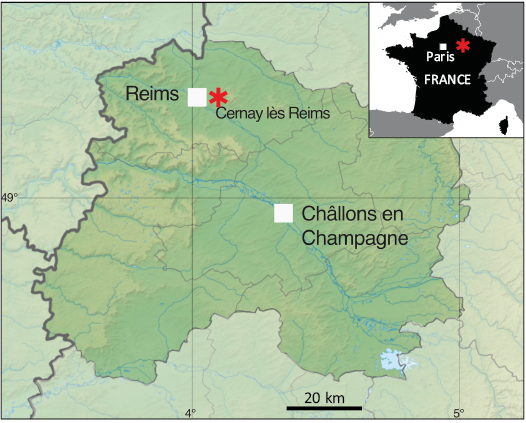
Fig. 1. Map of the Department of Marne, showing the position of the locality of Cernay (asterisk); in the inset, map of France, showing the position of the locality.
The Cernay fauna is the European reference level for MP 6 (Biochrom’97 1997), owing to its exceptionally rich mammalian assemblage (29 species recorded in 1967; 33 in 1997; Estes et al. 1967; Biochrom’97 1997). The fauna is late Paleocene in age (Thanetian). Numerical dating remains imprecise and varies among authors. The Thanetian spans between 59.24 and 56.0 Ma (Cohen et al. 2025). Earlier proposed ages of 52.9±1.9 Ma (Pomerol et al. 1977) and 55.7–55 Ma (Duprat 1997) for the Cernay fauna are now considered inconsistent with current chronostratigraphic frameworks. More recent estimates place the Cernay fauna around 58.0 Ma (Escarguel et al. 1997) or between 57–56 Ma (Hooker and Collinson 2012). Among herpetofauna, from the Cernay/Mont-de-Berru area there have been described relatively few (but important) fossil remains of urodelans, anurans, choristoderans, crocodylians, turtles, and lizards (Gervais 1877; Estes et al. 1967; Vergnaud-Grazzini and Hoffstetter 1972; Rage 2003; Pérez-García 2012, 2020; Folie et al. 2013; Martin et al. 2014; Macaluso et al. 2025).
Systematic palaeontology
Squamata Oppel, 1811
Anguimorpha Fürbringer, 1900
Anguioidea Gray, 1825
Glyptosauridae Marsh, 1872 (sensu Čerňanský et al. 2023a)
Glyptosauridae indet.
Fig. 2.
Material.—One isolated osteoderm (NMB Cy.1144); Cernay, upper Paleocene (MP 6).
Description.—The osteoderm NMB Cy.1144 is incomplete, missing part of its posterior portion (Fig. 2). The osteoderm is rectangular; in dorsal view, its surface is covered by distinct tubercles, with the exception of its anteriormost one third of this surface, which is totally smooth (Fig. 2A1). This smooth surface is more elevated than the remaining sculptured portion of the osteoderm, from which it is separated by a transverse groove. In the sculptured area, the prominent tubercles are of irregular size, though they are mostly rounded and closely spaced to each other. There is no keel in the midline of the osteoderm. In ventral view, the osteoderm is smooth, being irregularly pierced only by a few small foramina (Fig. 2A2).
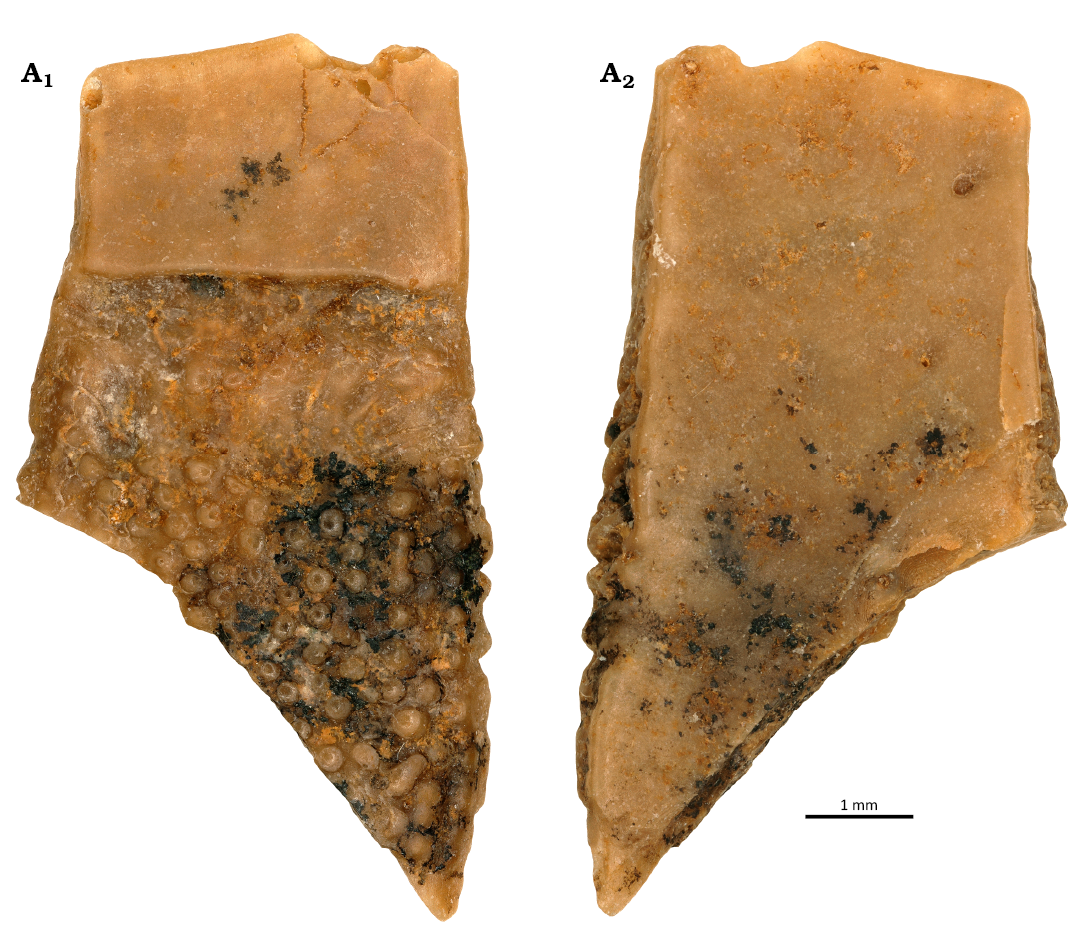
Fig. 2. Isolated osteoderm (NMB Cy.1144) of Glyptosauridae indet. from the upper Paleocene of Cernay, Paris Basin, France in dorsal (A1) and ventral (A2) views.
Remarks.—The osteoderm NMB Cy.1144 can be referred to Glyptosauridae based on the ornamentation of its dorsal surface, covered by distinct tubercles (Hoffstetter 1962b; Sullivan 1979, 2019; Čerňanský et al. 2023a). Based on its rectangular overall shape, the shape and size of the tubercles, and the presence of a smooth area on approximately the anterior one third of its dorsal surface, the specimen represents a body osteoderm, rather than a cephalic one (e.g., Rage 1978; Estes 1983; Čerňanský et al. 2023a, 2024). Based on this single body osteoderm, it is not possible to assign the material to either Glyptosaurinae or either “Melanosaurinae” and therefore we solely treat it as Glyptosauridae indet.
Discussion
Glyptosauridae represents an abundant group of heavily armored lizards, with an extensive Holarctic geographic distribution. Their record in Europe is rich (Depéret 1917; Hoffstetter 1962a; Sullivan 1979, 2019; Estes 1983; Augé 1990a, b, 2005; Augé and Sullivan 2006; Sullivan and Augé 2006; Klembara and Green 2010; Sullivan et al. 2012; Bolet 2017; Georgalis et al. 2021; Čerňanský et al. 2023a, 2024, 2026; Lemierre and Georgalis 2025; see full details in Table 1), also including beautifully preserved articulated skeletons from the Fossillagerstätte localities of Messel and Geiseltal (Kuhn 1940; Meszoely et al. 1978; Keller and Schaal 1988; Keller 2009; Smith et al. 2018). Notably though, their record is confined exclusively to the western and central portions of the continent, with no glyptosaurid occurrences known from Eastern Europe (Fig. 3), a pattern also reflecting the scarcity and rareness of Eocene squamate-yielding terrestrial localities in the eastern margins of the continent (see also Smith and Georgalis 2022). Their remains have been known in Europe since the 19th century (Gervais 1848–1852, 1876; Pictet et al. 1855–1857; Filhol 1876, 1882, 1894; Zittel 1887–1890; Lydekker 1888a; see full details in Table 1). This existing European fossil record attests to a moderate diversity in the continent, with at least nine valid species, spanning across the entire Eocene (Sullivan 2019; Čerňanský et al. 2023a; Lemierre and Georgalis 2025; see full details in Table 1): Paraplacosauriops quercyi (Filhol, 1882), Paraxestops stehlini Hoffstetter, 1962a, Placosauriops weigelti Kuhn, 1940, Cadurcopanoplos vaylatsensis Lemierre & Georgalis, 2025, Gaultia ragei (Sullivan et al., 2012), Placosaurus estesi Sullivan & Augé, 2006, Placosaurus rugosus Gervais, 1848–1852, Placosaurus? europaeus (Filhol, 1876), and Sullivanosaurus gallicus (Čerňanský et al., 2023a). In addition, a few other taxa have been also named from Europe but they are currently regarded as either nomina dubia or junior synonyms of the above-mentioned species (see full details in Table 1). The youngest occurrence of glyptosaurids in Europe is at the latest Eocene and they are totally absent from Oligocene localities of the continent, suggesting that they were extirpated from the continent during the “Grande Coupure” at the Eocene/Oligocene boundary (unlike the case of North America and Asia, where the group survived into the early Oligocene). Interestingly, a similar such pattern of broad extinctions in Europe and survival in Northern America and Asia is also observed in other vertebrate groups like ungulate mammals at the Eocene/Oligocene transition (Blanco et al. 2025) making this scenario more global among different tetrapod lineages.
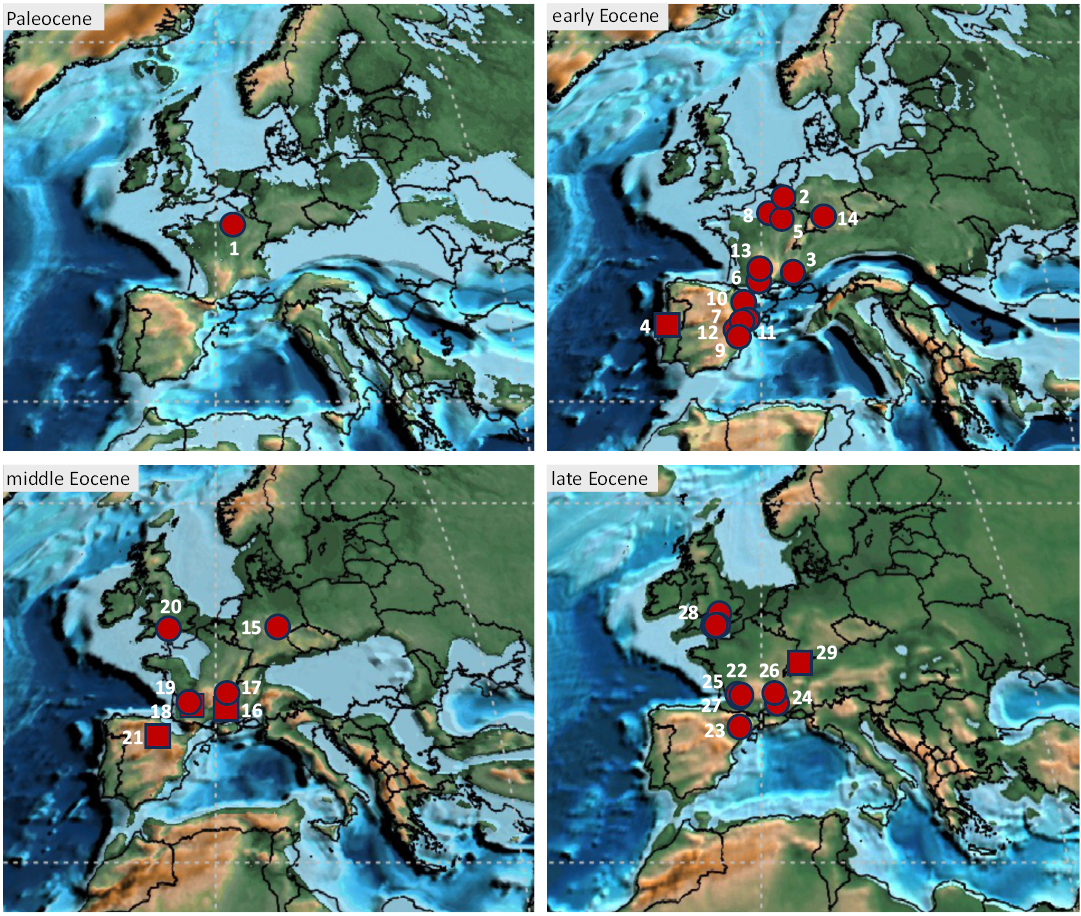
Fig. 3. Palaeogeographic maps of Europe during the Paleocene and Eocene (modified from Scotese 2021), showing all formally described glyptosaurid occurrences. Data on occurrences are based on Table 1. Circles and squares indicate a minimum number of 1 and 2 glyptosaurid taxa, respectively, from each locality. Occurrences from the “old collections” of the Phosphorites du Quercy with no precise locality and age data are not indicated here. 1, Cernay (= Cernay-lès-Reims), Paris Basin; 2, Dormaal (= Orsmael), Flemish Brabant; 3, Rians C; 4, Silveirinha, Coimbra; 5, Condé-en-Brie, Aisne, Paris Basin; 6, La Borie, Saint-Papoul, Aude, Occitanie; 7, Masia de l’Hereuet, Catalonia; 8, Prémontré, Aisne, Hauts-de-France; 9, Barranc del Fusteró, Catalonia; 10, Escarlà, Catalonia; 11, La Morera (= La Coma), Catalonia; 12, Font del Torricó, Catalonia; 13, Cos, near Caylus, Quercy, Tarn-et-Garonne, Occitanie; 14, Messel, Hesse; 15, Geiseltal, Saxony-Anhalt; 16, Saint-Maximin, Gard; 17, Lissieu, Auvergne-Rhône-Alpes; 18, Lavergne, Quercy, Occitanie; 19, Le Bretou, Quercy, Tarn-et-Garonne; 20, Creechbarrow, Dorset; 21, Mazaterón, Soria, Castile and León; 22, La Bouffie (= Bouffie), Quercy, Lot; 23, Sossís, Catalonia; 24, Euzet (= Euzet-les-Bains), Gard; 25, Perrière, Quercy, Lot; 26, La Débruge (Sainte-Radegonde d’Apt = Sainte-Redegonde = Sainte Aldegarde), Vaucluse, Provence-Alpes-Côte d’Azur; 27, Sainte Néboule (Ste.-Néboule), Quercy, Lot; 28, Headon Hill, Isle of Wight; Hatherwood Limestone, Hampshire; Osborne, Isle of Wight; Bembridge, Isle of Wight; 29, Mount Mormont (= Mormont = Mauremont), near Éclépens, Vaud.
Table 1. List of all described occurrences of Glyptosauridae from Europe. Note that the list includes only material that has been formally described and/or figured or at least collection numbers have been provided. List appears in chronological order of the localities. Locality numbers indicate the respective entry on the maps of Fig. 3. Alternative / older names of the localities can also appear in parentheses. The locality name is further followed by the name of the broader administrative region, in order to provide a more concise geographic context. 1, Cernay (=Cernay-lès-Reims), Paris Basin; 2, Dormaal (= Orsmael), Flemish Brabant; 3, Rians C; 4, Silveirinha, Coimbra; 5, Condé-en-Brie, Aisne, Paris Basin; 6, La Borie, Saint-Papoul, Aude, Occitanie; 7, Masia de l’Hereuet, Catalonia; 8, Prémontré, Aisne, Hauts-de-France; 9, Barranc del Fusteró, Catalonia; 10, Escarlà, Catalonia; 11, La Morera (= La Coma), Catalonia; 12, Font del Torricó, Catalonia; 13, Cos, near Caylus, Quercy, Tarn-et-Garonne, Occitanie; 14, Messel, Hesse; 15, Geiseltal, Saxony-Anhalt; 16, Saint-Maximin, Gard; 17, Lissieu, Auvergne-Rhône-Alpes; 18, Lavergne, Quercy, Occitanie; 19, Le Bretou, Quercy, Tarn-et-Garonne; 20, Creechbarrow, Dorset; 21, Mazaterón, Soria, Castile and León; 22, La Bouffie (= Bouffie), Quercy, Lot; 23, Sossís, Catalonia; 24, Euzet (= Euzet-les-Bains), Gard; 25, Perrière, Quercy, Lot; 26, La Débruge (Sainte-Radegonde d’Apt = Sainte-Redegonde = Sainte Aldegarde), Vaucluse, Provence-Alpes-Côte d’Azur; 27, Sainte Néboule (Ste.-Néboule), Quercy, Lot; 28a, Headon Hill, Isle of Wight; 28b, Hatherwood Limestone, Hampshire; 28c, Osborne, Isle of Wight; 29, Mount Mormont (= Mormont = Mauremont), near Éclépens, Vaud; 28d, Bembridge, Isle of Wight.
|
Country |
Locality |
Epoch |
Mammal age |
Taxon |
Reference |
Remarks |
|
France |
1 |
late |
MP 6 |
Glyptosauridae indet. |
this paper |
|
|
Belgium |
2 |
early Eocene |
MP 7 |
Gaultia ragei |
Hecht and Hoffstetter 1962; Hoffstetter 1962b; Estes 1983; Godinot et al. 1978; Augé 1990b, 2003a, 2005; Augé and Sullivan 2006; Sullivan et al. 2012; Sullivan 2019; Čerňanský et al. 2024 |
type locality of a valid species (originally Anguidae near Melanosaurus in Hecht and Hoffstetter [1962]; cf. Melanosaurus sp. of Hoffstetter [1962b]; Melanosaurus? sp. of Estes [1983]; Melanosaurini indet. of Augé [1990b]; Glyptosaurinae of Augé [2003a]; Placosaurus indet. of Augé [2005]; cf. Paraplacosauriops quercyi in Augé and Sullivan [2006]; ?Placosaurus ragei and cf. ?Placosaurus ragei of Sullivan et al. [2012]; Melanosaurini indet. of Sullivan [2019]) |
|
Glyptosauridae indet. |
Glyptosaurinae indet. of Augé (1990b) and Sullivan et al. (2012) |
|||||
|
France |
3 |
early Eocene |
MP 7 |
“Melanosaurinae” indet. |
Melanosaurini indet. of Augé (2005) |
|
|
Portugal |
4 |
early Eocene |
MP 7 |
cf. Melanosaurus sp. |
|
|
|
Glyptosaurinae indet. |
Glyptosaurini indet. of Rage and Augé (2003) |
|||||
|
Glyptosauridae indet. |
Glyptosaurinae indet. of Rage and Augé (2003) |
|||||
|
France |
5 |
early Eocene |
MP 8/9 |
cf. Paraplacosauriops quercyi |
||
|
“Melanosaurinae” indet. |
Melanosaurini indet. of Augé (1990a) |
|||||
|
Glyptosauridae indet. |
Glyptosaurinae indet. of Augé (1990a) |
|||||
|
France |
6 |
early Eocene |
MP 8/9 |
Glyptosauridae indet. |
Glyptosaurinae indet. of Laurent et al. (2010); not figured |
|
|
Spain |
7 |
early Eocene |
MP 8/9 |
Glyptosaurinae indet. |
Glyptosaurini indet. of Bolet (2017) |
|
|
Glyptosauridae indet. |
Glyptosaurinae indet. of Bolet (2017) |
|||||
|
France |
8 |
early Eocene |
MP 10 |
?Placosauriops sp. |
Glyptosaurinae indet. of Augé et al. (1997) |
|
|
Spain |
9 |
early Eocene |
MP 10 |
Glyptosauridae indet. |
Glyptosaurinae indet. of Bolet (2017) |
|
|
Spain |
10 |
early Eocene |
MP 10 |
cf. Placosaurus sp. |
close to Sullivanosaurus according to Čerňanský et al. (2025) |
|
|
Spain |
11 |
early Eocene |
MP 10 |
Glyptosaurinae indet. |
Glyptosaurini indet. of Bolet (2017) |
|
|
Glyptosauridae indet. |
Glyptosaurinae indet. of Bolet (2017) |
|||||
|
Spain |
12 |
early Eocene |
MP 10 or MP 8/9 |
Glyptosaurinae indet. |
Glyptosaurini indet. of Bolet (2017) |
|
|
France |
13 |
early Eocene |
MP 10–11 |
Sullivanosaurus gallicus |
type locality of a valid species |
|
|
Glyptosauridae indet. |
|
|||||
|
Germany |
14 |
early–middle Eocene |
MP 11 |
Placosauriops weigelti |
Xestops abderhaldeni of Keller and Schaal (1988); Placosauriops abderhaldeni of Keller (2009) |
|
|
Germany |
15 |
late early or middle Eocene |
|
Placosauriops weigelti |
type locality of a valid
species (including type of |
|
|
Glyptosauridae indet. |
type material of Loricotherium waltheri Weigelt, 1929b, and Placosaurus waltheri Weigelt, 1929a; material referred to Placotherium waltheri by Kuhn (1940b) |
|||||
|
France |
16 |
middle Eocene |
MP 13 |
Glyptosaurinae indet. |
Glyptosaurini indet. of Duffaud and Rage (1997) |
|
|
“Melanosaurinae” indet. |
Melanosaurini indet. of Duffaud and Rage (1997) |
|||||
|
France |
17 |
middle Eocene |
MP 14 |
Glyptosauridae indet. |
including type of Placosaurus lugdunensis Depéret, 1917; Glyptosaurinae indet. of Rage and Augé (2010) |
|
|
France |
18 |
middle Eocene |
MP 16 |
Paraplacosauriops quercyi |
|
|
|
Placosaurus rugosus |
|
|||||
|
?Placosaurus sp. |
|
|||||
|
Glyptosauridae indet. |
Buffrenil et al. 2010, 2011; Rage 2013; Čerňanský et al. 2026 |
Glyptosaurinae indet. of
Buffrénil et al. (2010, 2011);
|
||||
|
France |
19 |
middle Eocene |
MP 16 |
Placosaurus sp. |
|
|
|
UK |
20 |
middle Eocene |
MP 16 |
Glyptosauridae indet. |
Glyptosaurinae indet. of Klembara and Green (2010) |
|
|
Spain |
21 |
middle Eocene |
MP 16 |
Glyptosaurinae indet. |
Glyptosaurini indet. of Bolet (2025) |
|
|
“Melanosaurinae” indet. |
Glyptosaurini indet. of Bolet (2025) |
|||||
|
France |
22 |
late |
MP 17a |
Cadurcopanoplos
|
type locality of a valid species |
|
|
Glyptosauridae indet. |
|
|||||
|
Spain |
23 |
late |
MP 17a |
Glyptosaurinae indet. |
Glyptosaurini indet. of Bolet and Evans (2013) |
|
|
Glyptosauridae indet. |
Glyptosauridae indet. of Bolet and Evans (2013) |
|||||
|
France |
24 |
late |
MP 17 |
Placosaurus rugosus |
|
|
|
France |
25 |
late |
MP 17 |
Placosaurus estesi |
type locality of a valid
species (Placosaurus quercyi |
|
|
France |
26 |
late |
MP 18 |
Placosaurus rugosus |
type locality of a valid species |
|
|
France |
27 |
late Eocene |
MP 18 |
Placosaurus sp. |
|
|
|
Glyptosauridae indet. |
||||||
|
UK |
28a |
late |
MP 18 |
Glyptosauridae indet. |
Glyptosaurinae indet. of Rage and Ford (1980) |
|
|
UK |
28b |
late |
MP 18 |
Glyptosauridae indet. |
Glyptosaurinae indet. of Klembara and Green (2010) |
|
|
UK |
28c |
late |
MP 19 |
Glyptosauridae indet. |
Glyptosaurinae indet. of Klembara and Green (2010) |
|
|
Switzerland |
29 |
late |
MP 19 |
Paraxestops stehlini |
type locality of a valid species |
|
|
Placosaurus rugosus |
|
|||||
|
UK |
28d |
late |
MP 20 |
Glyptosauridae indet. |
Glyptosaurinae indet. of Klembara and Green (2010) |
|
|
France, Quercy (imprecise locality) |
probably middle or late Eocene |
Paraplacosauriops quercyi |
Filhol 1882; Zittel 1887–1890; De Stefano 1903; Augé 2005; Augé and Sullivan 2006; Georgalis et al. 2021 |
type locality of a valid species (Diploglossus sp. of Zittel [1887–1890]; including type of Diploglossus cadurcensis De Stefano, 1903) |
||
|
France, Quercy (imprecise locality, but near near Caylus, Tarn-et-Garonne) |
probably middle or late Eocene |
Paraplacosauriops quercyi |
|
|||
|
France Quercy (imprecise locality |
probably middle or late Eocene |
Paraplacosauriops sp. |
Anguidae indet. of Lydekker (1888a, b); type of Placosaurus leenhardti Leenhardt, 1926 |
|||
|
“Melanosaurinae” indet. |
Melanosaurini indet. of Augé (2005) and Georgalis et al. (2021) |
|||||
|
Placosaurus rugosus |
|
|||||
|
Placosaurus sp. |
holotype of Necrodasypus galliae Filhol, 1894; syntypes of Protrachysaurus gaudryi De Stefano, 1903; lectotype of Propseudopus cayluxi De Stefano, 1903 |
|||||
|
“Placosaurus” europaeus |
type locality of a valid species |
|||||
|
Glyptosauridae indet. |
including type of Varanus margariticeps Gervais, 1876; Varanus margariticeps of Lydekker 1888a; Glyptosaurinae indet. of Sullivan and Augé (2006) |
|||||
Glyptosauridae in North America were also rather abundant and diverse and they achieved there an even greater temporal distribution, spanning from the Late Cretaceous up to the “middle” Oligocene (Marsh 1871, 1872; Gilmore 1928; Meszoely 1970; Sullivan 1979, 2019; Gauthier 1982; Estes 1983; Smith 2009, 2011a, b; Smith and Gauthier 2013; Scarpetta 2019). To the contrary, their Asian fossil record is considerably poor, confined to only a few remains spanning from the middle Eocene up to the early Oligocene (Gilmore 1943; Sullivan and Dong 2018; Čerňanský and Augé 2019; Syromyatnikova 2025).
Taking into consideration these distribution data, it has been widely accepted that glyptosaurids have been genuinely absent in the Paleocene of Europe and that they only managed to disperse to the continent from North America, immediately after the PETM. Indeed, glyptosaurids are notoriously absent from the (admittedly very) few Paleocene squamate-yielding localities from Europe (e.g., Čerňanský and Vasilyan 2024); a large anguimorph described and figured by Smith et al. (2014) from the uppermost Paleocene of Rivecourt, France, does not pertain to glyptosaurids but to some other anguimorph group (the figured osteoderm of Smith et al. 2014 does not bear the typical tuberculated ornamentation of glyptosaurids [that specimen is regarded here as Anguimorpha indet.], while the figured vertebra and the fragmentary dentary can likely only be identified as Anguimorpha indet.).
The description herein of a glyptosaurid from Cernay challenges the above scenario and demonstrates that this lizard group managed to disperse to Europe already slightly before the PETM. It is worth noting here that Lemoine (1878–1879: 403), who was the pioneer researcher in the locality of Cernay in the late 19th century, had already mentioned that among his (never described) material from that locality, there were remains reminiscent of the genus Placosaurus (“quelques plaques rappelleraient le genre Placosaurus”). This sentence, however, has fallen into oblivion and no subsequent researcher commented on this early mention, while Lemoine’s Cernay lizard material is of unknown whereabouts (even though his Cernay mammal collection is deposited at the Museum National d’Histoire Naturelle, Paris; Gaudry 1898; Boyer et al. 2012).
But when and how did glyptosaurids arrived in Europe? A large number of terrestrial vertebrates (also including an array of reptile taxa) is now known to have dispersed from North America to Europe during the PETM, facilitated by the very warm temperatures and the terrestrial corridors between the two landmasses, likely via Greenland (see discussion in Georgalis and Mennecart 2025 and references therein). The identification of early Eocene glyptosaurid lizards as far north as Ellesmere island (Estes and Hutchison 1980) supported the claim that these lizards could have indeed used such north dispersal routes in order to reach Europe. Recently, it was suggested that another, brief, global warming event (Pre-Onset Excursion [POE]) occurred during the latest Paleocene, slightly before the PETM (Tabuce et al. 2025). During this brief event, there is now evidence that some terrestrial mammals managed to disperse from North America to Europe (“precursor” dispersers), taking advantage of large terrestrial corridors of evergreen forests that emerged in high latitudes (Tabuce et al. 2025). With an age pertaining to the latest Paleocene, the Cernay specimen shows that among these “precursor” dispersers that reached Europe were also glyptosaurid lizards, a group that would later be iconic and widespread throughout Eocene European herpetofaunas.
Acknowledgements
We are grateful to Gael Spicher (Jurassica Museum, Porrentruy, Switzerland) and Florian Dammeyer and Loïc Costeur (both NMB) for access to the NMB collection. GLG acknowledges funding from the research project no. 2023/49/B/ST10/02631 financed by the National Science Center of Poland (Narodowe Centrum Nauki). The quality of the paper was enhanced thanks to the useful comments provided by the editor Daniel E. Barta (Oklahoma State University, Tahlequah, USA) and the two reviewers, Edward Stanley (Florida Museum of Natural History, Gainesville, USA) and an anonymous one.
Editor: Daniel Barta
References
Augé, M. 1990a. La faune de Lézards et d’Amphisbaenes de l’Éocène inférieur de Condé-en-Brie (France). Bulletin du Muséum national d’Histoire naturelle, 4e série 12: 111–141.
Augé, M. 1990b. La faune de lézards et d’Amphisbènes (Reptilia, Squamata) du gisement de Dormaal (Belgique, Eocène inférieur). Bulletin de l’Institut Royal des Sciences Naturelles de Belgique, Sciences de la Terre 60: 161–173.
Augé, M. 2003a. Lacertilian faunal change across the Paleocene-Eocene boundary in Europe. In: S.L. Wing, D. Gingerich, B. Schmitz, and E. Thomas (eds.), Causes and Consequences of Globally Warm Climates in the Early Paleogene. Geological Society of America Special Paper, Colorado 369: 441–454. Crossref
Augé, M. 2003b. La faune de Lacertilia (Reptilia, Squamata) de l’Éocène inférieur de Prémontré (Bassin de Paris, France). Geodiversitas 25 (3): 539–574.
Augé, M. 2005. Évolution des lézards du Paléogène en Europe. Mémoires du Muséum national d’Histoire naturelle, Paris 192: 1–369.
Augé, M. and Sullivan, R.M. 2006. A new genus, Paraplacosauriops (Squamata, Anguidae, Glyptosaurinae), from the Eocene of France. Journal of Vertebrate Paleontology 26: 133–137. Crossref
Augé, M., Duffaud, S., Lapparent de Broin, F. de, Rage, J.-C., and Vasse, D. 1997. Les amphibiens et les reptiles de Prémontré (Cuisien, Bassin parisien): une herpétofaune de référence pour l’Eocène inférieur. Géologie de la France 1: 23–33.
Aumonier, J.M. and Eck, A. 1873. Notice sur la constitution géologique de la Montagne de Berru. 68 pp. Imprimerie Coopérative de Reims, Reims.
BiochroM’97 1997. Tables de corrélation. In: J.P. Aguilar, S. Legendre, and J. Michaux (eds.), Actes du Congrès BiochroM’97. Mémoires et Travaux de l’E.P.H.E., Institut de Montpellier 21: 769–805.
Blanco, F., Lazagabaster, I.A., Sanisidro, Ó., Bibi, F., Heckeberg, N.S., Ríos, M., Mennecart, B., Alberdi, M.T., Prado, J.L., Saarinen, J., Silvestro, D., Müller, J., Calatayud, J., and Cantalapiedra, J.L. 2025. Two major ecological shifts shaped 60 million years of ungulate faunal evolution. Nature Communications 16: 4648. Crossref
Bolet, A. 2017. First early Eocene lizards from Spain and a study of the compositional changes between late Mesozoic and early Cenozoic Iberian lizard assemblages. Palaeontologia Electronica 20.2.20A: 1–22. Crossref
Bolet, A. 2025. Lizards and amphisbaenians (Reptilia, Squamata) from the middle Eocene of Mazaterón (Soria, Spain). The Anatomical Record 308: 1753–1768. Crossref
Bolet, A. and Evans, S.E. 2013. Lizards and amphisbaenians (Reptilia, Squamata) from the late Eocene of Sossís (Catalonia, Spain). Palaeontologia Electronica 16(8A): 1–23. Crossref
Boulenger, G.A. 1891. Notes on the osteology of Heloderma horridum and H. suspectum, with remarks on the systematic position of the Helodermatidae and on the vertebræ of the Lacertilia. Proceedings of the Zoological Society of London 1891: 109–118. Crossref
Boulenger, G.A. 1918. Les Lezards Helodermatides de l’Eocène Supérieur de la France. Comptes rendus hebdomadaires des séances de l’Académie des Sciences de Paris 166: 889–893.
Boyer, D.M., Costeur, L., and Lipman Y. 2012. Earliest record of Platychoerops (Primates, Plesiadapidae), a new species from Mouras Quarry, Mont de Berru, France. American Journal of Physical Anthropology 149: 329–346. Crossref
Buffrénil, V. de, Rage, J.-C., Dauphin, Y., and Sire, J.-Y. 2011. An enamel-like tissue, osteodermine, on the osteoderms of a fossil anguid (Glyptosaurinae) lizard. Comptes Rendus Palevol 10: 427–438. Crossref
Buffrénil, V. de, Sire, J.Y., and Rage, J.C. 2010. The histological structure of glyptosaurine osteoderms (Squamata: Anguidae), and the problem of osteoderm development in squamates. Journal of Morphology 271: 729–737. Crossref
Čerňanský, A. and Augé, M.L. 2019. The Oligocene and Miocene fossil lizards (Reptilia, Squamata) of Central Mongolia. Geodiversitas 41: 811–839. Crossref
Čerňanský, A. and Vasilyan, D. 2024. Roots of the European Cenozoic ecosystems: lizards from the Paleocene (~MP 5) of Walbeck in Germany. Fossil Record 27: 159–186. Crossref
Čerňanský, A., Georgalis, G.L., Orliac, M., and Martin, J.E. 2026. The reptiles from the Lavergne locality of Phosphorites du Quercy in France show a high taxonomic diversity at the end of the late middle Eocene (MP 16). Swiss Journal of Palaeontology 145: 343–401. Crossref
Čerňanský, A., Smith, R., Smith, T., and Folie, A. 2024. Timing of intercontinental faunal migrations: Anguimorph lizards from the earliest Eocene (MP 7) of Dormaal, Belgium. Zoological Journal of the Linnean Society 201: zlae082. Crossref
Čerňanský, A., Tabuce, R. and Vidalenc, D. 2023a. Anguimorph lizards from the lower Eocene (MP 10–11) of the Cos locality, Phosphorites du Quercy, France, and the early evolution of Glyptosaurinae in Europe. Journal of Vertebrate Paleontology 42: e2211646. Crossref
Čerňanský, A., Tabuce, R. and Vidalenc, D. 2023b. A replacement name for Sullivania Čerňanský et al., 2023, non Sullivania Palmer, 1947. Journal of Vertebrate Paleontology 42: e2231254. Crossref
Cohen, K., Harper, D., Gibbard, P. and Car, N. 2025. The ICS international chronostratigraphic chart this decade. Episodes 48: 105–115. Crossref
De Stefano, G. 1903. I sauri del Quercy appartenenti alla collezione Rossignol. Atti della Società Italiana di Scienze Naturali e del Museo Civico di Storia Naturale in Milano 42: 382–418.
Depéret, C. 1906. Relations stratigraphiques des faunes de Cernay et de Meudon au mont de Berru. Bulletin de la Société Géologique de France, Série 4 6: 442–443.
Depéret, C. 1917. Monographie de la faune de mammifères fossiles du Ludien inférieur d’Euzet-les-Bains (Gard). Annales de l’Université de Lyon, Nouvelle Série 40: 1–288. Crossref
Duffaud, S. and Rage J.-C. 1997. Les remplissages karstiques polyphasés (Éocène, Oligocène, Pliocène) de Saint-Maximin (Phosphorites du Gard) et leur apport à la connaissance des faunes européennes, notamment pour l’Éocène moyen (MP 13). Systématique: Amphibiens et Reptiles. In: J.P. Aguilar, S. Legendre, and J. Michaux (eds.), Actes du Congrès BiochroM’97. Mémoires et Travaux de I’ E.P.H.E., Institut de Montpellier 21: 729–735.
Duprat, M. 1997. Les faciès à mammifères (MP 6 d MP 16) dans le Nord-Est du Bassin de Paris: argumentation du modèle tectono-sédimentaire des dépôts paléogènes. In: J.P. Aguilar, S. Legendre and J. Michaux (eds.), Actes du Congrès BiochroM’97. Mémoires et Travaux de I’ E.P.H.E., Institut de Montpellier 21: 315–336.
Escarguel, G., Marandat, B., and Legendre, S. 1997. Sur l’âge numérique des faunes de mammifères du Paléogène d’Europe occidentale, en particulier celles de l’Eocène inférieur et moyen. Mémoires et Travaux de l’Institut de Montpellier 21: 443–460.
Estes, R. 1983. Sauria Terrestria, Amphisbaenia. In: P. Wellnhofer (ed.), Encyclopedia of Paleoherpetology. Part 10a. 249 pp. Gustav Fischer Verlag, Stuttgart.
Estes, R. and Hutchison, J.H. 1980. Eocene lower vertebrates from Ellesmere Island, Canadian Arctic Archipelago. Palaeogeography, Palaeoclimatology, Palaeoecology 30: 325–347. Crossref
Estes, R., Hecht, M.K., and Hoffstetter, R. 1967. Paleocene amphibians from Cernay, France. American Museum Novitates 2295: 1–25.
Filhol, H. 1876. Sur les reptiles fossiles des phosphorites du Quercy. Bulletin de la Société Philomathique de Paris, Série 6 11: 27–28.
Filhol, H. 1882. Note sur une nouvelle espèce de Reptile fossile du genre Plestiodon. Bulletin de la Société Philomathique de Paris Série 7 6: 127–128.
Filhol, H. 1894. Observations concernant quelques mammifères fossiles nouveaux du Quercy. Annales des Sciences Naturelles, Zoologie et Paléontologie 16: 129–150.
Folie, A., Smith, R., and Smith T. 2013. New amphisbaenian lizards from the Early Paleogene of Europe and their implications for the early evolution of modern amphisbaenians. Geologica Belgica 16 (4): 227–235.
Fürbringer, M. 1900. Zur vergleichenden anatomie des Brustschulterapparates und der Schultermuskeln. Jenaische Zeitschrift für Naturwissenschaft 34: 215–718. Crossref
Gaudry, A. 1898. Note sur les travaux scientifiques de Victor Lemoine et particularement sur ses découvertes à Cernay. Bulletin de la Société géologique de France 26 (3): 300–310.
Gauthier, J. 1982. Fossil xenosaurid and anguid lizards from the early Eocene Wasatch Formation, southeast Wyoming, and a revision of the Anguioidea. Contributions to Geology, University of Wyoming 21: 7–54.
Georgalis, G.L. and Mennecart, B. 2025. Another wanderer from the Paleocene–Eocene Thermal Maximum? A new species of the North American snake genus Cheilophis Gilmore, 1938 from the early Eocene of France. In: G.L. Georgalis, H. Zaher, and M. Laurin (eds.), Snakes from the Cenozoic of Europe—towards a macroevolutionary and palaeobiogeographic synthesis. Comptes Rendus Palevol 24: 317–331. Crossref
Georgalis, G.L., Čerňanský, A., and Klembara J. 2021. Osteological atlas of new lizards from the Phosphorites du Quercy (France), based on historical, forgotten, fossil material. Geodiversitas 43 (9): 219–293. Crossref
Gervais, P. 1848–1852. Zoologie et Paléontologie françaises (animaux vertébrés): ou nouvelles recherches sur les animaux vivants et fossiles de la France. 271 pp. Arthus Bertrand, Paris. Crossref
Gervais, P. 1876. Zoologie et Paléontologie générales. 72 pp. Arthus Bertrand, Paris.
Gervais, P. 1877. Enumération de quelques ossements d’animaux vertébrés recueillis aux environs de Reims par M. Lemoine. Journal de Zoologie 6: 74–79.
Gilmore, C.W. 1928. The fossil lizards of North America. Memoirs of the National Academy of Sciences 11: 1–197.
Gilmore, C.W. 1943. Fossil Lizards of Mongolia. Bulletin of the American Museum of Natural History 81: 361–384.
Godinot, M., Broin, F. de, Buffetaut, E., Rage, J.-C., and Russell, D. 1978. Dormaal: une des plus anciennes faunes eocenes d’Europe. Comptes rendus hebdomadaires des séances de l’Académie des Sciences, Série D 287: 1273–1276.
Gray, J.E. 1825. A synopsis of the genera of Reptiles and Amphibia, with a description of some new species. Annals of Philosophy, Series 2 10: 193–217.
Hecht, M. and Hoffstetter, R. 1962. Note préliminaire sur les amphibiens et les squamates du Landénien supérieur et du Tongrien de Belgique. Bulletin de l’Institut royal des Sciences naturelles de Belgique, Sciences de la Terre 38: 1–30.
Hoffstetter, R. 1962a. Additions à la faune reptilienne de l’Éocène supérieur de Mormont-Saint-Loup (Suisse). Bulletin de la Société Géologique de France 4: 109–117. Crossref
Hoffstetter, R. 1962b. Observations sur les ostéodermes et la classification des anguides actuels et fossiles (Reptiles, Sauriens). Bulletin du Muséum national d’Histoire naturelle 34: 149–157. Crossref
Hooker, J. J. and Collinson, M.E. 2012. Mammalian faunal turnover across the Paleocene-Eocene boundary in NW Europe: the roles of displacement, community evolution and environment. Austrian Journal of Earth Sciences 105: 17–28.
Keller, T. 2009. Beiträge zur Kenntnis von Placosauriops abderhaldeni Kuhn, 1940 (Anguidae, Glyptosaurinae Marsh, 1872) aus dem Mitteleozän der Grube Messel - Skelettanatomie, Taphonomie und Biomechanik. Kaupia, Darmstädter Beiträge zur Naturgeschichte 16: 3–145.
Keller, T. and Schaal, S. 1988. Schuppeneschen – reptilien auf Erfolgskurs. In: S. Schaal and W. Ziegler (eds.), Messel – ein Schaufenster in die Gerschichte der Erde und des Lebens, 119–122. Verlag Waldemar Kramer, Frankfurt am Main.
Klembara, J. and Green, B. 2010. Anguimorph lizards (Squamata, Anguimorpha) from the Middle and Upper Eocene of the Hampshire Basin of Southern England. Journal of Systematic Palaeontology 8: 97–129. Crossref
Kuhn, O. 1940. Die Placosauriden und Anguiden aus dem Mittleren Eozän des Geiseltales. Nova Acta Academia Leopoldina, Carolinska 53: 461–486.
Laurent, Y., Adnet, S., Bourdon, E., Corbalan, D., Danilo, L., Duffaud, S., Fleury, G., Garcia, G., Godinot, M., Le Roux, G., Maisonnave, C., Métais, G., Mourer-Chauviré, C., Presseq, B., Sigé, B., and Solé, F. 2010. La Borie (Saint-Papoul, Aude): un gisement exceptionnel dans l’Éocène basal du Sud de la France. Bulletin de la Société d’histoire naturelle de Toulouse 146: 89–103.
Leenhardt, H. 1926. Sur quelques sauriens de l’Éocène supérieur de la France. Bulletin de la Société Géologique de France, series 4 26: 371–374.
Lemierre, A. and Georgalis, G.L.
2025. Diversity in a greenhouse world: herpetofauna from the late Eocene
(MP 17A) of La Bouffie, Quercy Phosphorites (Lot, SW France). Swiss
Journal of Palaeontology 144: article 40.
Crossref
Lemoine, V. 1878–1879. Oiseaux fossiles des terrains tertiaires inférieurs des environs de Reims. Bulletin de la Société géologique de France, Série 3 7: 398–403. Crossref
Lemoine, V. 1879. Recherches sur les ossements fossiles des terrains tertiaires inférieurs des environs de Reims. Première partie. Étude du genre Arctocyon. Annales des sciences naturelles, Zoologie 8: 1–56. Crossref
Lemoine, V. 1880. Sur les ossements des terrains tertiaires inférieurs des environs de Reims. Compte Rendu de la Association Française pour l’Avancement des Sciences 8: 585–594.
Lemoine, V. 1889. Considérations générales sur les Vertébrés fossiles des environs de Reims et spécialement sur les Mammiferes de la faune Cernaysienne. Compte rendu des séances du Congrès international de zoologie, Paris 1889: 233–280.
Lemoine, V. 1891. Etude d’ensemble sur les dents de mammifères fossiles des environs de Reims. Bulletin de la Société Géologique de France, Serie 3 19: 263–290.
Louis, P. 1996. Recherches de mammiferes Paleogenes dans les departements de l’Aisne et de la Marne pendant la deuxieme moitie du vingtieme siecle. Palaeovertebrata 25: 83–113. Crossref
Lydekker, R. 1888a. Catalogue of Fossil Reptiles and Amphibians in the British Museum (Natural History). Part I. Containing the Orders Ornithosauria, Crocodilia, Dinosauria, Squamata, Rhynchocephalia, and Proterosauria. 309 pp. British Museum (Natural History), London.
Lydekker, R. 1888b. Notes on Tertiary Lacertilia and Ophidia. Geological Magazine 5: 110–113. Crossref
Macaluso, L., Villa, A., Rozzi, R., Fabre, A.-C., and Mennecart, B. 2025. Time to grow up: the PETM climatic event favoured metamorphosing salamanders (Urodela, Salamandridae). Proceedings of the Royal Society B 293: 20251333. Crossref
Martin, J.E., Smith, T., Lapparent de Broin F. de, Escuillié F., and Delfino, M. 2014. Late Palaeocene eusuchian remains from Mont de Berru, France, and the origin of the alligatoroid Diplocynodon. Zoological Journal of the Linnean Society 172: 867–891. Crossref
Marsh, O.C. 1871. Notice of some new fossil reptiles from the Cretaceous and Tertiary Formations. American Journal of Science, Series 3 1 (6): 447–459. Crossref
Marsh, O.C. 1872. Preliminary description of new Tertiary reptiles. Parts I and II. American Journal of Science, Series 3 4: 298–309. Crossref
Meszoely, C.A.M. 1970. North American fossil anguid lizards. Bulletin of the Museum of Comparative Zoology 139: 87–150.
Meszoely, C., Estes, R., and Haubold, H. 1978. Eocene anguid lizards from Europe and a revision of the genus Xestops. Herpetologica 34:156–166.
Nopcsa, F. 1908. Zur Kenntnis der fossilen Eidechsen. Beitrage zur Paläontologie und Geologie Österreich-Ungarns und des Orients 21: 33–62.
Nopcsa, F. 1928. The Genera of Reptiles. Palaeobiologica 1: 163–188. Crossref
Oppel, M. 1811. Die Ordnungen, Familien und Gattungen der Reptilien als Prodrom einer Naturgeschichte derselben. 87 pp. Joseph Lindauer, Munich. Crossref
Pérez-García, A. 2012. Berruchelus russelli, gen. et sp. nov., a paracryptodiran turtle from the Cenozoic of Europe. Journal of Vertebrate Paleontology 32: 545–556. Crossref
Pérez-García, A. 2020. Surviving the Cretaceous-Paleogene mass extinction event: A terrestrial stem turtle in the Cenozoic of Laurasia. Scientific Reports 10: 1489. Crossref
Pictet, F.J., Gaudin, C.T., and de La Harpe, P. 1855–1857. Mémoire sur les Animaux vertébrés trouvés dans le terrain Sidérolithique du Canton de Vaud et appartenant à la faune Eocène. Matériaux pour la Paléontologie Suisse 1. 120 pp. J. Kessmann, Genève. Crossref
Pomerol, B., Renard, M., and Riveline, J. 1977. Données nouvelles sur le Thanétien supérieur du Nord du Bassin de Paris. La limite Paléocène-Eocène dans les bassins nordiques et sa corrélation avec les bassins mésogéens. Bulletin de la Société Géologique de France, Serie 7 19: 155–164. Crossref
Rage, J.-C. 1978. Squamates. In: B. Geze, J.-C. Rage, F. Vergnaud-Grazzini, F. de Broin, E. Buffetaut, C. Mourier-Chauvire, J.-Y. Crochet, B. Sigé, J. Sudre, A. Remy, L. Langebadre, L. de Bonis, J.L. Hartenberger, and M. Vianey-Liaud (eds.), La poche à Phosphate de Ste-Néboule (Lot) et sa faune de vertébrés du Ludien supérior. Palaeovertebrata 8: 201–215. Crossref
Rage, J.-C. 1988. Le gisement du Bretou (Phosphorites du Quercy, Tarn-et-Garonne, France) et sa faune de vertébrés de l’Eocène supérieur. I Amphibiens et Reptiles. Palaeontographica Abteilung A 205: 3–27.
Rage, J.-C. 2003. Oldest Bufonidae (Amphibia, Anura) from the Old World: a bufonid from the Palaeocene of France. Journal of Vertebrate Paleontology 23: 462–463. Crossref
Rage, J.-C. 2013. Mesozoic and Cenozoic squamates of Europe. Palaeobiodiversity and Palaeoenvironments 93: 517–534. Crossref
Rage, J.-C. and Augé, M. 2003. Amphibians and squamate reptiles from the lower Eocene of Silveirinha (Portugal). Ciências da Terra, Universidade Nova de Lisboa 15: 103–116.
Rage, J.-C. and Augé, M. 2010. Squamate reptiles from the middle Eocene of Lissieu (France). A landmark in the middle Eocene of Europe. Geobios 43: 253–268. Crossref
Rage, J.-C. and Ford, R.L.E. 1980. Amphibians and squamates from the Upper Eocene of the Isle of Wight. Tertiary Research 3: 47–60.
Russell, D.E. 1964. Les mammifères paléocènes d’Europe. Mémoires du Muséum national d’Histoire naturelle C 13: 1–324.
Scarpetta, S.G. 2019. Peltosaurus granulosus (Squamata, Anguidae) from the middle Oligocene of Sharps Corner, South Dakota, and the youngest known chronostratigraphic occurrence of Glyptosaurinae. Journal of Vertebrate Paleontology 39: e1622129. Crossref
Scotese, C.R. 2021. An Atlas of Phanerozoic paleogeographic maps: the seas come in and the seas go out. Annual Review Earth and Planetary Sciences 49: 679–728. Crossref
Smith, K.T. 2009. A new lizard assemblage from the earliest Eocene (zone Wa0) of the Bighorn Basin, Wyoming, USA: biogeography during the warmest interval of the Cenozoic. Journal of Systematic Palaeontology 7: 299–358. Crossref
Smith, K.T. 2011a. The evolution of mid-latitude faunas during the Eocene: Late Eocene lizards of the Medicine Pole Hills reconsidered. Bulletin of the Peabody Museum of Natural History 52: 3–105. Crossref
Smith, K.T. 2011b. The long-term history of dispersal among lizards in the early Eocene: new evidence from a microvertebrate assemblage in the Bighorn Basin of Wyoming, USA. Palaeontology 54: 1243–1270. Crossref
Smith, K.T. and Gauthier, J.A. 2013. Early Eocene lizards of the Wasatch Formation near Bitter Creek, Wyoming: diversity and paleoenvironment during an interval of global warming. Bulletin of the Peabody Museum of Natural History 54: 135–230. Crossref
Smith, K.T. and Georgalis, G.L. 2022. The diversity and distribution of Palaeogene snakes—a review, with comments on vertebral sufficiency. In: D. Gower and H. Zaher (eds.), The Origin and Early Evolutionary History of Snakes, 55–84. Cambridge University Press, Cambridge. Crossref
Smith, K.T., Čerňanský, A., Scanferla, A. and Schaal, S.F.K. 2018. Lizards and snakes—warmth-loving sunbathers. In: K.T. Smith, S.F.K. Schaal, and J. Habersetzer (eds.), Messel: An Ancient Greenhouse Ecosystem, 123–147. Schweizerbart, Stuttgart.
Smith, T., Quesnel, F., de Plöeg, G., de Franceschi, D., Métais, G., de Bast, E., Solé, F., Folie, A., Boura, A., Claude, J., Dupuis, C., Gagnaison, C., Iakovleva, A., Martin, J., Maubert, F., Prieur, J., Roche, E., Storme, J.-Y., Thomas, R., Tong, H., Yans, J., and Buffetaut, E. 2014. First Clarkforkian equivalent Land Mammal Age in the Latest Paleocene basal Sparnacian Facies of Europe: fauna, flora, paleoenvironment and (bio)stratigraphy. PLoS ONE 9: e86229. Crossref
Stehlin, H.G. 1909. Remarques sur les faunules de mammifères des couches éocènes et oligocènes du Bassin de Paris. Bulletin de la Société géologique de France 19: 488–520.
Sullivan, R. 1979. Revision of the Paleogene genus Glyptosaurus (Reptilia, Anguidae). Bulletin of the American Museum of Natural History 163: 1–72.
Sullivan, R.M. 2019. The taxonomy, chronostratigraphy and paleobiogeography of glyptosaurine lizards (Glyptosaurinae, Anguidae). Comptes Rendus Palevol 18: 747–763. Crossref
Sullivan, R.M. and Augé, M. 2006. Redescription of the holotype of Placosaurus rugosus Gervais 1848–1852 (Squamata, Anguidae, Glyptosaurinae) from the Eocene of France. Journal of Vertebrate Paleontology 26: 127–132. Crossref
Sullivan, R.M. and Dong, L. 2018. Stenoplacosaurus mongoliensis, a new generic name for “Placosaurus” mongoliensis (Anguidae, Glyptosaurinae) from the Shara Murun Formation, Nei Mongol (Inner Mongolia), China. In: S.G. Lucas and R.M. Sullivan (eds.), Fossil Record 6. New Mexico Museum of Natural History and Science Bulletin 79: 691–694.
Sullivan, R.M., Augé, M., Wille, E., and Smith, R. 2012. A new glyptosaurine lizard from the earliest Eocene of Dormaal, Belgium. Bulletin de la Societé géologique de la France 183: 627–633. Crossref
Syromyatnikova, E. 2025. Palaeogene records of Glyptosauridae (Squamata: Anguimorpha) from Kazakhstan and Mongolia. Palaeobiodiversity and Palaeoenvironments 105: 459–467. Crossref
Tabuce, R., Marandat, B., Adnet, S., Gernelle, K., Girard, F., Marivaux, L., Solé, F., Schnyder, J., Steurbaut, E., Storme, J., Vianey-Liaud, M., and Yans J. 2025. European mammal turnover driven by a global rapid warming event preceding the Paleocene–Eocene Thermal Maximum. Proceedings of the National Academy of Sciences of the United States of America 122 (25): e2505795122. Crossref
Vergnaud-Grazzini, C. and Hoffstetter, R. 1972. Présence de Palaeobatrachidae (Anura) dans des gisements tertiaires Français. Palaeovertebrata 5: 157–177. Crossref
Weigelt, J. 1929a. Loricotherium Waltheri ist doch kein Gürteltier, sondern eine Gürtlelechse: Placosaurus Waltheri n. sp. Jahrbuch des Halleschen Verbandes für die Erforschung der mitteldeutschen Bodenschätze 8: 187–191.
Weigelt, J. 1929b. Loricotherium Waltheri nov. gen. nov. sp. Ein altweltliches Gürteltier aus der mitteleozänen Braunkohle des Geiseltals. Jahrbuch des Halleschen Verbandes für die Erforschung der mitteldeutschen Bodenschätze 8: 5–31.
Zittel, K.A. 1887–1890. Handbuch der Palæontologie. I. Abteilung. Palæozoologie. III. Band. Pisces, Amphibia, Reptilia, Aves. 900 pp. Druck und Verlag von R. Oldenbourg, Munchen.
Acta Palaeontol. Pol. 71 (3): 509–518, 2026
https://doi.org/10.4202/app.01331.2026