
An exceptional Dimetropus pes imprint with scalation pattern from the lower Permian of Lodève and its broader implications for early synapsid palaeobiogeography and skin evolution
ANTOINE LOGGHE, VALENTIN BUFFA, and LORENZO MARCHETTI
Logghe, A., Buffa, V., and Marchetti, L. 2026. An exceptional Dimetropus pes imprint with scalation pattern from the lower Permian of Lodève and its broader implications for early synapsid palaeobiogeography and skin evolution. Acta Palaeontologica Polonica 71 (2): 363–382.
Dimetropus is one of the most widespread tetrapod ichnogenera of the Permian, known from several Cisuralian units of Euramerica and North Africa. Generally attributed to pelycosaur-grade synapsid trackmakers, two ichnospecies are currently considered valid: D. leisnerianus and D. osageorum. A revision of a well-preserved Dimetropus pes footprint from the lower Permian (upper Artinskian) Rabéjac Formation of the Lodève Basin highlights the first definitive presence of D. osageorum from the Variscan Belt. A synapomorphy-based track–trackmaker correlation suggests ophiacodontids, such as Ophiacodon, as potential tracemakers of D. osageorum. Therefore, this potentially extends the palaeobiogeographic distribution of ophiacodontids in the upper Cisuralian in both North American and European basins. Moreover, the presence of well-preserved epidermal scale imprints on the D. osageorum pes of Lodève precises the evolution of epidermal scalation in pelycosaur-grade synapsids and suggests the presence of both dermal and epidermal scales in ophiacodontids. This occurrence is time-equivalent with the Artinskian Warming Event, strengthening the scenario of epidermal scale evolution in light of palaeoclimatic changes in the Variscan Belt, from everwet-adapted biotas to seasonal drought-adapted biotas.
Key words: Ophiacodontidae, Dimetropus osageorum, epidermal scales, track-trackmaker correlation, Artinskian Warming Event.
Antoine Logghe [antoine.logghe1@mnhn.fr; ORCID: https://orcid.org/0000-0002-2854-7716], Centre de Recherche en Paléontologie–Paris, Muséum national d’Histoire Naturelle, CP38, 8 rue Buffon, 75005 Paris, France.
Valentin Buffa [valentin.buffa@wits.ac.za; ORCID: https://orcid.org/0000-0002-4255-7822], Department of Paleontology, University of Zurich, Karl-Schmid-Strasse 4, 8006 Zurich, Switzerland; Evolutionary Studies Institute, University of the Witwatersrand, Private Bag 3, WITS, 2050, Johannesburg, South Africa.
Lorenzo Marchetti [lorenzo.marchetti85@gmail.com; ORCID: https://orcid.org/0000-0002-1047-7887], Museum für Naturkunde, Leibnitz-Institut für Evolutions-und Biodiversitätsfoschung, Invalidenstrasse 43, 10115 Berlin, Germany.
Received 6 February 2026, accepted 31 March 2026, published online 29 June 2026.
Copyright © 2026 A. Logghe et al.This is an open-access article distributed under the terms of the Creative Commons Attribution License (for details please see http://creativecommons.org/licenses/by/4.0/), which permits unrestricted use, distribution, and reproduction in any medium, provided the original author and source are credited.
Introduction
The earliest diverging synapsids from the
Permo-Carboniferous, hereafter called “pelycosaur-grade synapsids” for
consistency with older literature (therein often called “pelycosaurs”;
see Sumida 2025), are essential for understanding the
evolution of early terrestrial clades, representing one of the earliest
groups of terrestrial amniotes (Bolton et al. 2025).
They form a paraphyletic assemblage of stem-mammals that
represent the earliest-diverging members of Synapsida Osborn, 1903 (Romer
and Price 1940; Sumida 2025). The earliest
members of synapsids appeared during the middle Pennsylvanian but their
diversity drastically increased in the early Permian (Romer
and Price 1940; Reisz 1980, 1986;
Sumida 2025). They are represented by the
Eothyrididae Romer & Price, 1940, and the Caseidae Williston, 1911,
both forming the clade Caseasauria Williston, 1912, as well as the
Varanopidae Romer & Price, 1940, the Ophiacodontidae Nopsca, 1923,
and the two sailed-back clades Edaphosauridae Cope, 1882, and
Sphenacodontidae Marsh, 1878, including the apex predators of the early
Permian of northern Pangea. Recent studies have suggested reptilian
affinities for varanopids (Ford and Benson 2020; Buffa
et al. 2024), although most subsequent analyses have once again
recovered them as pelycosaur-grade synapsids (Benoit et al.
2021; Simões et al. 2022; Jenkins
et al. 2025). Fossil discoveries in North and South America,
Europe, Russia and South Africa (only Varanopidae for the latter)
indicate a nearly global distribution of these early-
derived synapsids (MacRae 1999; Angielczyk
and Kammerer 2018; Sumida 2025 and references
therein; Angielczyk et al. 2026). Pelycosaurian-grade
synapsids exhibit a great morphological and ecological
diversity (e.g., Canoville and Laurin 2010; Angielczyk
and Kammerer 2018; Singh et al. 2024), from
small insectivorous eothyridids to large herbivorous
caseids, and predatory sphenacodontids (Romer and Price
1940; Berman et al. 2023; Sumida 2025). Their north American fossil record
reveals the establishment of the first amniote-dominated food webs as
early as the early Permian (~290 Ma) (Sumida 2025). In
Europe, terrestrial food webs were mostly dominated by temnospondyls
(e.g., Buxières-les-Mines; Steyer et al. 2000; Luccisano
et al. 2023), with few small-sized pelycosaur-grade synapsids
(e.g., Falconnet 2014; Berman et al.
2020). In one case, the ecosystem was dominated by herbivorous
diadectids (Berman et al. 2023). Moreover, several key
anatomical and ecological innovations, including herbivory, heterodont
dentition, and even parental, social, or aggregation behaviours (Jasinoski
and Abdala 2017; Smith et al. 2021;
Marchetti et al. 2025a), first appeared within
early synapsids, foreshadowing the evolutionary trends that would later
culminate in mammals (Reisz 1986; Brocklehurst
et al. 2016; Mann and Paterson 2019; Bolton
et al. 2025; Sumida 2025).
The ichnofossil record of late Palaeozoic
tetrapods is crucial to get further insights into their palaeoecology
and behaviour. The tetrapod fossil record of pelycosaur-grade synapsids
reflects the abundance seen in trace fossil occurrences, both in the
Carboniferous (Lucas 2022; Lucas et al.
2022; Lucas and Stimson 2025) and Permian (Lucas
2018; Marchetti et al. 2025b). The most
abundant track associated with early-diverging synapsid trackmakers is
the ichnogenus Dimetropus Romer &
Price, 1940, recovered from Pennsylvanian and Cisuralian strata (see Marchetti et al. 2025b, and references therein).
Precise synapomorphy-based track-trackmaker correlation helped us
decipher the biostratigraphic and palaeobiogeographic range of the Dimetropus producers, as well as permitting
inferences on locomotion (e.g., Hunt and Lucas 1998;
Voigt 2005; Sacchi et al. 2014; Hopson 2015; Romano et al. 2016; Calábková
et al. 2023). Furthermore, Dimetropus tracks
and associated body impressions, Bromackerichnus
requiescens, allowed precisions on the behaviour and soft
tissue anatomy of sphenacodont synapsid producers (Marchetti
et al. 2025a). So, trace fossils can be a reliable data source for
the understanding of the early evolution of soft tissues in synapsids,
which is scattered or non-existent in the body fossil record (e.g., Romer 1956; Reisz 1972).
Here we re-describe some Dimetropus specimens from the Rabéjac Formation of the Lodève Basin (southern Massif Central, France) which allow us to: (i) perform a thorough systematic assignment at the ichnospecies level based on well-preserved material; (ii) carry out a precise anatomy-based track-trackmaker correlation at the family level; (iii) evaluate the biostratigraphical range of the family producer in the Variscan Belt in comparison to that of North America; (iv) improve our knowledge regarding epidermal scale evolution in Palaeozoic synapsids; and (v) verify whether the acquisition of epidermal scales is related to the Carboniferous–Permian palaeoenvironmental and palaeoclimatic changes linked to the demise of the Late Palaeozoic Ice Age and the resulting global warming and aridification.
Institutional abbreviations.—ML, Musée de Lodève, Hérault, France; FMNH, Field Museum of Natural History, Chicago, USA; MCZ, Museum of Comparative Zoology, Harvard University, Cambridge, USA; MNG, Friedenstein Stiftung Gotha, Germany; MNHN, Muséum national d’Histoire naturelle, France; UR, University “La Sapienza” of Rome, Italy.
Geological setting
Geology and lithology of the Rabéjac Formation.—The Rabéjac Formation can be found on the whole East to West extent of the Lodève Basin (Odin 1986), in the south part of the Massif Central (Fig. 1). It is composed of the St-Xist (deltaic conglomerates), Rabéjac and Lafont facies (Odin 1986). The Rabéjac Formation, 280 m thick, starts with a thick conglomeratic deposit (Gand et al. 2003; Schneider et al. 2006). This layer is overlain by alluvial red beds that correspond to the majority of the formation sedimentation. The top of the Rabéjac Formation is composed of alluvial sandstones, progressively transgressing into red bed siltstones, characteristic of the playa environments of the overlying Salagou and La Lieude formations (Lopez et al. 2008).
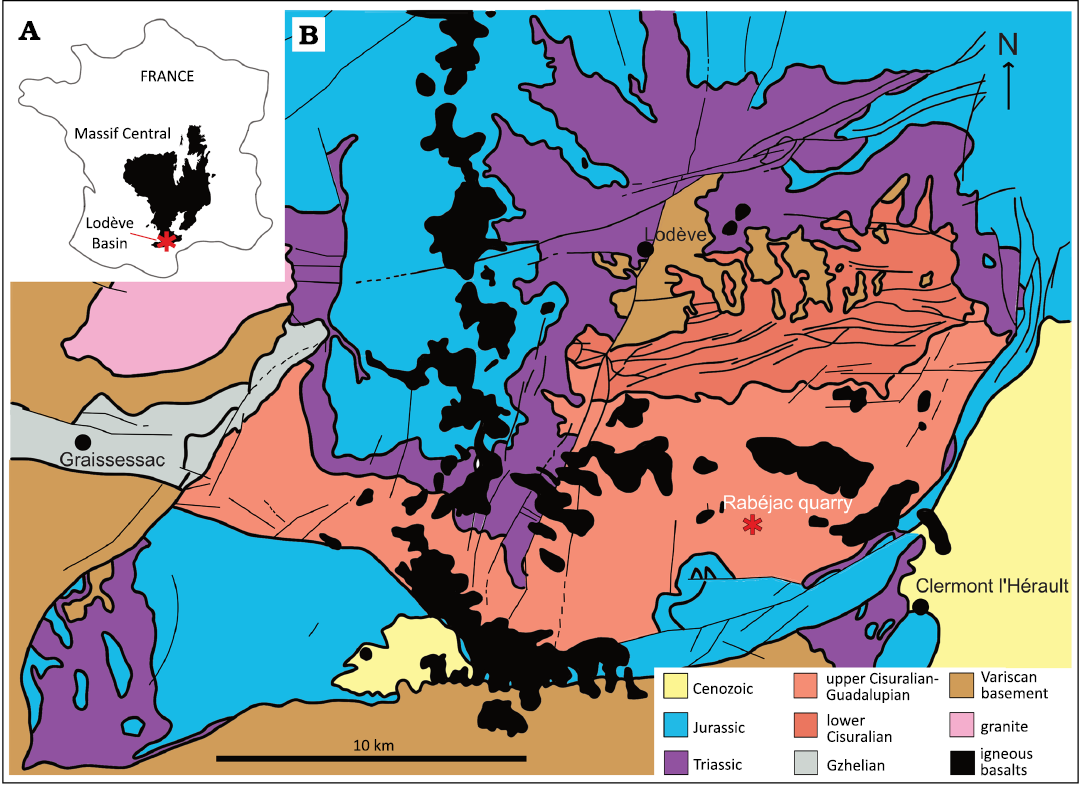
Fig. 1. Location (A) and geological map (B) of the Lodève Basin with the locality of the studied specimens (asterisk) (redrawn from Lopez et al. 2005).
Sedimentation marks have been described from the Rabéjac Formation, such as the dendritic surge mark ‘Dendrophycus’ (Heyler & Gand, 2000) as well as raindrops and current marks (Heyler and Gand 2000).
The age of the Rabéjac Formation is well constrained, with a tuff bed (N°III of Michel et al. 2015) from the lower part of the underlying Viala Formation dated to 290.96 ±0.19 Ma with 206Pb/238U (therefore approximately at the base of the Artinskian). Several tuff beds from the lower part of the overlying Octon Member (150 m above the upper boundary of the Rabéjac Formation) of the Salagou Formation have been dated to respectively 284.40 ±0.13 Ma and 284.46 ±0.10 Ma with 206Pb/238U (Michel et al. 2015), corresponding to the uppermost Artinskian. The Rabéjac Formation has thus an age comprised between uppermost Sakmarian and uppermost Artinskian, but considering the deposition of the Viala Formation, the basal unconformity of the Rabéjac Formation and the deposition of the overlying Salagou Formation, it was likely upper but not uppermost Artinskian. Although tuff beds have been recognised from the Rabéjac Formation (Nmila et al. 1989), they have yet to be dated to propose a more precise absolute age of the formation.
Geomagnetic data suggested a global upper Cisuralian–lower Guadalupian age for the Rabéjac Formation: Sakmarian–Artinskian (Kruseman 1962; Maillol and Evans 1992) and Artinskian–Wordian (Mérabet and Guillaume 1988). Further constraints come from the tetrapod footprint record. Haubold and Lucas (2001) considered an upper Artinskian age for the Rabéjac Formation based on tetrapod footprints. This formation includes the base of the Erpetopus tetrapod footprint biochron, which is now considered late Artinskian–Kungurian (Voigt and Lucas 2018; Marchetti et al. 2025b). An upper Artinskian–Kungurian age has also been proposed based on the palaeofloral assemblage (Galtier and Broutin 2008). This is consistent with the upper but not uppermost Artinskian age from radiosiotopic ages.
Palaeontology of the Rabéjac Formation.—The Rabéjac Formation is the most fossil-rich Permian unit of the Lodève Basin, and preserves diverse plants, invertebrates, and tetrapod trace fossils (Schneider et al. 2006) which were recovered for the great part from the Rabéjac quarry (Fig. 1). Its palaeoflora, including conifers (Autunia), callipterids (Supaia), and Taeniopteris leaves, shows lower diversity than the underlying formations, likely due to taphonomic biases (Galtier and Broutin 2008). Invertebrate traces include burrows (Scoyenia, Beaconites; Gand et al. 2003, 2004; Lopez et al. 2005), trackways (Isopodichnus furcosus, Cruziana, Acripes; Gand 1987, 1994; Gand et al. 2008), and abundant notostracan feeding/resting traces (Rusophycus minutus; Debriette and Gand 1990; Gand et al. 2008).
The palaeoichnofauna of the Rabéjac Formation was first described by Heyler and Lessertisseur (1963). The Rabéjac tetrapod ichnofauna forms the Association III of the Lodève Basin (Gand and Durand 2006) characteristic of deltaic palaeoenvironment (Odin 1986). It is one of the most diverse in the region and includes nine ichnogenera (Heyler and Lessertisseur 1963; Haubold 1971, 1973; Ellenberger 1983a, b; Gand 1987; Heyler and Gand 2000; Gand and Durand 2006; Marchetti et al. 2021b): Batrachichnus, attributed to small-sized temnospondyls or lepospondyls, including “microsaurs” (Voigt 2005; Petti et al. 2014; Allen et al. 2022; Marchetti et al. 2025b), Limnopus, attributed to large-sized temnospondyls such as eryopoids (Marchetti 2019; Marchetti et al. 2025b), Dimetropus, attributed to pelycosaur-grade synapsids (Gand 1987; Haubold 2000; Voigt 2005; Marchetti et al. 2025b), Tambachichnium, attributed to varanodontine varanopids (Marchetti et al. 2021a, 2025b), Erpetopus, attributed to small “parareptiles” such as nyctiphrutetids and acleistorhinids (Marchetti et al. 2022b, 2025a), Pachypes, attributed to pareiasauromorphs (Marchetti et al. 202b, 2025b), Notalacerta, attributed to non-diapsid stem reptiles (Marchetti et al. 2020, 2025b), Hyloidichnus, attributed to captorhinids (Logghe et al. 2021; Matamales-Andreu et al. 2023; Marchetti et al. 2025b), and Dromopus, which upper Pennsylvanian–Guadalupian occurrences are attributed to araeoscelid diapsids and non-varanodontine varanopids (Marchetti et al. 2021a, 2025b). Key discoveries from the Rabéjac Formation include the first appearance of Pachypes ollieri (upper Artinskian; Marchetti et al. 2021b) and the introduction of the Erpetopus footprint biochron base (Voigt and Lucas 2018; Schneider et al. 2020). The Rabéjac Formation is thus a key unit for the understanding of the late Cisuralian reptile radiation in the footprint record (e.g., Marchetti et al. 2013, 2019b; Voigt and Lucas 2017) and the change of continental floras and faunas that is part of the Artinskian Warming Event (Marchetti et al. 2022a).
Material and methods
The specimens described in this study are housed in the Musée de Lodève (Hérault, France) (ML 2001.1453.1; 2001.1482.1; 2001.1483.1) and the Muséum national d’Histoire naturelle (Paris, France) (MNHN.F.LOD59). All track specimens were studied first-hand and photographed with adequate light conditions (artificial oblique light). The studied specimens were evaluated based on the preservation of their diagnostic features (e.g., Marchetti et al. 2019a). Photo series in full light were taken to obtain 3D models by using the photogrammetry technique (e.g., Mujal et al. 2020). Photographs were done using a Nikon D5300 and a Canon EOS 2000D (with a camera lens EFS-S 18–55 mm) digital cameras. The 3D models were built using the software Agisoft Metashape Professional (v. 2.1.3), and contour lines and colour depth maps were obtained using the software Cloud Compare (v. 2.7.0.) and ParaView (v.5.9.1.). The 3D models were uploaded to the digital repository MorphoSource (https://www.morphosource.org). The material was digitally measured with ImageJ2, and the measurements are reported in Table 1.
Table 1. Trace fossil measurements (in mm) of the Dimetropus osageorum from the Rabéjac Formation. FL, foot length; FW, foot width; I–V D, divarication (angle in degrees) of digits I–V; I–V L, digit I–V length; × , no measurement was possible.
|
|
FL |
FW |
I L |
II L |
III L |
IV L |
V L |
I–V D |
FL |
FW |
I L |
II L |
III L |
IV L |
V L |
I–V D |
|
Specimen |
manus |
pes |
||||||||||||||
|
2001.1453.1 |
× |
× |
× |
× |
× |
× |
× |
× |
224.2 |
120.6 |
47.2 |
51.9 |
55.8 |
60.5 |
51.4 |
67.54 |
|
2001.1482.1 |
~101 |
>43.9 |
× |
× |
× |
× |
× |
× |
183.3 |
61.6 |
38.6 |
46.4 |
50.6 |
63.5 |
44.6 |
58.92 |
Systematic palaeontology
Ichnogenus Dimetropus Romer & Price, 1940
Type ichnospecies: Dimetrodon berea (Tilton, 1931); Waynesburg Formation, Cisuralian, west Virginia, USA.
Included ichnospecies: Dimetropus leisnarianus (Geinitz, 1863) and Dimetropus osageorum Sacchi et al., 2014. Sacchi et al. (2014) recognised five valid ichnospecies of Dimetropus: D. leisnerianus, D. osageorum, D. berea (Tilton, 1931), D. salopensis Haubold & Sarjeant, 1973, and D. nicolasi Gand & Haubold, 1984. Voigt (2005) synonymised D. berea, D. salopensis and D. nicolasi, with D. leisnerianus. Lucas et al. (2016) discussed the validity of D. osageorum, based on the similarity with the historical material of D. berea and concluded on the impossibility in deciphering Dimetropus ichnospecies (Voigt and Lucas 2015; Lucas et al. 2016).
Diagnosis (after Marchetti et al. 2025b, emended after Voigt 2005).—Plantigrade to semiplantigrade pentadactyl ectaxonic tracks of a quadruped. Large tracks (50–200 mm in length). Plantigrade pes significantly larger than the manus, with a fully impressed large sole extended proximally and laterally. Pedal digits relatively short compared with the palm/sole size. Digits end in thin and acuminate claw impressions, often bifurcated. Medial parts of digits from fully to non-impressed, resulting in paw-like impressions. Basal pads of the digits large, in an arcuate disposition, with evident hemispherical shape when visible. Manual digit proportions: I<II=V<III<IV. Pedal digit proportions: I<II≤V≤III≤IV. Total digit divergence low in the pes (about 50–70°). Trackway showing a simple pes-manus alternating arrangement pattern. Secondary overstep possible in case of lower pace angulation. Footprints are aligned to the trackway midline, with the pes slightly turned outwards in rare occasions.
Remarks.—Waiting for a comprehensive revision, we follow Voigt (2005) and Marchetti et al. (2025b), recognising only D. leisnerianus and D. osageorum as valid, considering the wide range of extramorphological variations of Dimetropus and the need of a comprehensive revision study (e.g., Gand 1987; Haubold et al. 1995; Hunt et al. 1995; Voigt and Lucas 2015).
Stratigraphic and geographic range.—Definite Dimetropus occurrences are known from Pennsylvanian and Cisuralian units (Marchetti et al. 2025a). It has been recovered from the USA (Arizona, Colorado, New Mexico, Oklahoma, Texas, West Virginia, Pennsylvania), Canada (Nova Scotia), Spain, France, Italy, Germany, Poland, Czech Republic, and Morocco. See Marchetti et al. (2025b) and Lucas and Stimson (2025) and references therein for complete bibliography of Dimetropus occurrences.
Dimetropus osageorum Sacchi et al., 2014
Figs. 2–5; Table 1.
1983 ‘Pseudanthropopus egregrius’; Ellenberger 1983a: 557, pl. 1: 11.
1983 ‘Pseudanthropopus insolitus’; Ellenberger 1983a: 557, pl. 1: 12.
1987 Dimetropus leisnerianus; Gand 1987: 168, text-fig. 47H., pl. 6: c.
1987 Dimetropus leisnerianus; Gand 1987:168, text-fig. 47I.
2000 Dimetropus leisnerianus; Heyler and Gand 2000: 15, fig. 25.
2006 Dimetropus leisnerianus; Gand and Durand 2006:160, fig. 2D3.
2025 Dimetropus isp.; Marchetti et al. 2025a: 2755, supplementary figure S3.
Material.—ML 2001.1453.1 (Figs. 2–5), original specimen track of a right pes, concave epirelief; MNHN.F.LOD59 (Fig. 5A2), plaster cast of the track of a right pes, concave and convex hyporelief; 2001.1482.1 (Fig. 3A1), original specimen right manus-pes couple, concave epirelief; 2001.1483.1 (Fig. 3A2), counterpart of specimen 2001.1482.1, original specimen manus-pes-couple, convex hyporelief. All from Rabéjac Formation, Lodève Basin, Rabéjac quarry, France; upper Artinskian, Cisuralian (Permian).
Description.—Plantigrade, pentadactyl footprint of a quadrupedal tetrapod. The pes is 224.2 mm long and 100.5 mm wide. It is weakly ectaxonic (i.e., digit IV is the longest) and digits I and V are more proximal compared to digits II–IV (Figs. 2A2 and 3A2). Digit impressions are relatively short (I, 47.2 mm; II, 51.9 mm; III, 55.8 mm; IV, 60.5 mm; V, 51.4 mm) compared to the metatarsal pad (68 mm long) (Table 1). Digits present more or less the same length, with only a slight increase from digit I to IV. Digits II–IV are closely grouped, subparallel compared to each other, presenting a low divarication angle. They are not superimposed at their base. Digit I is the shortest. Digit V is slightly shorter than digit II. The divergence angle between digits I and V is about 67.54° (Table 1). Digits are straight, thin and end in enlarged impressions, sometimes bifurcated. The digits are more impressed proximally and distally, the metapodial-phalangeal pads of the pes (i.e., metatarsal-phalangeal pads) I to V are visible, especially I (Figs. 2A2 and 3A2). These pads are arranged along a symmetric semicircle, with metatarsal-phalangeal pads I and V positioned in a significant distal position compared to the digit bases than metatarsal-phalangeal pads II–IV (Figs. 2A2, 3A2, SOM: fig. 1; Supplementary Online Material available at http://app.pan.pl/SOM/app71-Logghe_etal_SOM.pdf). The metatarsal-phalangeal pads I and V are significantly larger than the metatarsal-phalangeal pads II–IV (Fig. 2A2). They also present an ovoid shape (Figs. 2A2 and 3A2), contrary to the circular shape of the metatarsal-phalangeal pads II–IV.
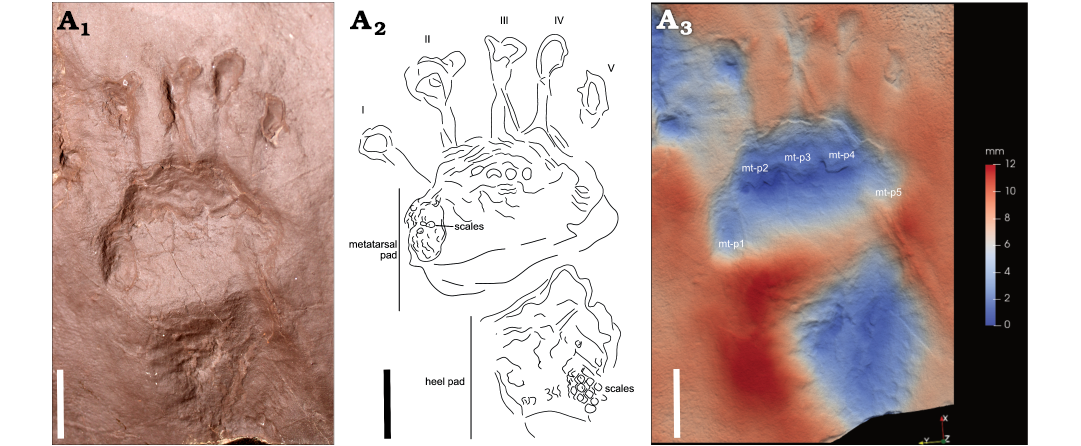
Fig. 2. Right pes of Dimetropus osageorum Sacchi et al., 2014 (ML 2001.1453.1, concave epirelief) from Rabéjac Formation, Lodève Basin, Rabéjac quarry, France; upper Artinskian (Permian). Exceptionally preserved skin folds and scale impressions on the digits, metatarsal and heel pads. Photograph (A1), explanatory drawing (A2), false-colour height map (A3). I–V, digit numbers; mt-p1–5, metatarsal-phalangeal pads 1–5. Scale bars 40 mm.
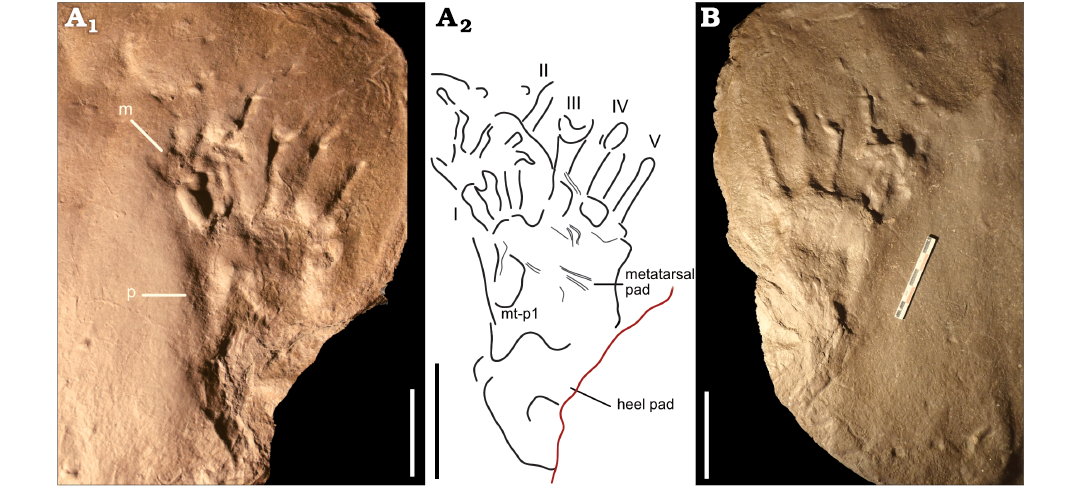
Fig. 3. Right manus-pes couple of cf. Dimetropus osageorum Sacchi et al., 2014, described as ‘Pseudanthropopus insolitus’ Ellenberger, 1983, from Rabéjac Formation, Lodève Basin, Rabéjac quarry, France; upper Artinskian (Permian). A. ML 2001.1482.1, concave epirelief, photograph (A1), explana-tory drawing (A2). B. ML2001.1483.1, counterpart of A, convex hyporelief. I–V, digit numbers; m, manus; mt-p1, metatarsal-phalangeal pad 1; p, pes. Scale bars 50 mm. Photos by Stéphane Fouché.
The sole is longer than wide. It consists of two parts, a metatarsal pad and a heel pad (Figs. 2A2 and 3A2). The metatarsal pad impression is ovoid, wider (68 mm) than long (61.6 mm). A large heel pad impression, longer (95.7 mm) than wide (30 mm) is visible posteriorly to the metatarsal pad impression. It is separated from it by a marked expulsion rim impression (~2 mm wide). The heel pad impression is more impressed medially. The sole imprint has a hourglass-shape: it is wider in its distal (middle of the metatarsal pad) and proximal (middle of the heel pad) parts and thinner to non-impressed in its middle part, between the two pads.
ML 2001.1482.1 (Fig. 3) preserves an incomplete manus imprint, at least 1/3 of the size of the pes footprint. The digit imprints are short and straight. As for the pes, they are thin. They are closely grouped and sub-parallel. They do not seem to be superimposed at their base. Only digits II to IV seem to be preserved. The manus is superimposed by the pes imprint, blurring anatomical features.
Scale impressions in ML 2001.1453.1 (Figs. 2A2, 4, 5) are present on the metatarsal pad, forming a small patch at the base of digits III and IV (Fig. 4), on the metatarsal-phalangeal pad I (Figs. 2A2 and 5), and on the proximal right part of the heel pad (Fig. 2A2). Scales on the metatarsal-phalangeal pad I and at the base of the digits are ovoid to circular, approx. 1 mm long. They do not appear evenly arranged. Skin creases are also present on the metatarsal impression, at the base of the digits in ML 2001.1453.1 and 2001.1482.1 (Fig. 4). Scales on the right part of the heel pad are hexagonal, approx. 2.5–5 mm long (Figs. 2A2, 5). They are especially visible on the plaster cast of the original specimen, MNHN.F.LOD.59 (Fig. 5A2). The hexagonal scales of the heel impression are more prominent and tightly arranged, in a bee-hive like configuration, and present thick margins of equivalent thickness. No ornamentation is visible on the scale impressions. In this way, the scales on the heel impression are larger than those present on the metatarsal impression. They are also organised in a specific configuration, contrary to the metatarsal scale impressions.
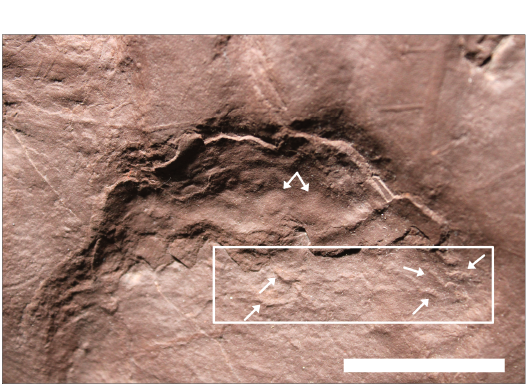
Fig. 4. Skin folds on the metatarsal pad of Dimetropus osageorum Sacchi et al., 2014, ML 2001.1453.1 (concave epirelief) from Rabéjac Formation, Lodève Basin, Rabéjac quarry, France; upper Artinskian (Permian). White rectangle highlighting the base of digits III–V, where skin creases are visible. Arrows point at the scale impressions. Scale bar 20 mm.
Remarks.—ML 2001.1453.1 was first figured by Ellenberger (1983a) as “Pseudanthropopus egregerius”, then by Dutuit and Heyler (1985) as ‘Feraequadigitipes parallelus’ in a popular science journal. Gand (1987) discarded these two ichnogenera as nomen nudum, as they did not have a diagnosis. Gand (1987) and Heyler and Gand (2000) referred this material to Dimetropus leisnerianus.
The material described here presents the
following features that allow its attribution to Dimetropus
osageorum: a pes weakly ectaxonic, the
proportionally shorter digits compared to the sole
impression, digits II–IV of about the same length, lacking the marked
increase in digits I–IV (well-visible in “Dimetropus
salopensis” material, here considered as synonym to D. leisnerianus) (Haubold and
Sarjeant 1973) and a digit V shorter than digit II.
Also, the symmetric semi-circle arrangement of the metatarsal-
phalangeal pads is present, a key feature of D.
osageorum. The only difference seems to be the
thinner digit imprints in the Lodève material, but this is probably a
taphonomic artifact, especially in the case of Dimetropus
which can vary considerably the depth of impression of the
middle part of digits (e.g., Voigt 2005).
These specimens represent the first definite occurrence of D. osageorum from the Lodève Basin. Also, this represents the first occurrence of D. osageorum outside the type locality of the lower Artinskian Wellington Formation (Oklahoma, USA), although Sacchi et al. (2014) assigned several specimens from the Lodève Basin to D. cf. osageorum, without an official description (and not including the specimens re-assigned herein). This further supports the presence of D. osageorum from the Lodève Basin.
ML 2001.1482.1 (Fig. 5) was figured as Dimetropus leisnerianus by Gand (1987: fig. 47I). The pes impression of this specimen shows similarities with ML 2001.1453.1 (e.g., digits shorter compared to the sole impression, digit II to IV of similar size). It also presents an incomplete manus impression placed in front of the pes, partly overlapped by it and at least three times shorter than the pes impression. Based on these elements, we hereby assign this specimen to D. osageorum, pending complete description of the Dimetropus material of the Rabéjac Formation. Finally, the ichnospecies ‘D. nicolasi’ was raised from material of the early Permian of the St-Affrique Basin (Massif Central, France; Gand and Haubold 1984; Gand 1987). Voigt (2005) considered most of the ‘D. nicolasi’ material as undertracks of D. leisnarianus. However, several specimens from the Cisuralian St-Affrique and Lodève basins of France (e.g., Gand and Haubold 1984: fig. 11a from the Mas d’Alary Member, Viala Formation), the Robledo Mountains Formation of New Mexico (e.g., Haubold et al. 1995: fig. 24C), and the Carboniferous–Permian Cape John Formation of Canada (Van Allen et al. 2005: fig. 6) present similarities with D. osageorum. These similarities include: (i) the pes imprints markedly larger than the manus imprints, (ii) the symmetrical semi-circular arrangement of the metatarsal-phalangeal pads, (iii) the extensive sole impression and the weak pedal ectaxony. Here, we suggest that D. osageorum might be the correct assignment for several specimens previously classified as ‘D. nicolasi’ and also some material previously assigned to D. leisnerianus (e.g., Gand 1986: fig. 5; Gand 1991: pl. 1: d; Voigt et al. 2012: fig. 5A), suggesting broader biostratigraphic and palaeogeographic occurrences for this ichnospecies. As such, although material referred to ‘D. nicolasi’ clearly includes undertracks of Dimetropus (Gand and Haubold 1984; Gand 1987; Haubold et al. 1995; Voigt 2005; Gand and Durand 2006), further revision of this ichnospecies (as suggested by Sacchi et al. 2014) is needed to support putative D. osageorum assignments.
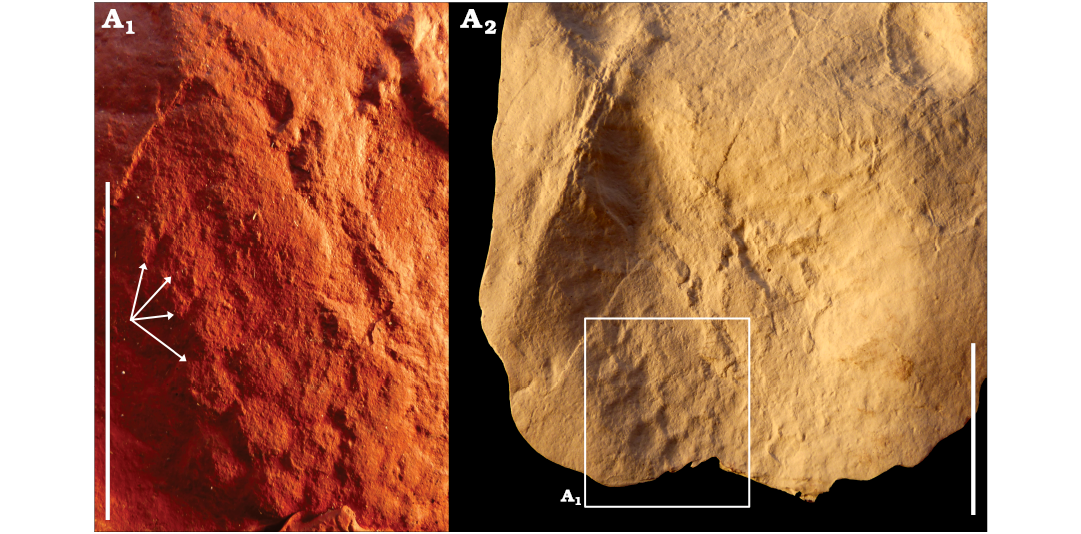
Fig. 5. Epidermal scalation on the heel pad of the right pes of Dimetropus osageorum Sacchi et al., 2014, from Rabéjac Formation, Lodève Basin, Rabéjac quarry, France; upper Artinskian (Permian). MNHN.F.LOD59 (ML 2001.1453.1), latex mould, convex epirelief, arrows are pointing at the epidermal scale impressions (A1); plaster cast, concave epirelief, showing the epidermal scale impressions within the heel-pad impression (A2). Scale bars 20 mm.
One of the most conspicuous differences between D. leisnerianus and D. osageorum, in addition to the clearly smaller manus compared to the pes, is the overall arrangement and morphology of the metapodial-phalangeal pads of the pes (see SOM: fig. 1). Contrary to Dimetropus leisnerianus where the metatarsal-phalangeal pads are arranged in an asymmetric configuration, those of D. osageorum are arranged along a symmetric semi-circle, with metatarsal-phalangeal pads I and V positioned way more distally in regard to the base of the digits than metatarsal-phalangeal pads II to V (SOM: fig. 1). Moreover, the shape of metatarsal-phalangeal pads I and V are ovoid, contrary to the circular shape recovered in the metatarsal-phalangeal pads II to IV, and the shape of all metatarsal-phalangeal pads of Dimetropus leisnerianus. In D. leisnerianus, the metatarsal-phalangeal pad IV is the biggest, whereas in D. osageorum, the metatarsal-phalangeal pads I and V are the biggest (SOM: fig. 1).
The described scales on ML 2001.1453.1 are the only known occurrence from sole impressions of Dimetropus, and were only illustrated but not described in previous studies (Ellenberger 1983a; Heyler and Gand 2000; Marchetti et al. 2025a). Scales associated with Dimetropus digit imprints have been reported or figured previously (e.g., Pabst 1908; Voigt 2005). They are wider than long, as wide as the digits and perpendicular to the digit axis (Voigt 2005; Marchetti et al. 2025a). Thin digital, plantar and transverse creases on the sole of Dimetropus material from Czech Republic were also described (Calábková et al. 2023). They are not as pronounced as the skin folds described here (Fig. 4). More recently, exceptional skin impressions of the limbs, trunk and tail, associated with Dimetropus have been described (Marchetti et al. 2025a), supporting the presence of epidermal scales in sphenacodontids. These body impressions have been assigned to the ichnogenus Bromackerichnus requiescens Marchetti et al., 2025a.
Stratigraphic and geographic range.—Lower to upper Artinskian, Wellington Formation (USA) and Rabéjac Formation (France)
Results
Trackmaker attribution
Synapomorphy-based track-trackmaker correlation.—The trackmaker of Dimetropus has been historically assigned to pelycosaur-grade synapsids (Gand 1987; Haubold 2000; Voigt 2005; Marchetti et al. 2025b), mostly based on the antero-posteriorly elongated sole pad impression, corresponding to a “fleshy pad” positioned at the level of the ovoid calcaneum of pelycosaur-grade synapsids (Reisz 1986; Sacchi et al. 2014). Dimetropus leisnerianus and the associated Bromackerichnus requiescens were correlated to sphenacodontid synapsids through a synapomorphy-based attribution (Marchetti et al. 2025a, b). Sacchi et al. (2014) assessed the trackmaker of D. osageorum as caseids or, potentially, putative edaphosaurids. In particular, they noted a congruence with the uniform digit lengths of both manus and pes in the caseid Cotylorhynchus romeri, although no caseid autopodia strictly matched the footprints of D. osageorum. In addition, Sacchi et al. (2014) noted biostratigraphic discrepancies between the tracks of D. osageorum and the younger large-sized caseids such as Cotylorhynchus. Romano et al. (2016) conducted a thorough investigation of the trackmaker and locomotion of both Dimetropus leisnerianus and Dimetropus osageorum, supporting their attribution to pelycosaur-grade synapsids. Marchetti et al. (2025a) noted that the high heteropody observed in D. osageorum rather indicated a trackmaker group different from sphenacodontids, potentially belonging to caseids, edaphosaurids and ophiacodontids. In the following section, we will compare the autopodial morphology of these three groups with that of Dimetropus osageorum tracks, thanks to the well-preserved material from the Rabéjac Formation (Lodève Basin).
In their discussion of the track-trackmaker attribution for the D. osageorum of the Wellington Formation, Sacchi et al. (2014) noted that early caseids such as Casea or Oromycter were markedly smaller than the putative trackmakers of the footprints, and that only younger giant caseids such as Cotylorhynchus were a match in absolute size. A similar situation occurs in the Rabéjac Formation, where the D. osageorum pes tracks are more than 220 mm long (Table 1). This is at least 1/3 longer than the pes of the putative early caseid Callibrachion gaudryi from the Sakmarian Millery Formation, Autun Basin, northern Massif Central, France (Spindler et al. 2016) or the early caseid Martensius bromackerensis from the upper Asselian Tambach Formation, Thuringian Forest Basin, central Germany (Tables 2, 3, Fig. 6A–C). The absolute size range could conform to that of the larger Euromycter rutenus and especially Ruthenosaurus russellorum from the Grès Rouge Group of the Rodez Basin (Massif Central, France), currently considered Asselian–lower Kungurian (Werneburg et al. 2022), though no pes is known from either taxon. Among early caseids, a complete foot is only known in Martensius (Fig. 6A, C), which displays a long digit I and a clear increase in digit length from digit I to IV (Table 3). This contrasts with the short digit I impression, markedly shorter than digit II, and similarly long digits II–IV impressions of D. osageorum. In contrast, later-diverging caseids present a shorter digit I (though not markedly smaller than digit II) and subequal digits II–IV, comparable to D. osageorum, including the relatively early diverging Ennatosaurus tecton from the middle Permian of Russia (Table 1; Olson 1962). Phylogenetic bracketing under recent topologies suggests that this might also have been the case at least for Ruthenosaurus (Werneburg et al. 2022). In addition, complete skeletons of the early caseids Callibrachion, Martensius and Ennatosaurus show no marked heteropody (Olson 1962; Spindler et al. 2016; Berman et al. 2020), contrary to D. osageorum. Also, larger, later diverging caseids such as Cotylorhynchus lack this heteropody and contrast with D. osageorum (as suggested by Sacchi et al. 2014). It is unknown whether Euromycter or Rhuthenosaurus showed heteropody. However, all late-diverging caseids show thick manual and pedal digits, including Ennatosaurus, Euromycter or Cotylorhynchus (Fig. 6D; Olson 1962; Stovall et al. 1966; Sigogneau-Russell and Russell 1974). This is different from the rather gracile digits observed in D. osageorum, especially in the well-preserved tracks of the Rabéjac Formation described herein. Moreover, the thickness of the first phalanges in these later caseids caused a high divarication angle between the base of the digits, especially digits IV and V, as is the case in Ennatosaurus and Cotylorhynchus (Fig. 6D; Olson 1962; Stovall et al. 1966). This contrasts with the parallel digits I to V and the low divarication angle of the autopods observed in D. osageorum. Lastly, digit V of the pes of Cothylorhynchus is smaller than digit II (Table 3), comparable to a key characteristic of D. osageorum. However, this character cannot be assessed in other late-diverging caseids. In light of all this, we think that D. osageorum is unlikely to have been made by a caseid trackmaker, contrary to Sacchi et al. (2014).
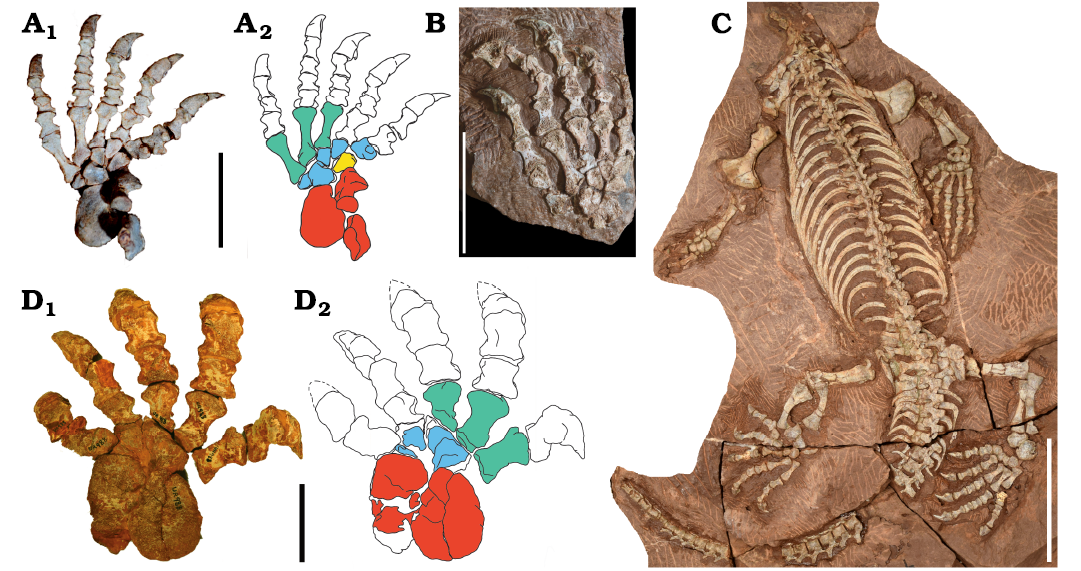
Fig. 6. Caseidae manus and pes bodyfossils: Martensius bromackerensis Berman et al., 2020, Tambach Formation, Bromacker (Germany), upper Asselian (Cisuralian) (A–C) and Cotylorhynchus bransoni Olson and Barghusen, 1962, Chickasha Formation, Omega quarry, Oklahoma (USA), early Roadian (Guadalupian) (D). A. MNG 13814, left pes in dorsal view; photograph (A1), explanatory drawing (A2). B. MNG 10595, left manus in dorsal view. C. MNG 14230, sub-complete skeleton of a juvenile individual in dorsal view. D. FMNH UR 988, described in Romano and Nicosia (2015), stored at the Field Museum of Natural History; right pes in dorsal view; photograph (D1), explanatory drawing (D2). Red, astragalo-calcaneal complex; yellow, centrale; blue, distal tarsals (1–5); green, metatarsals III–V. Scale bars 50 mm, except C 100 mm.
The autopodia of edaphosaurids is not well
known (Spindler et al. 2020). The manus of Edaphosaurus
seems to present gracile straight and parallel
digits (Kummell et al. 2020), potentially congruent
with the footprints of
D. osageorum, although gracile digit
imprints in D. osageorum are mostly in the
pes. We note that most European edaphosaurid specimens are
relatively small compared to their North American
counterparts (Spindler et al. 2020), and in turn, to
D. osageorum. However, this may
reflect the scarcity of the European edaphosaurid fossil record. To
sum up, we provisionally exclude an edaphosaurid
trackmacker attribution for D. osageorum.
The manus and pes of Ophiacodontidae has been poorly studied compared to caseids, and no complete autopods are known from European ophiacodontids (Falconnet 2014). However well-preserved Ophiacodon mirus and Ophiacodon retroversus material from the lower Permian of North America showing sub-complete to complete autopodia are known (Fig. 7), as well as some subcomplete pedes of Varanosaurus (Case, 1910). Amongst pelycosaurian-grade synapsids, ophiacodontids present the best case of heteropody, especially in O. retroversus (Fig. 7C, D), with a pes at least 1/3 larger than the manus, similar to D. osageorum (Fig. 5). Also, the digits of the manus of Ophiacodon species (Table 2) display an increase in length from digits I to IV, with digit V of similar size as digit II, which seems consistent with the manus of ML 2001.1482.1 from the Rabéjac Formation (Fig. 5). The pes of Ophiacodon retroversus also displays an increase in length of digits I to IV, although digits II–IV remain rather similar in size (Table 3). Digit I is clearly smaller than digit II. Digit V appears to be of similar size, only very slightly longer than digit II (Table 3), in accordance with a key feature of D. osageorum. The metatarsal-phalangeal pads in the herein described D. osageorum specimens are arranged along a symmetric semi-circle (SOM: fig. 1), with the metatarsal-phalangeal pads of digits I and V more proximal compared to that of digits II–IV. In Ophiacodon, the metatarsal-phalangeal articulations of digits I and V are also more proximal than those of digits II–IV (SOM: fig. 1). This is also the case, to a lesser degree, in Varanosaurus (Case, 1910). In contrast, in sphenacodontids, the metatarsal-phalangeal articulations of digits I and II are positioned more closely to those of digits III–V, and so in a more distal position compared to those of ophiacodontids (SOM: fig. 1), which instead conforms to the asymmetric configuration of the metatarsal-phalangeal pads of D. leisnerianus (Marchetti et al. 2025a, b).
Table 2. Skeletal measurements (in mm) of the manus of synapsids from lower Permian units of Euamerican Variscan Belt. DML, digit metapodial length; FL, autopodium length; FW, autopodium width; MCL, metacarpal-carpal length; I–V D, divarication (angle in degrees) of digits I–V; I–V L, digit I–V length; × , no measurement was possible. Measurements from Marchetti et al. (2025a).
|
Family |
Species |
Specimen |
FL |
DML |
MCL |
FW |
I L |
II L |
III L |
IV L |
V L |
I–V D |
|
Caseidae |
Martensius
|
MNG 13814 |
152.6 |
122.6 |
61.2 |
83.8 |
22.7 |
42.2 |
46.2 |
67.2 |
53.5 |
43.07 |
|
MNG 10595 |
91.4 |
82.2 |
55.0 |
63.1 |
23.5 |
33.3 |
45.5 |
46.3 |
40.9 |
30.06 |
||
|
MNG 14320 |
81.6 |
67.8 |
35.4 |
39.1 |
× |
26.5 |
39.3 |
44.6 |
32.6 |
× |
||
|
Edaphosauridae |
Edaphosaurus pogonias |
FMNH |
199.7 |
162.6 |
110.8 |
189.8 |
48.3 |
69.9 |
85.0 |
88.9 |
70.0 |
88.86 |
|
Edaphosaurus boanerges |
MCZ 1366 |
163.0 |
128.4 |
88.2 |
117.8 |
40.9 |
53.1 |
68.5 |
78.4 |
52.2 |
50.65 |
|
|
Ophiacodontidae |
Ophiacodon mirus |
FMNH |
109.4 |
90.3 |
67.7 |
86.8 |
15.0 |
22.1 |
31.7 |
47.5 |
24.6 |
91.84 |
|
FMNH 240 |
108.7 |
90.7 |
72.6 |
91.7 |
16.5 |
23.1 |
33.5 |
47.5 |
27.5 |
76.59 |
||
|
Ophiacodon retroversus |
FMNH 458 |
165.8 |
116.8 |
108.3 |
112.5 |
26.3 |
39.5 |
51.5 |
68.5 |
36.0 |
63.77 |
|
|
Ophiacodon uniformis |
MCZ 1366 |
110.1 |
78.7 |
72.3 |
105.5 |
11.7 |
29.0 |
37.4 |
45.0 |
24.8 |
99.82 |
Table 3. Skeletal measurements (in mm) of the pes of synapsids from lower Permian units of Euamerican Variscan Belt. DML, digit metapodial length; FL, autopodium length; FW, autopodium width; MTL, metatarsal-tarsal length; I–V D, divarication (angle in degrees) of digits I–V; I–V L, digit I–V length. Measurements from Marchetti et al. (2025a).
|
Family |
Species |
Specimen |
FL |
DML |
MTL |
FW |
I L |
II L |
III L |
IV L |
V L |
I–V D |
|
Caseidae |
Martensius
|
MNG 13814 |
123.2 |
89.9 |
76.4 |
104.7 |
34.0 |
38.5 |
39.3 |
50.0 |
43.0 |
65.25 |
|
MNG 10595 |
138.3 |
104.1 |
72.0 |
75.8 |
23.9 |
38.1 |
56.1 |
68.5 |
56.1 |
28.36 |
||
|
MNG 14320 |
93.6 |
75.6 |
47.0 |
65.5 |
23.3 |
31.2 |
38.5 |
46.7 |
37.7 |
59.28 |
||
|
Cotylorhynchus bransoni |
UR 988 |
170.1 |
88.5 |
57.4 |
165.7 |
>31.3 |
52.5 |
>62.2 |
>61.4 |
>36.3 |
123.49 |
|
|
Edaphosauridae |
Edaphosaurus pogonias |
FMNH |
231.8 |
177.1 |
134.8 |
189.1 |
36.8 |
58.7 |
81.5 |
106.9 |
85.8 |
52.44 |
|
Edaphosaurus boanerges |
MCZ 1366 |
172.2 |
121.0 |
100.9 |
116.8 |
36.3 |
56.7 |
67.4 |
78.6 |
57.6 |
55.55 |
|
|
Ophiacodontidae |
Ophiacodon mirus |
FMNH |
158.4 |
116.8 |
103.4 |
133.7 |
25.9 |
39.4 |
48.7 |
63.6 |
55.8 |
71.58 |
|
FMNH 240 |
159.5 |
109.4 |
97.0 |
131.6 |
21.3 |
35.5 |
52.9 |
68.4 |
52.3 |
85.85 |
||
|
Ophiacodon retroversus |
FMNH 458 |
128.1 |
92.8 |
84.3 |
104.1 |
22.9 |
37.0 |
44.5 |
46.8 |
38.3 |
68.60 |
|
|
Ophiacodon uniformis |
MCZ 1366 |
224.7 |
166.2 |
147.1 |
177.4 |
37.0 |
54.1 |
68.8 |
90.6 |
65.4 |
52.44 |
The position of the metatarsal-phalangeal pads in D. leisnerianus pes thus seems to match the metatarsal-digit articulation of some of their trackmakers (e.g., sphenacodontid synapsids, SOM: fig. 1). Moreover, the placement of the metatarsal-phalangeal pads in Dimetropus footprints might also reflect the functional prevalence of their tracemakers: median in D. osageorum (median digits II–IV more predominantly used during the locomotor cycle) and lateral in D. leisnerianus (lateral digits III–V more predominantly used during the locomotor cycle). The differences in functional prevalence recovered from both Dimetropus ichnospecies is therefore consistent with that of their trackmakers considering the metatarsal-phalangeal articulations, and suggest a weak lateral to median functional prevalence in the locomotor cycle of ophiacodontids. Moreover, the proximal phalanx of digit III of Ophiacodon (Fig. 7: green) is also thicker compared to the phalanges of digits V and IV, with more prominent distal processes. This might suggest higher surface for articulation and muscle attachments. This would have led to a medial-median functional prevalence with a high utility of digit III in the locomotor cycle, congruent with the medial functional prevalence, weak ectaxony and deep impression of the basal part of digit III in D. osageorum. In contrast, our observations of the proximal phalanges of sphenacodont synapsids and other small caseids correlated with D. leisnarianus, reveal thicker proximal phalanges in the digits III–V (Fig. 6), congruent with the marked ectaxony of these taxa. Further investigation on the proximal phalanges shape in relation to functional prevalence is needed to back up these observations.
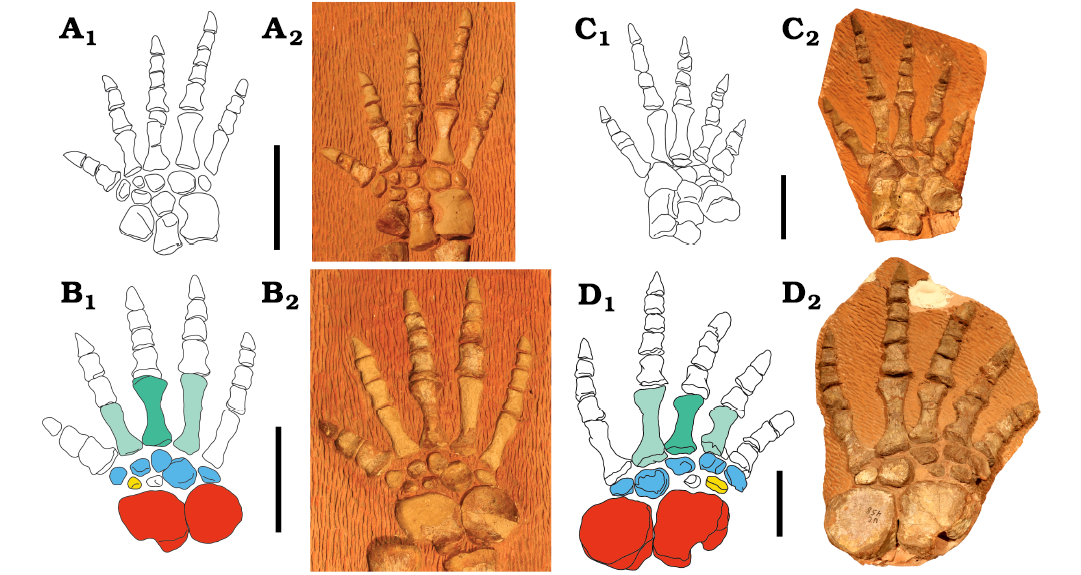
Fig. 7. Manus and pes of Ophiacodontidae species. A, B. Ophiacodon mirus Marsh, 1878, Conemaugh Group, Linton (Ohio, USA), Gzhelian (upper Carboniferous), FMNH 240, manus (A) and pes (B) in dorsal views. C, D. Ophiacodon retroversus Cope, 1878, Nocona Formation, Mount Barry, Wichita County (Texas, USA), Asselian–Sakmarian (lower Permian), FMNH 458, manus (C) and pes (D) in dorsal views. Photographs (A1–D1), explanatory drawings (A2–D2). Red, astragalo-calcaneal complex; blue, distal tarsals; yellow, centrale; green, metatarsals II–IV; dark green, metatarsal III. Scale bars 50 mm.
In conclusion, we discard Cotylorynchus and other large caseids as a possible trackmaker of D. osageorum because of the lack of heteropody, the thick proximal phalanges and the resulting high divarication of the digits, features contrasting the morphological features of this ichnospecies. We also discard large but earlier diverging caseids such as Rhutenosaurus, for which autopodia are incompletely known, based on their inferred morphology for the aforementioned characters. Edaphosaurids are also tentatively discarded due to the relatively smaller size of all known European early Permian edaphosaurids (although there are large edaphosaurid remains from the USA). Ophiacodontidae may represent the better fit for a D. osageorum trackmaker amongst pelycosaurian-grade synapsids, by presenting a high heteropody, especially in some Ophiacodon species. The metatarsal-phalangeal pad arrangement in D. osageorum is also consistent with the metatarsal-digit articulation in Ophiacodon and Varanosaurus with a more proximal articulation of the metatarsal-phalangeal pad impressions of digits I and V coupled with a deepened impressions of digits II–IV, probably reflecting the weak lateral functionality and ectaxony of D. osageorum. This is also supported by preliminary observations of the proximal phalanges of ophiacodontids that may reveal a median functional prevalence in their locomotor cycle, as in D. osageorum. In conclusion, we support and add ophiacodontids to the list of putative trackmakers of D. osageorum.
Early-diverging synapsid occurrences in the Massif Central and Ophiacodontidae palaeobiogeoraphy.—The Carboniferous–Permian formations of the Massif Central, in France, yield a surprising diversity and disparity of synapsids (Fig. 8). In the Permian, indeterminate sphenacodontids have been described from the bone breccia of the lower Sakmarian lower Viala Formation of the Lodève Basin (Falconnet 2014, 2015) but also from the coeval Millery Formation of the Autun Basin, with the historic description of Haptodus baylei Gaudry, 1886. Numerous Caseidae occurrences are known (Fig. 8), with the recovery of: Callibrachion gaudryi, from the Sakmarian Millery Formation of the Autun Basin (Boule and Glangeaud 1893), Ruthenosaurus russelbrum and Euromycter ruterus from the Asselian–lower Kungurian Red Sandstone Group of the Rodez Basin (Sigogneau-Russell and Russell 1974; Reisz et al. 2011) and Lalieudorhynchus gandi, from the lower Guadalupian La Lieude Formation of the Lodève Basin (Werneburg et al. 2022). Other putative pelycosaur-grade synapsid occurrences from the Massif Central are given through the presence of Dimetropus leisnerianus from several formations. It has been described from: the upper Sakmarian Meissac Formation of the Brive Basin (Gand 1987), the Asselian-lower Kungurian Red Sandstone Group of the Rodez Basin (Gand 1987), the Asselian Saint-Rome, Sakmarian Grès du Dourdou and upper Asselian–lower Kungurian Saint Pierre formations of the Saint-Affrique Basin (Gand 1993), and the lower Asselian Usclas-Saint Privas, upper Asselian Tuilières-Loirat, Sakmarian Viala and upper Artinskian Rabéjac formations of the Lodève Basin (Gand and Durand 2006).
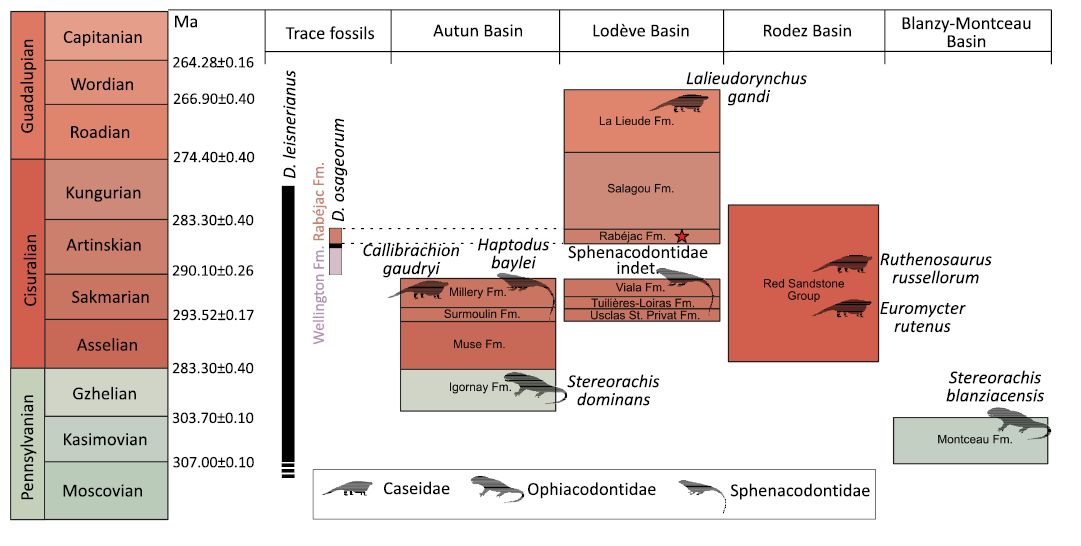
Fig. 8. Global stratigraphic range of Dimetropus osageorum, with occurrences of synapsids (Caseidae, Ophiacodontidae, and Sphenacodontidae) in Carboniferous–Permian basins of the Massif Central (France). Red star indicates D. osageorum occurrence (after Falconnet 2014; Marchetti et al. 2025a). Stratigraphic position of the Rabéjac Formation after Michel et al. (2015), the Wellington Formation after Marchetti et al. (2022). Silhouettes from PhyloPic (https://www.phylopic.org/): Cotylorhynchus (Caseidae) by Nobu Tamura, vectorized by Roberto Díaz Sibaja; Stereorhachis (Ophiacocodontidae)by Dmitry Bogdanov; Haptodus (Sphenacodontidae) by Dmitry Bogdanov, vectorized by T. Michael Kessey.
The ichnotaxon Dimetropus osageorum was previously only known from the type locality, the Wellington Formation in Oklahoma, dated to the lower Artinskian (Sacchi et al. 2014; Marchetti et al. 2022a). The D. osageorum from the Rabéjac Formation, dated to the upper Artinskian thus represents a younger occurrence of this ichnospecies and extends its stratigraphic range (Fig. 8). The only known body fossils of similar age in the French basins are the relatively smaller and older caseids Callibrachion, Euromycter and Ruthenosaurus from the Sakmarian, or the younger large caseid Lalieudorhynchus, the only taxon of comparable size to D. osageorum. None of the taxa above are, however, considered as potential tracemakers of D. osageorum (see section above). Rather, the synapomorphy-based track-trackmaker correlation carried out here suggests, for the first time, the presence of ophiacodontid synapsids in the Massif Central (France), and more generally, within the lower Permian of the Variscan Belt, leading to several implications regarding ophiacodontid palaeobiogeography.
Ophiacodontidae are rare from
Palaeozoic basins of the Variscan Belt, where only assessed
Carboniferous early-
diverging forms are known (e.g., Reisz 1975; Falconnet
2013, 2014; Spindler et al. 2020).
Archaeothyris has been described from the
Carboniferous of the Pilsen Basin (Czech Republic) (Reisz
1975), and two occurrences from the Massif Central (Fig. 8) are
also known: Stereorhachis dominans, from
the Gzhelian (see Pellenard et al. 2017; Mercuzot et al.
2023 for datations) Igornay Formation of the Autun Basin (Gaudry
1880; Thévenin 1910), and Stereorhachis
blanziacensis, from the Kasimovian Montceau Formation of the
Blanzy-Montceau Basin (Langiaux et al. 1974). A
putative occurrence has been described from the Kenilworth
Sandstone Formation of the late Gzhelian to early Asselian
Pennine Basin of England (Paton 1974; Spindler
2020). Considering ophiacodontids as potential trackmakers of the
D. osageorum tracks of Rabéjac, this would
support a Permian presence of the family Ophiacodontidae
in the Variscan Belt. On the contrary, Ophiacodontidae are widespread in
the lower Permian of North America with most of the occurrences come
from marginal marine units of Texas, spanning from the Asselian to
the late Artinskian (e.g., Lucas 2006, 2018).
Several occurrences are known from Oklahoma as well, from floodplain
environments spanning from the Sakmarian to the late
Artinskian (e.g., Lucas 2006, 2018).
Other occurrences are from the Asselian–Sakmarian floodplain units of
Arizona and New Mexico and are generally more scattered (e.g., Lucas
2006, 2018). Contrary to caseids,
ophiacodontids well-overlap the lower Artinskian D.
osageorum occurrence in North America.
Interestingly, the late Artinskian Rabéjac occurrence of putative ophiacodontid trackmaker is immediately preceding the “Redtankian events” (Benton 1989; Lucas 2016, 2018) associated with an extinction of “microsaurs”, anthracosaurs and ophiacodontids in the late Cisuralian (which has been associated to the Olson’s gap by some authors, see Sahney and Benton 2008; Benton 2012). The track-trackmaker correlation between D. osageorum and ophiacodontids could therefore suggest that the “Redtankian events” might be extended to western Europe. More evidence of actual bodyfossils and a review of the Dimetropus occurrences at the ichnospecies level are however needed to support his hypothesis.
The extreme scarcity of ophiacodontids, such as Ophiacodon, in the lower Permian of Europe (only one dubious occurrence, see Spindler 2020) was so far puzzling: ophiacodontids from North America are indeed the only pelycosaur-grade synapsids that do not share European counterpart (Spindler 2020). It has thus been suggested that their morphotype was linked to specific extensive coastal lowland or continuous floodplain environmental conditions, which differed from the isolated intramontane basins of the late Palaeozoic of Europe (Schneider 1993; Pardo et al. 2019; Spindler 2020). The recovery of putatively derived ophiacodontids, such as Ophiacodon-like trackmakers, in the upper Artinskian of the Lodève Basin, within the Variscan Belt, could support the W–E lag in the Permian increase of dryland suggested by Pardo et al. (2019), during the Artinskian Warming Event (e.g., Marchetti et al. 2022a). This change in palaeoclimate might actually have been advantageous for the dispersal of ophiacodontids from North America to Europe (contra Spindler 2020; although it must be noted that earlier D. osageorum occurences in France are possible, so more studies are needed to further verify dispersal hypotheses). The Rabéjac Formation, characterised by a dry tropical floodplain (Lopez et al. 2008) might have been therefore a favourable palaeoenvironment for Ophiacodontidae within the Variscan Belt.
Epidermal scale evolution in Palaeozoic synapsids
Epidermal scalation of Palaeozoic synapsids.—The material of D. osageorum from the Rabéjac Formation displays well-preserved epidermal scale impressions (Figs. 4, 5). The shape and organisation of the scales is consistent with that of the forelimb impressions of Bromackerichnus recquiensens from the upper Asselian of Bromacker (Tambach Formation, Thuringia Forest Basin, Germany) (Marchetti et al. 2025a, 2026b). The epidermal scales of Bromackerichnus requiescens show a remarkably well-preserved organisation and morphology, allowing a detailed reconstruction of the skin of this early Permian synapsid. The belly is covered with rhomboidal to rectangular scales, arranged in a regular grid of transverse and longitudinal rows that are slightly curved backward and laterally. The lateral parts of the trunk bear slightly more prominent scales. On the forelimbs, which are short and robust, the scales become hexagonal, smaller and arranged in oblique rows, suggesting greater flexibility in these areas. The hindlimbs display rectangular scales, often overlapping on the ventral side, following the curvature of the limb. Finally, the tail is covered with longitudinal rows of rectangular, prominent scales showing well-defined hinge regions. Bromackerichnus has been assigned to sphenacodontid synapsids.
Putative ophiacodontids as trace makers of Dimetropus osageorum would then suggest similar epidermal scalation in the autopods and hindlimbs in both sphenacodontids and ophiacodontids. Indeed, the epidermal scalation type II (following Marchetti et al. 2025b; see Fig. 9) is also recovered in the sphenacodontid body impression Bromackerichnus requiescens in the forelimb impression. In this way, a possible presence of more cornified epidermis (epidermal scalation type III of Marchetti et al. 2025a; see Fig. 9) could have also been present in ophiacodontids in other body parts (belly, tail, etc.) In Marchetti et al. (2025a), the Dimetropus pes described here was assigned to a caseid trackmaker, following Sacchi et al. (2014) and Romano et al. (2016). The new attribution to putative ophiacodontid trackmakers changes the interpretation pattern of these groups. The earliest occurrences of epidermal scales in synapsids would then be from the upper Asselian Tambach Formation (Germany), in sphenacodontids (Marchetti et al. 2025a, 2026b), and from the upper Artinskian Rabéjac Formation (France), in ophiacodontids (this study). Both groups belong to pelycosaur-grade synapsids, suggesting reptile-like epidermal scalation as ancestral in non-therapsid synapsids. No scales are known from edaphosaurids, however its presence in this group is likely considering the recovery of reptile-like epidermal scalation as ancestral in pelycosaur-grade synapsids (Marchetti et al. 2025; this study).
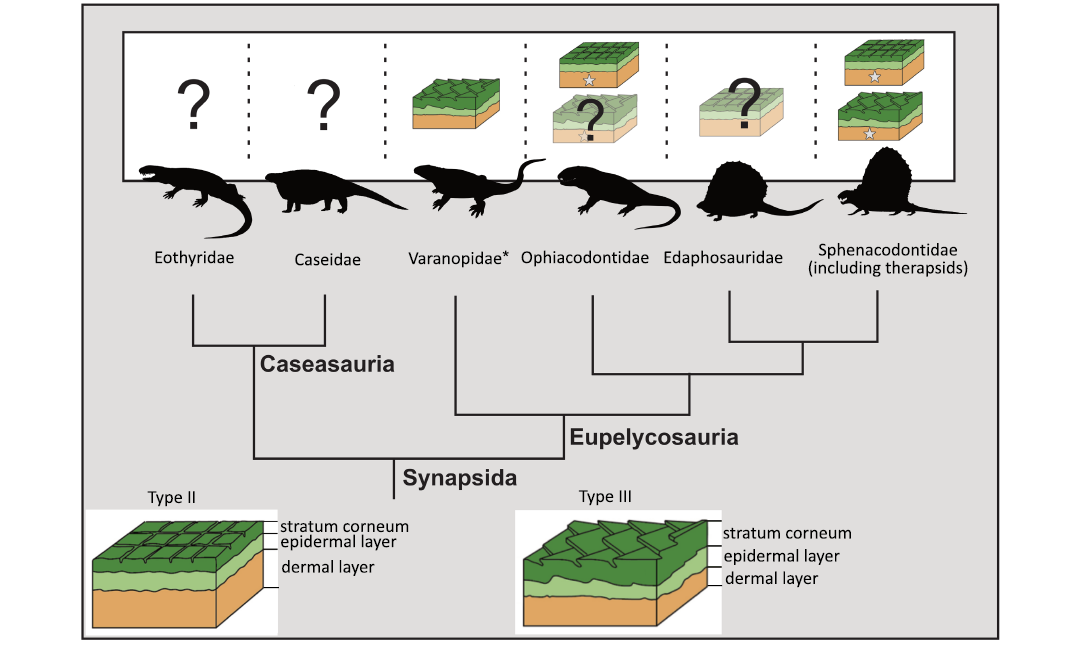
Fig. 9. Epidermal scalation evolution in Palaeozoic synapsids. Phylogeny after Sumida (2025): *, the phylogenetic position of Varanopidae is still unclear as either synapsids or early diverging reptiles. Skin three-dimensional sections after Marchetti et al. (2025b): Type II, non-overlapping thin epidermal scalation; Type III, thickened epidermal scales/overlapping scales; stars indicate the presence of dermal scales. Silhouettes from PhyloPic (https://www.phylopic.org/): Eothyris (Eothyridae), Edaphosaurus (Edaphosauridae) by Nobu Tamura; Cotylorhynchus (Caseidae) by Nobu Tamura, vectorized by Roberto Díaz Sibaja; Varanops (Varanopidae), Stereorhachis (Ophiacodontidae), Dimetrodon (Sphenacodontidae) by Dmitry Bogdanov.
Further conclusions regarding the ancestral state of skin scalation in synapsids would depend on the findings on skin remains or skin impressions attributed to caseids. It also depends on the phylogenetic position of Varanopidae, as either early synapsids (Romer 1956; Reisz 1975; Reisz and Dilkes 2003; Benson 2012; Jenkins et al. 2025) or early diverging diapsid reptiles (Spindler et al. 2018; Ford and Benson 2020). Also, some taxa previously attributed to Varanopidae, such as Ascendonanus, might represent neoreptiles instead (Jenkins et al. 2025). The exceptionally preserved Ascendonanus from the Leukersdorf Formation (Chemnitz Basin, Germany) presents a highly organised pattern of tetragonal to rectangular epidermal scales, covering the trunk, limbs and tail. These scales are small, often overlapping (this is especially seen on the tail region, see Spindler et al. 2018: figs. 14 and 24; Marchetti et al. 2026a: supplementary figure 4), and form longitudinal and transverse rows similar to the scalation of extant non-avian reptiles such as lizards and crocodilians (Spindler et al. 2018; Marchetti et al. 2025a).
The great similarities between early synapsid epidermal scalation and stem reptile epidermal scales (see Marchetti et al. 2026a) could therefore suggest a convergent evolution of integumentary adaptation in both groups or the appearance of reptile-like epidermal scalation as ancestral in amniotes. The latter scenario is also supported by the finding of putative epidermal scales in body fossils of the non-amniote seymouriamorph Discosauriscus from the lower Permian of the Renière Formation (Bourbon-l’Archambault Basin, northern Massif Central, France) (Logghe et al. 2025) as well as scale impressions on body traces attributed to Diplocaulidae (Walter and Werneburg 1988) and Diadectomorpha (Voigt et al. 2024).
Dermal scalation of Palaeozoic synapsids and the transition from dermal to epidermal scales.—The recovery of epidermal scalation in ophiacodontids is moreover interesting as presence of gastral scales sensu Witzmann (2007) have been described from this group, early-diverging ophiacodontid Archeothyris from the upper Carboniferous of Linton (Ohio) (Reisz 1975). These finely striated elongated-narrow ventral scales display a chevron-like organisation forming parallel oblique rows (Reisz 1975), reminiscent of that of other Palaeozoic tetrapods (e.g., Witzmann 2007). Ventral dermal scales have purportedly been reported associated with the sphenacodontid Dimetrodon milleri (Reisz, 1975). Gastralia or “abdominal ribs” sensu Witzmann (2011) are also known in ophiacodontids, in Ophiacodon (Romer 1956: 433) and differ from the scales reported in Archeothyris.
Dermal ventral scales possibly played a protective role (Witzmann 2007). They are ancestral in tetrapods (e.g., Jarvik 1952; Romer 1972; Witzmann 2011), and present in most late Palaeozoic lineages such as temnospondyl amphibians (e.g., Romer and Witter 1941; Findlay 1968; Boy and Sues 2000; Dias and Richter 2003; Witzmann 2007), lepospondyls (Caroll and Gaskill 1978; Mann et al. 2021), reptiles (Credner 1889; Caroll and Baird 1972; Bickelmann et al. 2009) and synapsids (e.g., Romer 1956; Reisz 1975; Berman et al. 2020). During the late Carboniferous and early Permian, a reduction in dermal scalation is observed in tetrapods, mainly in both amniote clades, sauropsids and synapsids, which conversely displayed an increasingly keratinised epidermis through the presence of thick epidermal scalation (Mooney et al. 2024; Marchetti et al. 2025a, 2026a). The replacement of a putatively protected skin through dermal scalation by a thicker epidermis happened in the late Carboniferous–late Permian, probably already in non-amniote crown tetrapods (Logghe et al. 2025). The presence of both scalation-type in late Palaeozoic tetrapods, such as ophiacodontids, is therefore not surprising. The epidermal scales, without ossified component, are formed through cornified-beta proteins in sauropsids and keratin-associated proteins in mammalian synapsids (Alibardi 2022; Holthaus et al. 2025, and references therein). Their increased cornification throughout the amniote evolutionary history provided protection against mechanical stress, desiccation and higher locomotor flexibility than dermal scalation, embedded deep into the dermis (Witzmann 2007). In comparison to dermal scalation, epidermal scales provided clear terrestrial adaptations in amniotes.
Skin evolution in light of early Permian palaeoclimate.—This new finding adds to our knowledge of the evolution of epidermal skin of Palaeozoic tetrapods, recently explored through the description of both ichno- (Voigt et al. 2024; Marchetti et al. 2025a, 2026a) and bodyfossils (Spindler et al. 2018; Logghe et al. 2025), and specifically on the epidermal scale of early synapsids (Table 4).
Table 4. Skin preservation of late Palaeozoic synapsids in the bodyfossil (BF) and ichnofossil (IF) record. *The phylogenetic position of Varanopidae is still unclear as either synapsids or early diverging reptiles.
|
Group (Taxon) |
Stratigraphy; locality |
Scale morphology |
Arrangement pattern |
Body regions with skin preserved |
BF/IF |
References |
|
Eothyridae |
Upper Carboniferous– |
no scales preserved |
N/A |
N/A |
N/A |
N/A |
|
Caseidae |
Lower Permian; North America and Europe |
no scales preserved |
N/A |
N/A |
N/A |
N/A |
|
Varanopidae* |
Lower Permian (Sakmarian), Leukersdorf Formation; Germany |
rhomboidal, rectangular or hexagonal (1–3 mm), sometimes overlapping and laterally tapering |
oblique or alternating rows |
trunk, tail, limbs |
BF |
|
|
Ophiacodontidae |
Lower Permian |
hexagonal |
irregular rows |
pes |
IF |
Marchetti et al. 2025b, this study |
|
Edaphosauridae |
Lower Permian; |
no scales preserved |
N/A |
N/A |
N/A |
N/A |
|
Sphenacodontidae |
Lower Permian |
rhomboidal, rectangular or hexagonal (4–5 mm), with hinge zones, sometimes overlapping |
transverse and longitudinal rows, slightly curved caudolaterally |
trunk, tail, limbs, pes, manus |
IF |
The time interval between the Gzhelian and the Artinskian was characterised by global warming, aridification and the progressive demise of the South Polar ice sheets of the Late Palaeozoic Ice Age (e.g., Montañez and Poulsen 2013; Richey et al. 2020). This caused more seasonal, hotter and drier climate at low palaeolatitudes of Pangaea, considerably changing the floras and the faunas in order to resist these new conditions. This includes the development of new integumentary structures such as epidermal scales in stem amniotes and amniotes, adaptations for fossoriality to be able to aestivate and in general a replacement of wet-adapted biotas by drought-adapted biotas (e.g., Marchetti et al. 2024, 2025a; Voigt et al. 2024). This culminated with the Artinskian Warming Event (AWE), a global warming peak induced by the release of large volcanic quantities of CO2 that affected both the floras and the faunas at low palaeolatitudes (Montañez et al. 2007; Richey et al. 2020; Marchetti et al. 2022a). This was also coupled with further warming mechanisms and an important sea-level transgression (Sun et al. 2022, 2026; Hou et al. 2023; Li et al. 2025; Wu et al. 2025). The Rabéjac Formation is time-equivalent with the AWE, therefore the effects of this event are observable in its footprint record, with an increase of diversity of reptilian footprints. Also, from this unit, we record epidermal scales in both reptilian, with a scaly body and tail impression associated with Erpetopus isp. (Ellenberger 1983a; Marchetti et al. 2025b: fig. 4.12D), and synapsid traces (this study). So, it is clear that the Rabéjac Formation is a key unit for the understanding of this climatic event on the continental realm, including the biota composition and also and foremost the evolution of integumentary structures.
Conclusions
In this study we therefore support:
• the first occurrence of Dimetropus osageorum from the Rabéjac Formation
(upper Artinskian, France), extending the ichnospecies range beyond
North America;
• a new track-trackmaker correlation for this ichnospecies, which strongly suggests an ophiacodontid-grade synapsid trackmaker based, among other features, on heteropody;
• thus, the presence of ophiacodontids in the Variscan Belt (Europe) during the late Artinskian, first such evidence outside North America and a possible dispersal of ophiacodontids across Pangaea during the Artinskian Warming Event (AWE);
• the presence of well-preserved epidermal scale imprints—earliest direct evidence of reptile-like epidermis in ophiacodontids;
• that integumentary adaptations towards more cornified, water-retentive skin were already established in early pelycosaur-grade synapsids, supporting correlation between climatic aridification, selective pressures for water-conserving integument, and synapsid terrestrial expansion.
Overall, this study highlights the Rabéjac Formation, which was deposited under dry tropical floodplain conditions, contemporaneous with the Artinskian Warming Event, as a key continental archive for studying early amniote adaptation to climate stress.
Authors’ contribution
AL and LM designed the original project, described and interpreted the fossils. AL wrote the manuscript with the help of all authors. LM did the 3D-model. AL prepared the figures. All authors reviewed the manuscript.
Acknowledgements
We would like to thank Stéphane Fouché, curator of the Earth Sciences and Archaeological Collections of the Musée de Lodève of France for providing access to the collection and exhibition, photographs and collection number of some specimens. We thank all the other curators and collection managers of the institutions storing comparative material: Nour-Eddine Jalil (MNHN), Tom Hübner and Sophie König (both MNG, Gotha, Germany); and William Simpson (FMNH). We also thank the editor Eudald Mujal Grané (Natural History Museum Stuttgart, Germany), and reviewers Rafael Matamales Andreu (Fundació Jardí Botànic de Sóller-Museu Balear de Ciències Naturals, Mallorca, Spain) and Gabriela Calábková (Masaryk University, Brno, Czech Republic), for their insightful remarks and corrections which help improve the quality of the manuscript.
Editor: Eudald Mujal Grané
References
Alibardi, L. 2022. Keratinization and cornification are not equivalent processes but keratinization in fish and amphibians evolved into cornification in terrestrial vertebrates. Experimental Dermatology 31: 794–799. Crossref
Allen, L.F., Stimson, M.R.,
King, O.A., Norrad, R.E., Lucas, S.G., Mann, A., Hinds, S.J., Park,
A.F., Calder, J.H., Maddin, H., and Montplaisir, M. 2022. A
Batrachichnus salamandroides trackway
from the Minto Formation of central New Brunswick, Canada:
implications for alternative tracemaker interpretations. Atlantic Geoscience 58: 239–260. Crossref
Angielczyk, K.D. and Kammerer, C.F. 2018. Non-mammalian synapsids: the deep-roots of the mammalian family tree. In: F. Zachos and R. Asher (eds.), Mammalian Evolution, Diversity and Systematics, 117–198. De Gruyter, Berlin. Crossref
Angielczyk, K.D., Fröbisch, J., Kammerer, C.F., Smith, R.M.H., Marsicano, C.A., Pardo, J.D., Richter, M., and Cisneros, J.C. 2026. Early synapsids from the Cisuralian (lower Permian) Pedra de Fogo Formation, Parnaíba Basin, Brazil: the first definitive South American “pelycosaurs.” Journal of Vertebrate Paleontology 45: e2621685. Crossref
Benoit, J., Ford, D.P., Miyamae, J.A., and Ruf, I. 2021. Can maxillary canal morphology inform varanopid phylogenetic affinities? Acta Palaeontologica Polonica 66: 389–393. Crossref
Benson, R.B. 2012. Interrelationships of basal synapsids: cranial and postcranial morphological partitions suggest different topologies. Journal of Systematic Palaeontology 10: 601–624. Crossref
Benton, M.J. 1989. Mass extinctions among tetrapods and the quality of the fossil record. Philosophical Transactions of the Royal Society of London B 325: 369–386. Crossref
Benton, M. J. 2012. No gap in the Middle Permian record of terrestrial vertebrates. Geology 40, 339–342. Crossref
Berman, D.S., Henrici, A.C., Sumida, S.S., and Martens, T. 2023. Origin of the modern terrestrial vertebrate food chain. Annals of Carnegie Museum 88: 193–201. Crossref
Berman, D.S., Maddin, H.C., Henrici, A.C., Sumida, S.S., Scott, D., and Reisz, R.R. 2020. New primitive caseid (Synapsida, Caseasauria) from the early Permian of Germany. Annals of Carnegie Museum 86: 43–75. Crossref
Bickelmann, C., Müller, J., and Reisz, R.R. 2009. The enigmatic diapsid Acerosodontosaurus piveteaui (Reptilia: Neodiapsida) from the Upper Permian of Madagascar and the paraphyly of ‘younginiform’ reptiles. Canadian Journal of Earth Sciences 46: 651–661. Crossref
Bolton, A.D., Mangera, T., and Benoit, J. 2025. 150 years of synapsid paleoneurology: the origins of the mammalian brain, behavior, sense organs and physiology. Journal of Paleontology [published online https://doi.org/10.1017/jpa.2025.10121]. Crossref
Boule, M. and Glangeaud, P. 1893. Le Callibrachion, nouveau reptile du Permien d’Autun. Comptes rendus hebdomadaires des Séances de l’Académie des Sciences 117: 646–648.
Boy, J.A. and Sues, H.D. 2000. Branchiosaurs: larvae, metamorphosis and heterochrony in temnospondyls and seymouriamorphs. In: H. Heatwole and R.L. Caroll (eds.), Amphibian Biology, Vol. 4: Palaeontology, 1150–1197. Surrey Beatty & Sons, Chiping Norton.
Brocklehurst, N., Reisz, R.R., Fernandez, V., and Fröbisch, J. 2016. A re-description of “Mycterosaurus” smithae and Early Permian eothyridid and its impact on the phylogeny of pelycosaurian-grade synapsids. PLoS ONE 11: e0156810. Crossref
Buffa, V., Frey, E., Steyer, J.S., and Laurin, M. 2024. ‘Birds’ of two feathers: Avicranium renestoi and the paraphyly of bird-headed reptiles (Diapsida: ‘Avicephalia’). Zoological Journal of the Linnean Society 202: 1–25. Crossref
Calábková, G., Březina, J., Nosek, V., and Madzia, D. 2023. Synapsid tracks with skin impressions illuminate the terrestrial tetrapod diversity in the earliest Permian of equatorial Pangea. Scientific Reports 13: 1130. Crossref
Canoville, A. and Laurin, M. 2010. Evolution of humeral microanatomy and lifestyle in amniotes, and some comments on palaeobiological inferences. Biological Journal of the Linnean Society 100: 384–406. Crossref
Caroll, R.L. and Baird, D. 1972. Carboniferous stem-reptiles of the family Romeriidae. Bulletin of the Museum of Comparative Zoology 143: 321–364.
Caroll, R.L. and Gaskill, P. 1978. The order Microsauria. Memoirs of the American Philosophical Society 126: 1–211. Crossref
Case, E.C. 1910. New or little known reptiles and amphibians from the Permian(?) of Texas. Bulletin American Museum of Natural History 28: 163–181.
Cope, E.D. 1882. Third contribution to the history of the Vertebrata of the Permian formation of Texas. Proceedings of the American Philosophical Society 20: 447–461.
Credner, H. 1889. Die Stegocephalen und Saurier aus dem Rothliegenden des Plauen’schen Grundes bei Dresden. Zeitschrift der Deutschen Geologischen Gesellschaft 41: 319–342.
Debriette, G. and Gand, G.
1990. Conséquences stratigraphiques et paléo-
environnementales de nouvelles observations paléontologiques dans le
Permien de la partie occidentale du bassin de Lodève (Sud du Massif
Central). Géologie de France 1: 19–32.
Dias, E.V. and Richter, M. 2003. On the squamation of Australerpeton cosgriffi Barberena, a temnospondyl amphibian from the Upper Permian of Brazil. Anais da Academia Brasileira de Ciências 74: 477–490. Crossref
Dutuit, J.-M. and Heyler, D. 1985. L’ichnologie, sciences des traces fossiles. Dossiers d’Archéologie 90: 12–23.
Ellenberger, P. 1983a. Sur la zonation ichnologique du Permien inférieur (Autunien) du bassin de Lodève (Hérault). Comptes rendus des séances de l’Académie des sciences de Paris, Série 2, Mécanique-Physique, Chimie, Sciences de l’univers, Sciences de la Terre 297: 631–633.
Ellenberger, P. 1983b. Sur la zonation ichnologique du Permien moyen (Saxonien) du bassin de Lodève (Hérault). Comptes rendus des séances de l’Académie des sciences de Paris, Série 2, Mécanique-Physique, Chimie, Sciences de l’univers, Sciences de la Terre 297: 553–558.
Falconnet, J. 2013. Diversification initiale des amniotes: l’apport des amniotes français. 336 pp. Unpublished Ph.D. Thesis, Muséum national d’Histoire naturelle, Paris, France.
Falconnet, J. 2014. An evaluation of French amniote diversity through the Pennsylvanian-Cisuralian boundary. Annales de Paléontologie 100:119–130. Crossref
Falconnet, J. 2015. The sphenacodontid synapsid Neosaurus cynodus, and related material, from the Permo-Carboniferous of France. Acta Palaeontologica Polonica 60: 169–182.
Findlay, G.H. 1968. On the structure of the skin in Uranocentrodon (Rhinesuchus) senekalensis van Hoepen. Palaeontologia Africana 11: 15–22.
Ford, D.P. and Benson, R.B. 2020. The phylogeny of early amniotes and the affinities of Parareptilia and Varanopidae. Nature Evology & Evolution 4: 57–65. Crossref
Galtier, J. and Broutin, J. 2008. Floras from red beds of the Permian Basin of Lodève (Southern France). Journal of Iberian Geology 34: 57–72.
Gand, G. 1986. Interprétations paléontologique et paléoécologique de quatre niveaux à traces de vertébrés observés dans l’Autunien du Lodèvois (Hérault). Géologie de la France 2: 155–176.
Gand, G. 1987. Les traces de vertébrés tétrapodes du Permian Français. 341 pp. Thèse d’Université Université de Bourgogne, Dijon.
Gand, G. 1991. Premières découvertes de traces de pas de vertébrés tétrapodes dans le bassin permien de Brive-la-Gaillarde (Corrèze). Géologie de la France 3: 43–51.
Gand, G. 1993. La palichnofaune de Vertébrés tétrapodes du bassin permien de St-Affrique (Aveyron): comparaisons et conséquences stratigraphiques. Géologie de la France 3–4: 41–56.
Gand, G. 1994. Ichnocoenoses à Isopodichnus furcosus nov. ichnosp. dans le Permien du bassin de Lodève, Massif Central, France. Geobios 27: 74–86. Crossref
Gand, G. and Durand, M. 2006. Tetrapod footprint ichnoassociations from French Permian basins. Comparisons with other Euamerican ichnofaunas. Geological Society of London Special Publications 265: 157–177. Crossref
Gand, G. and Haubold, H. 1984. Traces de Vertébrés du Permien du Bassin de Saint-Affrique (Description, datation, comparaison avec celles du bassin de Lodève). Géologie Méditerranéenne 11: 321–351. Crossref
Gand, G., Galtier, J., Garric, J., Schneider, J., Körner, F., and Béthoux, O. 2003. Les bassins carbonifère de Graissessac et permien de Lodève. Livret guide de l’excursion n°3, Congrès de Sienne sur l’évolution structurale et stratigraphique des successions marines et continentales entre le Carbonifère et le Trias, mai 2001. Première partie. Bulletin de la Société d’Histoire Naturelle d’Autun 185: 7–40.
Gand, G., Galtier, J., Garric, J., Schneider, J., Körner, F., and Béthoux, O. 2004. Les bassins carbonifère de Graissessac et permien de Lodève. Livret guide de l’excursion n°3, Congrès de Sienne sur l’évolution structurale et stratigraphique des successions marines et continentales entre le Carbonifère et le Trias, mai 2001. Deuxième partie. Bulletin de la Société d’Histoire Naturelle d’Autun 186: 9–40.
Gand, G., Garric, J., Schneider, J., Walter, H., Lapeyrie, J., Martin, C., and Thiery A. 2008. Notostraca trackways in Permian playa environments of the Lodève basin (France). Journal of Iberian Geology 34: 73–108.
Gaudry, A. 1880. Sur un reptile très perfectionné trouvé dans le terrain permien. Comptes rendus hebdomadaires des Séances de l’Académie des Sciences 91: 669–671.
Gaudry, A. 1886. Sur un reptile du terrain permien. Comptes rendus hebdomadaires des Séances de l’Académie des Sciences 103: 453–454.
Geinitz, H.B. 1863. Beiträge zur Kenntnis der organischen überreste in der Dyas. Neues Jahrbuch für Geologie und Paläontologie 1886: 385–398.
Haubold, H. 1971. Handbuch der Paläoherpetologie. Teil 18. Ichnia Amphibiorum et Reptiliorum fossilium. 66 pp. Gustav Fischer Verlag, Stuttgart.
Haubold, H. 1973. Die Tetrapodenfährten aus
dem Perm Europas. Frei-
berger Forschungshefte C 285: 5–55.
Haubold, H. 2000. Tetrapodenfährten aus dem Perm—Kenntnisstand und Progress 2000. Hallesches Jahrbuch Geowissenscaften B 22: 23–88.
Haubold, H. and Lucas, S.G. 2001. Die Tetrapodenfährten der Choza Formation (Texas) und das Artinsk-Alter der Redbed Ichnofaunen des Unteren Perm. Hallesches Jahrbuch für Geowissenschaften Reihe B 23: 79–108.
Haubold, H. and Sarjeant, W.A.S. 1973. Tetrapodenfährten aus den Keele und Enville Groups (Permokarbon: Stefan und Autun) von Shropshire und South Staffordshire, Großbritannien. Zeitschrift für Geologie Wissenschaften 1: 895–933.
Haubold, H., Hunt, A.P., Lucas, S.G., and Lockley, M.G. 1995. Wolfcampian (early Permian) vertebrate tracks from Arizona and New Mexico. New Mexico Museum of Natural History and Science Bulletin 6: 135–165.
Heyler, D. and Gand, G. 2000. Pistes et traces du Permien du sud de la France dans les collections du Muséum National d’Histoire Naturelle (Paris). Bulletin de la Société d’Histoire Naturelle d’Autun 176: 7–50.
Heyler, D. and Lessertisseur, J. 1963. Pistes de tétrapodes permiens dans la région de Lodève (Hérault). Mémoires du Muséum National d’Histoire Naturelle, Série C 11: 125–211.
Holthaus, K.B., Steinbinder, J., Sachslehner, A.P., and Eckhart, L. 2025. Skin appendages proteins of tetrapods: building blocks of claws, feathers, hair and other cornified epithelial structures. Animals 15: 457. Crossref
Hopson, J.A. 2015. Fossils, trackways, and transitions in locomotion: a case study of Dimetrodon. In: K.P. Dial, N. Shubin, and E.L. Brainerd (eds.), Great Transformations in Vertebrate Evolution, 125–141. University of Chicago Press, Chicago. Crossref
Hou, Z.S., Shen, S.Z., Henderson, C.M., Yuan, D.X., Zhang, Y.C. and Fan, J.X. 2023. Cisuralian (Early Permian) paleogeographic evolution of South China Block and sea-level changes: Implications for the global Artinskian Warming Event. Palaeogeography, Palaeoclimatology, Palaeoecology 613: 111395. Crossref
Hunt, A.P. and Lucas, S.G. 1998. Vertebrate tracks and the myth of the belly-dragging tetrapods of the late Paleozoic. New Mexico Museum of Natural History and Science Bulletin 12: 67–69.
Hunt, A.P., Lucas, S.G., Haubold, H., and Lockley, M.G. 1995. Early Permian (late Wolfcampian) tetrapod tracks from the Robledo Mountains, south-central New Mexico. New Mexico Museum of Natural History and Science Bulletin 6: 167–180.
Jarvik, E. 1952. On the fish-like tail in ichtyostegid stegocephalians with descriptions of a new stegocephalian and a new crossopterygian from the Upper Devonian of East Greenland. Meddelelser Om Grønland 114: 1–90.
Jasinoski, S.C. and Abdala, F. 2017. Aggregations and parental care in the Early Triassic basal cynodonts Galeosaurus planiceps and Thrinaxodon liorhinus. PeerJ 5: e2875. Crossref
Jenkins, X.A., Benson, R.B., Ford, D., Browning, C., Fernandez, V., Dollman, K., Gomes, T., Griffiths, E., Choiniere, J.N., and Peecock, B.R. 2025. Evolutionary assembly of crown reptile anatomy clarified by late Paleozoic relatives of Neodiapsida. Peer Community Journal 5: e89. Crossref
Kruesman, G.P. 1962. Etude paléomagnétique et sédimentologique du bassin de Lodève Hérault. 65 pp. Thèse d’Université d’Utrecht, Utrecht.
Kummel, S., Abdala, F., Sassoon, J., and Abdala, V. 2020. Evolution and identity of synapsid carpal bones. Acta Palaeontologica Polonica 65: 649–678. Crossref
Langiaux, J., Parriat, J., and Sotty, D. 1974. Faune fossile du bassin de Blanzy-Montceau. La Physiophile 80: 55–67.
Li, Y., Shao, L., Fielding, C.R., Frank, T.D., Ye, Z., Lu, J., Yang, K., and Wang, S. 2025. Continental weathering linked to climate warming at the Sakmarian to Artinskian transition. Global and Planetary Change 254: 105025. Crossref
Logghe, A., Mujal, E., Marchetti, L., Nel, A., Pouillon, I.-M., Giner, S., Garrouste, R., and Steyer, J.-S. 2021. Hyloidichnus trackways with digit and tail drag traces from the Permian of Gonfaron (Var, France): new insights on the locomotion of captorhinomorph eureptiles. Palaeogeography, Palaeoclimatology, Palaeoecology 573: 110436. Crossref
Logghe, A., Rebillard, A., Houée, G., Sánchez Gimeno, A., Courville, E., Elbaz, L., Taraba, P.-M., Paso, R., Herde, M., Štamberg, S., Pouillon, J.-M., and Steyer, J.-S. 2025. Palaeoecology and palaeoenvironment of Discosauriscus Kuhn, 1933 with exceptional preservation of skin and intestine molds from the early Permian of Franchesse (Allier, France). Comptes Rendus Palevol 24: 489–504. Crossref
Lopez, M., Gand, G., Garric, J., and Galtier, J. 2005. Playa environments in the Lodève Permian Basin and the Triassic cover (Languedoc- France). Excursion, 10-12 may 2005, Association des Sédimentologistes français, 54 pp.
Lopez, M., Gand, G., Garric, J., Körner, F., and Schneider, J. 2008. The playa environments of the Lodève Permian basin (Languedoc-France). Journal of Iberian Geology 34: 29–56.
Lucas, S.G. 2006. Global Permian tetrapod biostratigraphy and biochronology. Geological Society of London, Special Publications 265: 65–93. Crossref
Lucas, S.G. 2016. Early Permian tetrapod extinction events. Permophiles 63: 27–32.
Lucas, S.G. 2018. Permian tetrapod biochronology, correlation and evolutionary events. Geological Society of London Special Publications 450: 405–444. Crossref
Lucas, S.G. 2022. Carboniferous tetrapod biostratigraphy, biochronology and evolutionary events. Geological Society of London Special Publications 512: 965–1001. Crossref
Lucas, S.G. and Stimson, M. R. 2025. Carboniferous tetrapod footprints. In: S.G., Lucas, A.P. Hunt, and H. Klein (eds.), Vertebrate Ichnology Tetrapod Tracks and Trackways 1st Edition, 39–86. Elsevier, Amsterdam. Crossref
Lucas, S.G., Kollar, A.D., Berman, D.S., and Henrici, A.C. 2016. Pelycosaurian-grade (Amniote: Synapsida) footprints from the lower Permian Dunkard Group of Pennsylvania and West Virginia. Annals of the Carnegie Museum 83: 287–294. Crossref
Lucas, S.G., Stimson, M.R., King, O.A., Calder, J.H., Mansky, C.F., Hebert, B.L. and Hunt, A.P. 2022. Carboniferous tetrapod footprint biostratigraphy, biochronology and evolutionary events. Geological Society of London Special Publications 512: 933–963. Crossref
Luccisano, V., Cuny, G.,
Pradel, A., Fourel, F., Lécuyer, C., Pouillon, J.-M., Lachat, K., and
Amiot, R. 2023. Palaeoenvironmental and palaeoecological
reconstructions based on oxygen, carbon and sulfur isotopes of Early
Permian shark spines from the French Massif Central. Palaeogeography,
Palaeoclimatology, Palaeoecology 628: 111760. Crossref
MacRae, C.S. 1999. Life Etched in Stone: Fossils of South Africa. 305 pp. Geological Society of South Africa, Pretoria.
Maillol, J.M. and Evans, M.E. 1992. Magnetic intensity variations in red beds of the Lodève Basin (southern France) and their bearing on the magnetization acquisition process. Geophysical Journal International 111: 281–290. Crossref
Mann, A. and Paterson, R.S. 2019. Cranial osteology and systematics of the enigmatic early ‘sail-backed’ synapsid Echinerpeton intermedium Reisz, 1972, and a review of the earliest ‘pelycosaurs’. Journal of Systematic Palaeontology 18: 529–539. Crossref
Mann, A., Calthorpe, A.S., and Maddin, H. C. 2021. Joermungandr bolti, an exceptionally preserved ‘microsaur’ from the Mazon Creek Lagerstätte reveals patterns of integumentary evolution in Recumbirostra. Royal Society Open Science 8: 210319. Crossref
Marchetti, L. 2019. Can undertracks show higher morphologic quality than surface tracks? Remarks on large amphibian tracks from the early Permian of France. Journal of Iberian Geology 45: 353–363. Crossref
Marchetti, L., Avanzini, M., and Conti, M.A. 2013. Hyloidichnus bifurcatus Gilmore, 1927 and Limnopus heterodactylus (King, 1845) from the early Permian of Southern Alps (N Italy): a new equilibrium in the ichnofauna. Ichnos 20: 202–217. Crossref
Marchetti, L., Belvedere, M., Voigt, S., Klein, H., Castanera, D., Díaz-Martinez, I., Marty, D., Xing, L., Feola, S., Melchor, R.N., and Farlow, J.O. 2019a. Defining the morphological quality of fossil footprints. Problems and principles of preservation in tetrapod ichnology with examples from the Palaeozoic to the present. Earth-Science Reviews 193: 109–145. Crossref
Marchetti, L., Forte, G., Kustatscher, E., DiMichele, W.A., Lucas, S.G., Roghi, G., Juncal, M. A., Hartkopf-Fröder, C., Krainer, K., Morelli, C., and Ronchi, A. 2022a. The Artinskian Warming Event: an Euamerican change in climate and the terrestrial biota during the early Permian. Earth-Science Reviews 226: 103922. Crossref
Marchetti, L., Logghe, A., Buchwitz, M., and Fröbisch, J. 2025a. Early Permian synapsid impressions illuminate the origin of epidermal scales and aggregation behavior. Current Biology 35: 2752–2759. Crossref
Marchetti, L., Logghe, A., Buchwitz, M., MacDougall, M.J., Rebillard, A., Martens, T., and Fröbisch, J. 2026a. The earliest reptile body impressions with scaly skin. Current Biology 36: 1281–1290.e2. Crossref
Marchetti, L., Logghe, A., Mujal, E., Barrier, P., Montenat, C., Nel, A., Pouillon, J.-M., Garrouste, R., and Steyer, J.-S. 2022b. Vertebrate tracks from the Permian of Gonfaron (Provence, Southern France) and their implications for the late Capitanian terrestrial extinction event. Palaeogeography, Palaeoclimatology, Palaeoecology 599: 111043. Crossref
Marchetti, L., MacDougall, M. J., Buchwitz, M., Canoville, A., Herde, M., Kammerer, C.F., and Fröbisch, J. 2024. Origin and early evolution of vertebrate burrowing behaviour. Earth-Science Reviews 250: 104702. Crossref
Marchetti, L., Mujal, E., Logghe, A., Buchwitz, M., Klein, H., and Lucas, S.G. 2025b. Permian vertebrate tracks. In: S.G., Lucas, A.P. Hunt, and H. Klein (eds.), Vertebrate Ichnology Tetrapod Tracks and Trackways 1st Edition, 87–178. Elsevier, Amsterdam. Crossref
Marchetti, L., Stubenrauch, J., Käßner, A., Tichomirowa, M., König, S., Pint, A., and Voigt, T. 2026b. First high-precision radioisotopic age from the Permian Bromacker lagerstätte (Tambach Formation, Germany) and implications for biochronology and biota evolution. Gondwana Research [published online https://doi.org/10.1016/j.gr.2026.02.005]. Crossref
Marchetti, L., Voigt, S., Buchwitz, M., MacDougall, M.J., Lucas, S.G., Fillmore, D.L., Stimson, M.R., King, O.A., Calder, J.H., and Fröbisch, J. 2021a. Tracking the origin and early evolution of reptiles. Frontiers in Ecology and Evolution 9: 696511. Crossref
Marchetti, L., Voigt, S., Lucas, S.G., Francischini, H., Dentzien-Dias, P., Sacchi, R., Mangiacotti, M., Scali, S., Gazzola, A., Ronchi, A., and Millhouse, A. 2019b. Tetrapod ichnotaxonomy in eolian paleoenvironments (Coconino and De Chelly formations, Arizona) and late Cisuralian (Permian) sauropside radiation. Earth-Science Reviews 190: 148–170. Crossref
Marchetti, L., Voigt, S., Lucas, S.G., Stimson, M.R., King, O.A. and Calder, J.H. 2020. Footprints of the earliest reptiles: Notalacerta missourensis: ichnotaxonomy, potential trackmakers, biostratigraphy, palaeobiogeography and palaeoecology. Annales Societatis Geologorum Poloniae 90: 271–290. Crossref
Marchetti, L., Voigt, S., Mujal, E., Lucas, S.G., Francischini, H., Fortuny, J., and Santucci, V.L. 2021b. Extending the footprint record of Pareaisauromorpha to the Cisuralian: earlier appearance and wider palaeobiogeography of the group. Papers in Palaeontology 7: 1297–1319. Crossref
Marsh, O.C. 1878. Notice of new fossil reptiles. American Journal of Science 3: 409–411. Crossref
Matamales-Andreu, R., Mujal, E., Galobart, À., and Fortuny, J. 2023. A new medium-sized moradisaurine captorhinid eureptile from the Permian of Mallorca (Balearic Islands, western Mediterranean) and correlation with the co-occuring ichnogenus Hyloidichnus. Papers in Palaeontology 9: e1498. Crossref
Merabet, N. and Guillaume, A. 1988. Palaeomagnetism of the Permian rocks of Lodève (Hérault, France). Tectonophysics 145: 21–29. Crossref
Mercuzot, M., Rossignol, C., Bourquin, S., Ramezani, J., Ducassou, C., Poujol, M., Beccaletto, L., and Pellenard, P. 2023. U-Pb age constraints on the Carboniferous–Permian transition in continental basins of eastern equatorial Pangaea (France): Implications for the depositional history and correlations across the late Variscan Belt. Journal of the Geological Society 180: jgs2023–075. Crossref
Michel, L.A., Tabor, N.J., Montañez, I.P., Schmitz, M.D. and Davydov, V.I. 2015. Chronostratigraphy and paleoclimatology of the Lodève Basin, France: evidence for a pan-tropical aridification even across the Carboniferous–Permian boundary. Palaeogeography, Palaeoclimatology, Palaeoecology 430: 118–131. Crossref
Montañez, I.P., Tabor, N.J., Niemeier, D., DiMichele, W.A., Frank, T.D., Fielding, C.R., Isbell, J.L., Birgenheier, L.P., and Rygel, M.C. 2007. CO2-forced climate and vegetation instability furing Late Paleozoic deglaciation. Science 315: 87–91. Crossref
Mooney, E.D., Maho, T., Philp, R.P., Bevitt, J.J. and Reisz, R.R. 2024. Paleozoic cave system preserves oldest-known evidence of amniote skin. Current Biology 34: 417–426. Crossref
Montañez, I.P. and Poulsen, C.J. 2013. The Late Paleozoic ice age: an evolving paradigm. Annual Review of Earth and Planetary Sciences 41: 629–656. Crossref
Mujal, E., Marchetti, L., Schoch, R.R., and Fortuny, J. 2020. Upper Paleozoic to lower Mesozoic tetrapod ichnology revisited: photogrammetry and relative depth pattern inferences on functional prevalence of autopodia. Frontiers in Earth-Science 8: 248. Crossref
Nmila, A., Cabanis, B., Dardel, J., Saint-Martin, J., and Treuil, M. 1989. Reliques volcaniques dans le remplissage permien du bassin de Lodève. INdidence métallogénique. Comptes Rendus de l’Académie des Sciences, Paris 309: 1931–1938.
Nopsca, B.F. 1923. Die Familien der Reptilien. Forschritte der Geologie und Palaeontologie 2: 1–210.
Odin, B. 1986. Les formations permiennes Autunien supérieur à Thuringien du “bassin” de Lodève (Hérault, France). 392 pp. Thèse de Doctorat, de l’Université de Marseille III, spécialité Géologie, Marseille.
Olson, E.C. 1962. Late Permian terrestrial vertebrates, USA and USSR. Transactions of the American Philosophical Society 52: 1–224. Crossref
Osborn, H.F. 1903. On the primary division of the Reptilia into two sub-classes, Synapsida and Diapsida. Science 17: 275–276. Crossref
Pabst, W. 1908. Die Tierfährten in dem Rotliegenden Deutschlands. Nova Acta Leopold 89: 316–481.
Pardo, J.D., Small, B.J., Milner, A.R., and Huttenlocker, A.K. 2019. Carboniferous–Permian climate change constrained early land vertebrate radiations. Nature Ecology & Evolution 3: 200–206. Crossref
Paton, J.D. 1974. Lower Permian pelycosaurs from the English Midlands. Palaeontology 17: 541–552.
Petti, F.M., Bernardi, M., Ashley-Ross, M.A., Berra, F., Tessarollo, A., and Avanzini, M. 2014. Transition between terrestrial-submerged walking and swimming revealed by Early Permian amphibian trackways and a new proposal for the nomenclature of compound trace fossils. Palaeobiogeography, Palaeoclimatology, Palaeoecology 410: 278–289. Crossref
Reisz, R.R. 1972. Pelycosaurian reptiles from the Middle Pennsylvanian of North America. Bulletin of the Museum of Comparative Zoology, Harvard 144: 27–62.
Reisz, R.R. 1975. Pennsylvanian pelycosaurs from Linton, Ohio and Nýřany, Czechoslovakia. Journal of Paleontology 49: 522–527.
Reisz, R.R. 1980. The Pelycosauria: a review of phylogenetic relationships. Systematics Association Special Volume 15: 553–591.
Reisz R.R. 1986. Pelycosauria. Handbuch der Paläeoherpetology, Tiel 17A. 102 pp. Gustav Fischer Verlag, Stuttgart.
Resiz, R.R. and Dilkes, D.W. 2003. Archaeovenator hamiltonensis, a new varanopid (Synapsida: Eupelycosauria) from the Upper Carboniferous of Kansas. Canadian Journal of Earth Sciences 40: 667–678. Crossref
Reisz, R.R., Maddin, H.C., Fröbisch, J., and Falconnet, J. 2011. A new large caseid (Synapsida, Caseasauria) from the Permian of Rodez (France), including a reappraisal of “Casea” rutena Sigogneau-Russell & Russell, 1974. Geodiversitas 33: 227–246. Crossref
Richey, J.D., Montañez, I.P., Goddéris, Y., Looy, C.V., Griffis, N.P., and DiMichele, W.A. 2020. Influence of temporally varying weatherability on CO2-climate coupling and ecosystem change in the late Paleozoic. Climate of the Past Discussions 16: 1759–1775. Crossref
Romano, M., Citton, P., and Nicosia, U. 2016. Corroborating trackmaker identification through footprint functional analysis: the case study of Ichniotherium and Dimetropus. Lethaia 49: 102–116. Crossref
Romer, A.S. 1956. Osteology of the Reptiles. 793 pp. University of Chicago Press, Chicago.
Romer, A.S. 1972. A Carboniferous labyrinthodont amphibian with complete dermal armor. Kirtlandia 16: 1–8.
Romer, A.S. and Price, L.I. 1940. Review of the Pelycosauria. Geological Society of America Special Papers 28: 1–538. Crossref
Romer, A. S. and Witter, R. V. 1941. The skin of the rachitomous amphibian Eryops. American Journal of Sciences 239, 822–824. Crossref
Sacchi, E., Cifelli, R., Citton, P., Nicosia, U., and Romano, M. 2014. Dimetropus osageorum n. isp. from the Early Permian of Oklahoma (USA): a trace and its trackmaker. Ichnos 21: 175–192. Crossref
Sahney, S. and Benton, M.J. 2008. Recovery from the most profound mass extinction of all time. Proceedings of the Royal Society B 275: 759–765. Crossref
Schneider, J.W. 1993. Environment, biotas and taphonomy of the lacustrine Niederhäslich Limestone, Döhlen Basin, Germany. Transaction of the Royal Society of Edinburgh: Earth Sciences 84: 453–464. Crossref
Schneider, J.W., Körner, F., Roscher, M., and Kroner, U. 2006. Permian climate development in the northern peri-Tethys area—the Lodève basin, French Massif Central, compared in a European and global context. Palaeogeography, Palaeoclimatology, Palaeoecology 240: 161–183. Crossref
Schneider, J.W., Lucas, S.G., Scholze, F., Voigt, S., Marchetti, L., Opluštil, S., Werneburg, R., Golubev, V., Barrick, J.E., Nemyrovska, T., Ronchi, A., Silantiev, V., Rößler, R., Saber, H., Linnemann, U., Zarinova, V., and Shen, S. 2020. Late Paleozoic–early Mesozoic continental biostratigraphy—links to the standard global chronostratigraphic scale. Palaeoworld 29: 186–238. Crossref
Simões, T.R., Kammerer, C.F., Caldwell, M.W., and Pierce, S.E. 2022. Successive climate crises in the deep past drove the early evolution and radiation of reptiles. Sciences Advances 8: 1–13. Crossref
Smith, R.M.H., Angielczyk, K.D., Benoit, J., and Fernandez, V. 2021. Neonate aggregation in the Permian dicynodont Diictodon (Therapsida, Anomodontia): evidence for a reproductive function for burrows? Palaeogeography, Palaeoclimatology, Palaeoecology 569: 110311. Crossref
Sigogneau-Russell, D. and Russell, D.E. 1974. Étude du premier caséidé (Reptilia, Pelycosauria) d’Europe occidentale. Bulletin du Muséum national d’Histoire naturelle 230: 145–216.
Singh, S.A., Elsler, A., Stubbs, T.L., Rayfield, E.J., and Benton, M.J. 2024. Predatory synapsid ecomorphology signals growing dynamism of late Palaeozoic terrestrial ecosystems. Communications Biology 7: 201. Crossref
Spindler, F. 2020. Re-evaluation of an early sphenacodontian synapsid from the Lower Permian of England. Earth and Environmental Science Transactions of the Royal Society of Edinburgh 111: 27–37. Crossref
Spindler, F., Falconnet, J., and Fröbisch, J. 2016. Callibrachion and Datheosaurus, two historical and previously mistaken basal caseasaurian synapsids from Europe. Acta Palaeontologica Polonica 61: 597–616. Crossref
Spindler, F., Werneburg, R., Schneider, J.W., Luthardt, L., Annacker, V., and Rößler, R. 2018. First arboreal “pelycosaurs” (Synapsida: Varanopidae) from the early Permian Chemnitz Fossil Lagerstätte, SE Germany, with a review of varanopid phylogeny. PalZ 92: 315–364.
Spindler, F., Voigt, S., and Fischer, J. 2020. Edaphosauridae (Synapsida, Eupelycosauria) from Europe and their relationship to North American representatives. PalZ 94: 125–153. Crossref
Steyer, J.-S., Escuillié, F., Pouillon, J.-M., Broutin, J., Debriette, P., Freytet, P., Gand, G., Poplin, C., Rage, J.-C., Rival, J., Schneider, J.W., Štamberg, S., Werneburg, R., and Cuny, G. 2000. New data on the flora and fauna from the ?uppermost Carboniferous–Lower Permian of Buxières-les-Mines, Bourbon-l’Archambault Basin (Allier, France). A preliminary report. Bulletin de la Société géologique de France 171: 239–249. Crossref
Stovall, J.W., Price, L.I., and Romer, A.S. 1966. The postcranial skeleton of the giant Permian pelycosaur Cotylorhynchus romeri. Bulletin of the Museum of Comparative Zoology 135: 1–30.
Sumida, S.S. 2025. Review of the Pelycosauria revisited: Pelycosaurian-grade Synapsida, their role in updated interpretations of early amniotes, and their importance in understanding the origin of modern terrestrial food webs and ecosystems. Annual Review of Ecology, Evolution, and Systematics 56: 623–645. Crossref
Sun, F., Hu, W., Cao, J., Wang, X., Zhang, Z., Ramezani, J., and Shen, S. 2022. Sustained and intensified lacustrine methane cycling during Early Permian climate warming. Nature Communications 13: 4856. Crossref
Sun, S., Chen, A., Ogg, J.G., Azmy, K., Li, Q., Hou, M., Marchetti, L., and Fielding, C.R. 2026. An abrupt drop in weathering flux amplified the Artinskian Warming Event during the Late Paleozoic Ice Age. Communications Earth & Environment [published online https://doi.org/10.1038/s43247-026-03288-3]. Crossref
Thévenin, A. 1910. Les plus anciens quadrupèdes de France. Annales de Paléontologie 5: 1–65.
Tilton, J.L. 1931. Permian vertebrate tracks in West Virginia. The Geological Soceity of America Bulletin 42: 547–556. Crossref
Van Allen, H.E.K., Calder, J.H., and Hunt, A.P. 2005. The trackway record of a tetrapod community in a walchian conifer forest from the Permo-Carboniferous of Nova Scotia. New Mexico Museum of Natural History and Science Bulletin 30: 322–332.
Voigt, S. 2005. Die Tetrapodenichnofauna des kontinentalen Oberkarbon und Perm im Thüringer Wald—Ichnotaxonomie, Paläoökologie und Biostratigraphie. 305 pp. Cuvillier, Göttingen.
Voigt, S. and Lucas, S.G. 2015. On a diverse tetrapod ichnofauna from Early Permian red beds in San Miguel County, north-central New Mexico. New Mexico Geological Society Guidebook 66: 241–252. Crossref
Voigt, S. and Lucas, S.G. 2017. Early Permian tetrapod footprints from central New Mexico. New Mexico Museum of Natural History and Science Bulletin 77: 333–352.
Voigt, S. and Lucas, S.G. 2018. Outline of a Permian tetrapod footprint ichnostratigraphy. Geological Society of London Special Publications 450: 387–404. Crossref
Voigt, S., Niedźwiedzki, G., Raczyński, P., Mastalerz, K., and Ptaszyński, T. 2012. Early Permian tetrapod ichnofauna from the Intra-Sudetic Basin, SW Poland. Palaeogeography, Palaeoclimatology, Palaeoecology 313: 173–180. Crossref
Voigt, S., Calábková, G., Ploch, I., Nosek, V., Pawlak, W., Raczyński, P., Spindler, F., and Werneburg, R. 2024. A diadectid skin impression and its implications for the evolutionary origin of epidermal scales. Biology Letters 20: 20240041. Crossref
Walter, H. and Werneburg, R. 1988. Über Liegespuren (Cubichnia) aquatischer Tetrapoden (?Diplocauliden, Nectridae) aus den Rotteröder Schicten (Rotliegendes, Thüringer Wald/DDR). Freiberger Forschungshefte C 419: 96–106.
Werneburg, R., Spindler, F., Falconnet, J., Steyer, J.-S., Vianey-Liaud, M., and Schneider, J.W. 2022. A new caseid synapsid from the Permian (Guadalupian) of the Lodève basin (Occitanie, France). Palaeovertebrata 45: e2. Crossref
Williston, S.W. 1911. Permian reptiles. Science 33: 631–632. Crossref
Williston, S.W. 1912. Primitive reptiles. A review. Journal of Morphology 2: 637–699. Crossref
Witzmann, F. 2007. The evolution of the scalation pattern in temnospondyl amphibians. Zoological Journal of the Linnean Society 150: 815–834. Crossref
Witzmann, F. 2011. Morphological and histological changes of dermal scales during the fish-to-tetrapod transition. Acta Zoologica 92: 281–302. Crossref
Wu, A., Cao, J., Zhang, J., Hu, W., Wang, Y., Zhang, C., and Tang, Y. 2025. Linkage of paleolake to climate change during the Early Permian Artinskian deglaciation. Gondwana Research 148: 125–138. Crossref
Acta Palaeontol. Pol. 71 (2): 363–382, 2026
http://doi.org/10.4202/app.01338.2026