
The first fossil of the extant leatherback sea turtle Dermochelys coriacea
YI-LU LIAW and CHENG-HSIU TSAI
The leatherback sea turtle (Dermochelys coriacea) is the largest living sea turtle, but their evolutionary history remains poorly known due to the lack of any confirmed fossil record of the extant species. Here we describe a fossil humerus from the Pleistocene of Taiwan. Its preserved morphology shows a close match to the extant leatherback sea turtle, including the humeral head tilted to the intertubercular side, a slightly-curved secondary deltopectoral crest, and the absence of a deep intertubercular fossa. This Pleistocene humerus from Taiwan then presents the first fossil record of the extant leatherback sea turtle worldwide. The record suggests that the modern global migration pattern of the leatherback sea turtle has already included the western North Pacific. Our discovery of the first fossil leatherback sea turtle should encourage more fossil finds to reveal the detailed evolutionary history of the leatherback sea turtle and the ecosystem they utilize.
Introduction
Crown group sea turtles (Chelonioidea) include hard-shelled sea turtles (Cheloniidae) and the leatherback sea turtles (Dermochelyidae; see SOM 1: fig. S1, Supplementary Online Material available at http://app.pan.pl/SOM/app71-Liaw_Tsai_SOM.pdf ). The leatherback sea turtle (Dermochelys coriacea) is the only extant representative of Dermochelyidae and the largest turtle (TTWG 2025). Dermochelyidae has a long evolutionary history, which can be tracked back to Paleocene and diversified globally in the Eocene (Gentry et al. 2025). However, the dermochelyid turtles experienced at least three extinction events (at the Paleogene/Neogene boundary, end of the Early Miocene, and end of the Miocene; Sterli et al. 2025). After the last major extinction event of the dermochelyid turtles at the end of Miocene, the fossil record of this lineage remains extremely scarce globally, and there is no fossil of the only extant survivor the leatherback sea turtle, which hinders our understanding of their evolutionary history. Here we describe the first confirmed fossil leatherback sea turtle. This fossil specimen is represented by a well-preserved left humerus from the Pleistocene of Taiwan.
Institutional abbreviations.—NMMBA, National Museum of Marine Biology and Aquarium, Pingtung, Taiwan; NMMST, National Museum of Marine Science and Technology, Keelung, Taiwan; NTM, National Taiwan Museum, Taipei, Taiwan; NTUM-VP, Vertebrate Paleontology (Laboratory of Evolution and Diversity of Fossil Vertebrates), Museum of Zoology, National Taiwan University, Taipei, Taiwan.
Other abbreviations.—cap, capitellum; CCL, curved carapacial length; ecf, ectepicondylar foramen; hh, humeral head; if, intertubercular fossa; lp, lateral process; pcf, paracondylar fossa; scf, subcapitular fossa; sdpc, secondary deltopectoral crest; sef, supraepicondylar fossa; tro, trochlea; uep, ulnar epicondyle; Wef, width of the ectepicondylar foramen; WD, narrowest width of distal portion; WL, width between lateral process to concavity of ulnar side; WP, narrowest width of proximal portion.
Geological setting
The newly-discovered fossil NTUM-VP 250802 was dredged from the sea bottom of the Taiwan Strait (commonly known as Penghu Channel), between Penghu Islands and Taiwan (approximate coordinates: 22°40’–23°40’ N, 119°49’–119°50’ E according to Tsai et al. 2014). The bottom trawling operation for the fishery of this area has yielded abundant fossils, including an early hominin Denisovan (Tsutaya et al. 2025) and more marine and terrestrial vertebrates (see Biswas et al. 2025 or Liaw and Tsai 2023). Without the stratigraphical information, the precise geological age remains uncertain, but it can be broadly dated to the Middle–Late Pleistocene (see Tsai and Chang 2019). The average depth of the Taiwan Strait, for now, is about 60 to 70 m (see Biswas et al. 2025 for the bathymetric depth), and the sea bottom of this area had been land during the glacial periods or submerged during the interglacial times. Furthermore, the sea level mostly fluctuated between -100 to -50 m (Siddall et al. 2003) during 0.78–0.01 Ma, which indicates that this area had alternated between the grassland, narrow and winding channel, and shallow sea strait (see Voris 2000; Ludt and Rocha 2015; Biswas et al. 2025).
Material and methods
We follow Hermanson et al. (2024) for the anatomical terms of the humeri. For the size categories, we follow Eckert et al. (2012), Dodge et al. (2014), and Girondot (2015) in recognizing the subadult (CCL 100–145 cm) and adult (CCL >145 cm) categories. The key comparison materials include three skeletal specimens of adult and subadult Dermochelys coriacea. Two of them are female (stranded at Gongliao District, New Taipei City in February 1, 2022 and April 9, 2023, respectively), and both are currently on display at the two public museums (NMMST and NTM) in Taiwan. The other one was stranded at the coast of Mailiao Township, Yunlin County, Taiwan in November 30, 2020, and is now curated at NTUM for research (NTUM-VP 2011301). The CCL and curved carapacial width of NTUM-VP 2011301 are 124.5 cm and 96.5 cm, respectively. The measurement for the humeral specimen is based on a 150 mm digital sliding caliper and rounded to the nearest whole number.
Systematic palaeontology
Testudines Batsch, 1788
Cryptodira Cope, 1868
Chelonioidea Oppel, 1811
Dermochelyidae Baur, 1888
Genus Dermochelys Blainville, 1816
Type species: Dermochelys coriacea (Vandelli, 1761), Italy, Recent.
Dermochelys coriacea (Vandelli, 1761)
Fig. 1A.
Material.—NTUM-VP 250802, a well-preserved left humerus, from the Pleistocene of Taiwan. The 3D model is freely available at: https://zenodo.org/records/18545763 (SOM 2).
Description.—NTUM-VP 250802 is a large and robust humerus (see SOM 1: fig. S2 and Table S1 for the dimensions) and flattened in the capitular/intertubercular direction. The humeral head is well developed and tilted to the intertubercular side. The medial process is missing. The proximal view of the humeral head shows numerous foramina as seen in the vascularization of the bony tissue in the extant Dermochelys coriacea. In the intertubercular view, the secondary deltopectoral crest is slightly curved proximally. A ridge connects the humeral head and the secondary deltopectoral crest. Next to the ridge includes three fossae: one radial to the ridge; two ulnar to the ridge (SOM 1: fig. S3). The capitular surface is overall smooth and flat but has the subcapitular fossa. The radial epicondyle and part of the distal expansion are missing. The proximal margin of the ectepicondylar foramen is preserved, and the width of the ectepicondylar foramen (Wef) is 10 mm. The ulnar epicondyle is well developed and shows a right-angle shape. The distal view of the trochlea and capitellum includes numerous foramina.
Remarks.—The tilted humeral head in NTUM-VP 250802 differs from the Eocene dermochelyid from Tierra del Fuego (Bona et al. 2024). The lack of a deep intertubercular fossa in NTUM-VP 250802 differs from Zealosphargis terrypratchetti from the Eocene of New Zealand (Köhler 1996; Karl and Tichy 2007). The slightly-curved secondary deltopectoral crest in NTUM-VP 250802 differs from fossil dermochelyids (Köhler 1996; Karl and Tichy 2007; Bona et al. 2024), such as Eophargis gigas from the Eocene of England (long and proximally pointed), Eosphargis breineri from the Eocene of Denmark (separated from the lateral process, see Nielsen 1963), Egyptemys eocaenus from the Eocene of Egypt (located more proximally between the humeral head and the lateral process), Psephophorus polygonus from the Miocene of Belgium and the USA (disconnected to the lateral process and typically divided into two), and Cardiochelys rupeliensis from the Oligocene of Belgium (divided into two). NTUM-VP 250802 further differs from Psephophorus from the Miocene of California, USA, in the slightly concave connection between the humeral head and medial process. In addition, the wide distal portion of NTUM-VP 250802 and the thick lateral process in the capitular and intertubercular view are extremely different from Psephophorus polygonus and Egyptemys eocaenus.
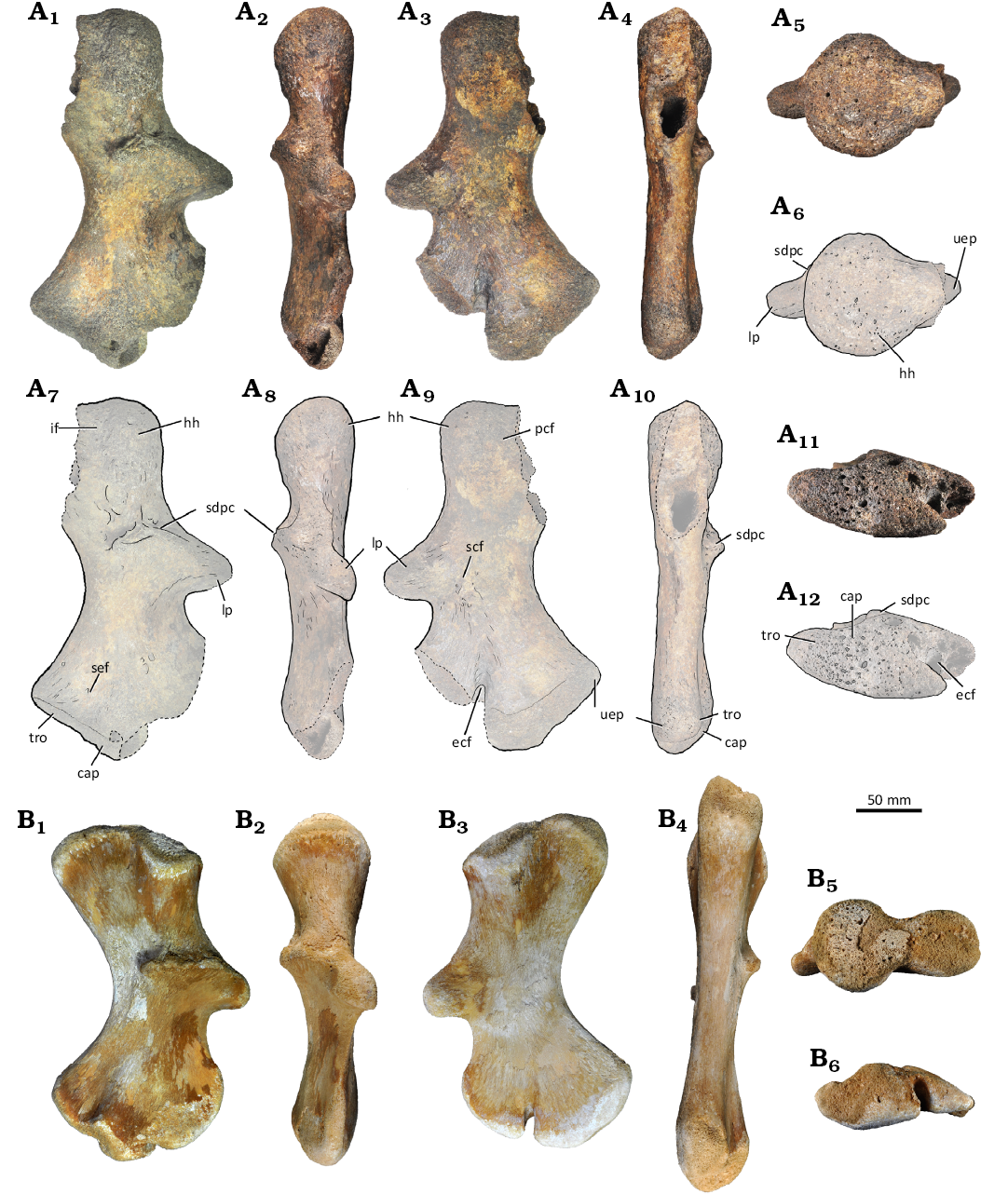
Fig. 1. Photographs and anatomical interpretations of the left humeri of fossil (A) and extant (B) leatherback turtle Dermochelys coriacea (Vandelli, 1761). A. NTUM-VP 250802, from the Pleistocene of Taiwan. B. NTUM-VP 2011301, from Yunlin, Taiwan. Intertubercular (A1, A7, B1), radial (A2, A8, B2), capitular (A3, A9, B3), ulnar (A4, A10, B4), proximal (A5, A6, B5) and distal (A11, A12, B6) views. Abbreviations: cap, capitellum; ecf, ectepicondylar foramen; hh, humeral head; if, intertubercular fossa; lp, lateral process; pcf, paracondylar fossa; scf, subcapitular fossa; sdpc, secondary deltopectoral crest; sef, supraepicondylar fossa; tro, trochlea; uep, ulnar epicondyle.
The morphology of the fossil NTUM-VP 250802 shows a close match to extant Dermochelys coriacea, but three morphological differences are identified. First, NTUM-VP 250802 shows a well-developed condition for the humeral head, ulnar epicondyle, and lateral process (Fig. 1), and this likely indicates that NTUM-VP 250802 belongs to a physically mature and large individual (see Hermanson et al. 2024: fig. 18). Second, the distal portion of NTUM-VP 250802 is slightly wider than the proximal portion while both measurements in extant Dermochelys coriacea (NTUM-VP 2011301, subadult individual) are almost the same (SOM 1: table S1), and this may result from intraspecific variation or even ontogenetic variation. Third, the ridge and fossae between the humeral head and secondary deltopectoral crest in the intertubercular view shows a mild ridge in extant Dermochelys coriacea, but this feature is prominent in NTUM-VP 250802 (SOM 1: fig. S3), and we consider that this morphological difference also results from intraspecific variation or ontogenetic variation. Given the overall similarity between NTUM-VP 250802 and extant Dermochelys coriacea, we conclude and identify NTUM-VP 250802 as an adult Dermochelys coriacea. Further, NTUM-VP 250802 shows a ridge and three fossae on the intertubercular side of the proximal portion, and this feature seems to only occur in female Dermochelys coriacea (SOM 1: fig. S4). If this interpretation is correct, NTUM-VP 250802 may represent a female individual.
Stratigraphic and geographic range.—NTUM-VP 250802 represents the only known fossil record of the extant Dermochelys coriacea from the Pleistocene of Taiwan (the western North Pacific). The extant Dermochelys coriacea has a cosmopolitan distribution, which is the most widespread among all the sea turtles.
Concluding remarks
NTUM-VP 250802, from the Pleistocene of Taiwan, shows a morphological combination that closely resembles extant Dermochelys coriacea and then represents the first confirmed fossil specimen of this living turtle species worldwide. The Taiwan Strait (at the boundary of tropical and subtropical waters) is far from the mating or nesting ground of extant Dermochelys coriacea but this area is part of the route to the foraging ground of the western Pacific population (Benson et al. 2011; TTWG 2025). This population of extant Dermochelys coriacea has experienced a dramatic decline, in contrast to the Atlantic population (Spotila et al. 2000; Tapilatu et al. 2013; Colman et al. 2019). During the Pleistocene glaciations, the topography along the western North Pacific should have been much different from the Present due to the sea level fluctuations (see Geological setting). Our discovery of the Pleistocene Dermochelys coriacea from Taiwan likely suggest that Dermochelys coriacea had been foraging along the coastal region of western North Pacific since Pleistocene, and future discoveries of Pleistocene Dermochelys coriacea should help to test this hypothesis.
According to molecular inferences, the global populations of Dermochelys coriacea likely dispersed from the Indo-Pacific Ocean within the past one million years during the Pleistocene (Dutton et al. 1999; Dutton and Shanker 2015). Our discovery of a Pleistocene Dermochelys coriacea from the western North Pacific (Taiwan) seems to support this radiation hypothesis. The distribution of extant Dermochelys coriacea ranges across the global oceans, but the Pleistocene fossil record was zero until this discovery from Taiwan (Frazier et al. 2018: supplemental information 2). The lack of Pleistocene fossils may in part result from the unusual morphology of extant Dermochelys coriacea, including the absence of a bony shell and keratinous scutes, as well as extremely reduced carapacial and plastral bones (Pritchard 2007). An additional key factor likely includes the scarcity of Pleistocene marine deposits worldwide. Pleistocene marine deposits in Taiwan are abundant, and recent progress (including this study) has uncovered more vertebrate fossils to reveal the previously unknown history along the western North Pacific (e.g., Tsai and Chang 2019; Liaw et al. 2025; Sun et al. 2026). Our discovery of the first fossil Dermochelys coriacea from the western North Pacific should then encourage more discoveries and in-depth analyses to understand the faunal turnover and evolution from the Pleistocene to the Present.
Authors’ contributions.—YLL and CHT contributed equally to this study: conceived and designed the research; collected and analysed the sea turtle data; discussed, wrote, and reviewed the manuscript, and approved the final submission.
Acknowledgements.—We thank Li-Ren Hou (Tainan, Taiwan) for collecting and donating the original fossil material (now known as NTUM-VP 250802) to CHT for permanent curation and research; I-Lin Lu (Taichung, Taiwan) and his 3D company for generating the 3D model; Chuan-I Lin (National Center for Instrumentation Research, Hsinchu, Taiwan) for the assistance in computer tomography scan; Hsiang-Hsia Kuo (Taiwan Cetacean Society, New Taipei, Taiwan), Tsung-Hsien Li (NMMBA), Po-Yu Wu (NMMBA), Yu-Hsuan Pan (Ching Yu Lung Ecology Company, New Taipei, Taiwan) and Yu-Feng Lin (NTU) for the assistance on collecting the extant sea turtle specimens; Chen-Yi Wu (NMMST), Li-Shu Chen (NMMST), Ren Hirayama (Waseda University, Tokyo, Japan), Tzu-Yun Chin (NMMST) for helping to examine the Dermochelys coriacea specimens; Adam Clause, Bradford D. Hollingsworth, Kesler Randall, Thomas Deméré (all SDNHM) for helping us to examine the fossil and extant dermochelyid specimens curated at the San Diego Natural History Museum. Reviewers Andrew Gentry (Learning Campus, Alabama, USA) and Evangelos Vlachos (CONICET and Museo Paleontológico Egidio Feruglio) are thanked for constructive comments; the editors Daniel Barta and Aleksandra Szmielew for handling this manuscript. This research was supported by the public donations to the Laboratory of Evolution and Diversity of Fossil Vertebrates, National Taiwan University (NTU FD107028) to CHT.
Ethics approval and consent to participate.—All the procedures for the extant leatherback sea turtle follow the Wild Conservation Act 2013 in Taiwan, with the consent of Yunlin County Government and Taipei City Animal Protection Office (No. 1092532087 and 1146013306). No animals were harmed in this study.
Editor: Daniel E. Barta
References
Bona, P., Sterli, J., Olivero, E., Fernández, M.S., and Reguero, M.A. 2024. The first record of dermochelyid turtles in the Eocene of Tierra del Fuego: new insights on the evolution of the Weddellian faunas. Advances in Polar Science 35: 63–77.
Batsch, A.J.G.C. 1788. Versuch einer Anleitung zur Kenntniss und Geschichte der Thiere und Mineralien. Erster Theil. Allgemeine Geschichte der Natur; besondre der Säugthiere, Vögel, Amphibien und Fische. 528 pp. Akademische Buchhandlung, Jena.
Baur, G. 1888. Osteologische Notizen über Reptilien. Fortsetzung III. Zoologischer Anzeiger 11 (285): 417–424.
Benson, S.R., Eguchi, T., Foley, D.G., Forney, K.A., Bailey, H., Hitipeuw, C., Samber, B.P., Tapilatu, R.F., Rei, V., Ramohia, P., Pita, J., and Dutton, P.H. 2011. Large‐scale movements and high‐use areas of western Pacific leatherback turtles. Dermochelys coriacea. Ecosphere 2 (7): 1–27. Crossref
Biswas, D.S., Banerjee, Y., Baker, D., Chang, C.-H., and Tsai, C.-H. 2025. A glimpse into a vanished ecosystem: reconstructing diet and palaeoenvironment of Palaeoloxodon from the Pleistocene of Taiwan. Royal Society Open Science 12 (11): 250935. Crossref
Blainville, H. de 1816. Prodrome d’une nouvelle distribution systématique du règne animal. Bulletin des Sciences par la Société Philomatique de Paris 1816: 105–112, 121–124.
Colman, L.P., Thomé, J.C., Almeida, A.D.P., Baptistotte, C., Barata, P.C., Broderick, A.C., Ribeiro, F.A., Vila-Verde, L., and Godley, B.J. 2019. Thirty years of leatherback turtle Dermochelys coriacea nesting in Espírito Santo, Brazil, 1988–2017: reproductive biology and conservation. Endangered Species Research 39: 147–158. Crossref
Cope, E.D. 1868. On the origin of genera. Proceedings of the Academy of Natural Sciences, Philadelphia 20: 242–300.
Dodge, K.L., Galuardi, B., Miller, T.J., and Lutcavage, M.E. 2014. Leatherback turtle movements, dive behavior, and habitat characteristics in ecoregions of the Northwest Atlantic Ocean. PLoS One 9 (3): e91726. Crossref
Dutton, P.H., Bowen, B.W., Owens, D.W., Barragan, A., and Davis, S.K. 1999. Global phylogeography of the leatherback turtle (Dermochelys coriacea). Journal of Zoology 248: 397–409. Crossref
Dutton, P.H. and Shanker, K. 2015. Phylogeny, phylogeography, and populations of the leatherback turtle. In: J.R. Spotila and P.S. Tomillo (eds.), The Leatherback Turtle: Biology and Conservation, 8–20. Johns Hopkins University Press, Baltimore.
Eckert, K.L., Wallace, B.P., Frazier, J.G., Eckert, S.A., and Pritchard, P.C.H. 2012. Synopsis of the Biological Data on the Leatherback Sea Turtle (Dermochelys coriacea). 160 pp. U.S. Department of Interior, Fish and Wildlife Service, Biological Technical Publication BTP-R4015-2012, Washington, D.C.
Frazier, J.G., Azzarà, V., Munoz, O., Marcucci, L.G., Badel, E., Genchi, F., Cattani, M., Tosi, M., and Delfino, M. 2018. Remains of Leatherback turtles, Dermochelys coriacea, at Mid-Late Holocene archaeological sites in coastal Oman: clues of past worlds. PeerJ 6: e6123. Crossref
Gentry, A.D., Burns, M.E., Ebersole, J.A., Gregson, K.A., Martinez, E.C., and Parham, J.F. 2025. A new leatherback marine turtle from the lower Oligocene of North America and a phylogenetic nomenclature for Dermochelyidae. Palaeodiversity 18: 127–149. Crossref
Girondot, M. 2015. Leatherback turtle populations in the Atlantic Ocean. In: J.R. Spotila and P.S. Tomillo (eds.), The Leatherback Turtle: Biology and Conservation, 99–111. Johns Hopkins University Press, Baltimore.
Hermanson, G., Arnal, F.A., Szczygielski, T., and Evers, S.W. 2024. A systematic comparative description of extant turtle humeri, with comments on humerus disparity and evolution based on fossil comparisons. The Anatomical Record 307: 3437–3505. Crossref
Karl, H.V. and Tichy, G. 2007. Maorichelys wiffeni n. gen. n. sp., a new sea turtle from the Eocene of New Zealand (Chelonii: Dermochelyidae). Studia Geologica Salmanticensia 43: 11–24.
Köhler, R. 1996. Eocene Turtles and Whales from New Zealand. xv + 359 pp. University of Otago. [available online: https://ourarchive.otago.ac.nz/esploro/outputs/doctoral/Eocene-turtles-and-whales-from-New/9926479960701891#file-0]
Liaw, Y.-L., Chuang, C.-K., and Tsai, C.-H. 2025. The first fossil loggerhead sea turtle (Cheloniidae: Caretta) from the North Pacific and its nannofossil biostratigraphy. Swiss Journal of Palaeontology 144: 42. Crossref
Liaw, Y.-L. and Tsai, C.-H. 2023. Taxonomic revision of Chinemys pani (Testudines: Geoemydidae) from the Pleistocene of Taiwan and its implications of conservation paleobiology. The Anatomical Record 306: 1501–1507. Crossref
Ludt, W.B. and Rocha, L.A. 2015. Shifting seas: The impacts of Pleistocene sea‐level fluctuations on the evolution of tropical marine taxa. Journal of Biogeography 42: 25–38. Crossref
Nielsen, E. 1963. On the post-cranial skeleton of Eosphargis breineri Nielsen. Bulletin of the Geological Society of Denmark 15: 281–328.
Oppel, M. 1811. Die Ordnungen, Familien und Gattungen der Reptilien als Prodrom einer Naturgeschichte derselben. 86 pp. J. Lindauer, München. Crossref
Pritchard, 2007. Evolution and structure of the turtle shell. In: J. Wyneken, M.H. Godfrey, and V. Bels (eds.), Biology of Turtles: From Structures to Strategies of Life (1st Edition), 45–83. CRC Press, Boca Raton. Crossref
Siddall, M., Rohling, E.J., Almogi-Labin, A., Hemleben, C., Meischner, D., Schmelzer, I., and Smeed, D.A. 2003. Sea-level fluctuations during the last glacial cycle. Nature 423: 853–858. Crossref
Spotila, J.R., Reina, R.D., Steyermark, A.C. Plotkin, P.T., and Paladino, F.V. 2000. Pacific leatherbacks turtles face extinction. Nature 405: 529–530. Crossref
Sterli, J., Vlachos, E., Cuitiño, J.I., Cerda, I.A., and Buono, M.R. 2025. Southernmost dermochelyid turtle from the Miocene. Ameghiniana 62: 240–258. Crossref
Sun, C. H., Biswas, D.S., Liaw, Y.L., Cho, Y. Y., Kohno, N., and Tsai, C.H. 2026. The southernmost Zalophus in the western North Pacific: The first pinniped (Carnivora, Pinnipedia) fossil from Taiwan. Journal of Vertebrate Paleontology 45 (6): e2634021. Crossref
Tapilatu, R.F., Dutton, P.H., Tiwari, M., Wibbels, T., Ferdinandus, H.V., Iwanggin, W.G., and Nugroho, B.H. 2013. Long‐term decline of the western Pacific leatherback, Dermochelys coriacea: a globally important sea turtle population. Ecosphere 4 (2): 1–15. Crossref
Tsai, C.-H. and Chang, C.-H. 2019. A right whale (Mysticeti, Balaenidae) from the Pleistocene of Taiwan. Zoological Letters 5 (1): 1–7. Crossref
Tsai, C.-H., Fordyce, R.E., Chang, C.-H., and Lin, L.-K. 2014. Quaternary fossil gray whales from Taiwan. Paleontological Research 18 (2): 82–93. Crossref
Tsutaya, T., Sawafuji, R., Taurozzi, A.J., Fagernäs, Z., Patramanis, I., Troché, G., Mackie, M., Gakuhari, T., Oota, H., Tsai, C.-H., Olsen, J.V., Kaifu, Y., Chang, C.-H., Cappellini, E., and Welker, F. 2025. A male Denisovan mandible from Pleistocene Taiwan. Science 388: 176–180. Crossref
TTWG [Turtle Taxonomy Working Group: Rhodin, A.G.J., Iverson, J.B., Fritz, U., Gallego-García, N., Georges, A., Shaffer, H.B., and van Dijk, P.P.]. 2025. Turtles of the World: Annotated Checklist and Atlas of Taxonomy, Synonymy, Distribution, and Conservation Status (10th Ed.). In: A.G.J. Rhodin, J.B. Iverson, P.P. van Dijk, C.B. Stanford, E.V. Goode, K.A. Buhlmann, and R.A. Mittermeier (eds.), Chelonian Research Monographs 10: 1–575.
Vandelli, D. 1761. Epistola de Holothurio, et Testudine coriacea ad celeberrimum Carolum Linnaeum equitem naturae curiosorum dioscoridem II. 12 pp. Patavius, Conzatti.
Voris, H.K. 2000. Maps of Pleistocene sea levels in southeast Asia: shorelines, river systems and time durations. Journal of Biogeography 27: 1153–1167. Crossref
Yi-Lu Liaw [liawlulu@gmail.com; ORCID: https://orcid.org/0009-0009-4363-7267 ], Department of Life Science, National Taiwan University, Taipei, 10617, Taiwan.
Cheng-Hsiu Tsai [whaletsai@ntu.edu.tw; craniata@gmail.com; ORCID: https://orcid.org/0000-0003-3617-366X ] (corresponding author), Department of Life Science and Institute of Ecology and Evolutionary Biology, National Taiwan University, Taipei, 10617, Taiwan.
Received 10 February 2026, accepted 27 March 2026, published online 17 June 2026.
Copyright © 2026 Y.-L. Liaw and C.-H. Tsai. This is an open-access article distributed under the terms of the Creative Commons Attribution License (for details please see http://creativecommons.org/licenses/by/4.0/), which permits unrestricted use, distribution, and reproduction in any medium, provided the original author and source are credited.
Acta Palaeontol. Pol. 71 (2): 267–271, 2026
https://doi.org/10.4202/app.01340.2026