
On the margins: exceptionally preserved small carbonaceous fossils (SCFs) from Silurian marginal marine strata of southern China
KAI WANG, BEN J. SLATER, XIAOLE ZHANG, PENG TANG, YI WANG, and HONGHE XU
Wang, K., Slater, B.J., Zhang, X., Tang, P., Wang, Y., and Xu, H. 2026. On the margins: exceptionally preserved small carbonaceous fossils (SCFs) from Silurian marginal marine strata of southern China. Acta Palaeontologica Polonica 71 (3): 605–617.
Small carbonaceous fossils (SCFs) have recently emerged as a novel means to track the evolution of non-mineralized animals throughout the early Palaeozoic. Currently however, records are largely concentrated in Cambrian-age strata, and little is known of the post-Cambrian extent of this style of preservation. Here, a previously unknown variety of SCFs are reported from shallow marine sediments of the Silurian (Ludlow to Pridoli) age Xiaoxi Formation, revealing exceptionally preserved microscopic anatomical remains of animals in what is otherwise a relatively unfossiliferous package of clastic rocks. Recovered SCFs encompass cuticular structures derived from eurypterid arthropods, including exquisitely preserved respiratory organs (kiemenplatten and lamellate book gills), sensory setae, fragments from other euarthropods, jaws of eunicid polychaete annelids (scolecodonts), a range of ornamented cuticles and spines of unknown affinity, and delicate protistan remains assigned to the possible euglenid Moyeria. Discovery of a range of animal-derived SCFs in the Xiaoxi Formation demonstrates that this style of fossil extraction and processing might be successfully developed and expanded into comparable upper Palaeozoic strata and deposits where the biota is similarly otherwise known only via trace fossil evidence. A concerted effort to expand this record has the potential to enrich our knowledge of otherwise poorly documented non-mineralized fossil taxa in shallow marine settings throughout the Palaeozoic.
Key words: Arthropoda, Eurypterida, Euglenida, Moyeria, scolecodonts, taphonomy, exceptional preservation, small carbonaceous fossils, Silurian, China.
Kai Wang [kaiwang@nigpas.ac.cn; ORCID: https://orcid.org/0000-0002-0346-050X], Xiaole Zhang [xlzh@nigpas.ac.cn; ORCID: https://orcid.org/0009-0006-7221-2979], Peng Tang [pengtang@nigpas.ac.cn; ORCID: https://orcid.org/0000-0002-2210-3751], Yi Wang [yiwang@nigpas.ac.cn; ORCID: https://orcid.org/0000-0002-6190-8691 ], and Honghe Xu [hhxu@nigpas.ac.cn; ORCID: https://orcid.org/0000-0002-7842-1468 ] (corresponding author), State Key Laboratory of Palaeobiology and Stratigraphy, Nanjing Institute of Geology and Palaeontology, Chinese Academy of Sciences, Nanjing 210008, China.
Ben J. Slater [ben.slater@geo.uu.se; ORCID: https://orcid.org/0000-0002-5774-9114 ] (corresponding author), Department of Earth Sciences, Palaeobiology, Uppsala University, 752 36 Uppsala, Sweden.
Received 11 February 2026, accepted 20 May 2026, published online 14 September 2026.
Copyright © 2026 K. Wang et al. This is an open-access article distributed under the terms of the Creative Commons Attribution License (for details please see http://creativecommons.org/licenses/by/4.0/), which permits unrestricted use, distribution, and reproduction in any medium, provided the original author and source are credited.
Introduction
Outside Lagerstätten, the bulk of the marine animal fossil record comes from conventional “shelly” fossils representing biomineralized organisms, or trace fossils which record animal behavior imparted in sediments. A third and increasingly explored source of information are so-called “small carbonaceous fossils” (SCFs) (Butterfield and Harvey 2012). These are the organically-preserved fragmentary remains of animals and other organisms, that can be extracted from siliciclastic sediments using gentle palynological processing. An advantage of SCFs is their capacity to reveal non-biomineralized elements of the fauna that are otherwise severely underrepresented in the wider fossil record.
To date, the focus of SCF research has primarily centred on tracking the earliest phases of animal evolution, and has therefore largely seen the targeting of Cambrian age sediments (ca. 538.8–458 Ma) or underlying Ediacaran strata (Slater and Bohlin 2022). A handful of studies have nevertheless successfully employed SCF-extraction techniques in younger Phanerozoic strata, notably from the Ordovician (e.g., Nowak et al. 2018; and more recently, exceptionally diverse SCF assemblages have been reported from the Ordovician (Tremadocian and Darriwilian) of North America; Mussini and Butterfield 2025), yet it remains unclear how stratigraphically extensive SCF preservation is, particularly in shallow-water nearshore depositional environments. Although organic fragments sourced from animals have long been noted in palynological studies of later Phanerozoic strata, for the most part these entail fortuitous and scattered recovery among preparations targeting more conventional microfossil groups (e.g., spores, pollen, dinoflagellates).
To test the stratigraphic continuity of this preservation style in younger Palaeozoic strata, we investigated SCF preservation in a late Silurian shallow-water deposit from southern China, the Xiaoxi Formation. To date, palynomorphs reported from the Xiaoxi assemblage include cuticle-like sheets possibly derived from land plants (Wang et al. 2023), smooth-walled tubes (Laevitubulus tenuis Burgess & Edwards, 1991), acritarchs (e.g., Veryhachium, Micrhystridium, and Domasia) (Wang and Zhang 1985; Wang et al. 2010, 2011), and biostratigraphically informative chitinozoans (e.g., Eisenackitina rimosa Umnova, 1976) (Geng et al. 1997). Processing here has further revealed a diverse assortment of exceptionally detailed fragments of non-mineralized metazoans. Significantly, this points to persistent SCF preservation throughout equivalent Palaeozoic strata, with important implications for enhancing our understanding of animal evolution in shallow marine settings.
Institutional abbreviations.— NIGPAS, CAS, Experimental Technologies Center of Nanjing Institute of Geology and Palaeontology, Chinese Academy of Sciences.
Geological setting
The Xiaoxi Formation (Ludlow–Pridoli, Silurian) is a ca. 3–360m-thick succession of clastic rocks, in unconformable contact with both the underlying Xiushan or Huixingshao formations (Telychian, Silurian) and overlying Yuntaiguan (Middle Devonian) or Liangshan (Lower Permian) formations (Wang et al. 2023). Deposited within the interior of the Yangtze Block, the Xiaoxi Formation has been well recorded from numerous well exposed outcrops in Guizhou, Chongqing, Hu’nan, Hubei, and Anhui provinces of southern China (Fig. 1). This formation mainly consists of yellow-green thinly layered silty shales with greyish-green fine-grained sandstone interlayers. Prominent sedimentary structures include ripple marks, ripple cross-lamination, hummocky cross-stratification and trace fossils, which occur throughout the formation (Wang et al. 2010; Zhang et al. 2024). The ichnofossils are diverse, and several taxa have been recognized, such as Cruziana, Dimorphichnus, Lockeia, Phycodes, Planolites, Ptychoplasma, Rusophycus, and Thalassinoides (Wang et al. 2024; Zhang et al. 2024). Among them, the most abundant is Thalassinoides, often ascribed to euarthropods such as decapod crustaceans (Knaust 2021; Zhang et al. 2024). Some eurypterid body fossils, such as Adelophthalmus cf. mansfieldi Hall, 1877, Parahughmilleria sp., Hughmilleria viriosa Lei, 2022, and Erettopterus sp., have also been reported from the Xiaoxi Formation (Lei 2022), along with occasional vertebrate fish remains (e.g., galeaspids belonging to the genus Dunyu) (Li et al. 2024). Recent studies on trace fossils and sedimentary fabrics of the Xiaoxi Formation have revealed a sequence from the lower offshore to middle shoreface, associated with storm activity (Zhang et al. 2024). In addition, previous palaeobotanical and palynological studies have produced abundant nematophyte body fossils (Prototaxites? sp.), cuticle-like sheets (resembling categories 1–3 in the scheme of Edwards 1982), and tubular palynomorphs that can be assigned to the Laevitubulus–Porcatitubulus–Constrictitubulus association (Wang et al. 2010, 2011, 2017, 2023), indicating significant terrestrial input. Collectively, the Xiaoxi Formation represents deposits formed in shallow marine settings above the storm wave base, with inputs of terrestrial organic matter (Wang et al. 2011, 2023). A late Silurian age for the Xiaoxi Formation has previously been suggested based on its relationship to adjacent, overlying and underlying strata, and on biostratigraphic grounds (Wang et al. 2010). The corresponding adjacent Chejiaba Formation has notably been constrained to a late Ludlow age using conodonts (e.g., Ozarkodina snajdri Walliser, 1964, and Ozarkodina crispa Walliser, 1964) (Tang et al. 2010). In particular, chitinozoans reported from the Xiaoxi Formation (e.g., Eisenackitina rimosa) are strongly suggestive of a late Silurian age (Geng et al. 1997), as are reports of vertebrate fish assignable to late Silurian taxa from the Galeaspida (e.g., Li et al. 2024), along with the presence of distinctive cuticle-like sheets recovered among the palynomorph assemblage that are elsewhere known only from strata of late Ludlow to early Pridoli age (Wang et al. 2010, 2011, 2017).
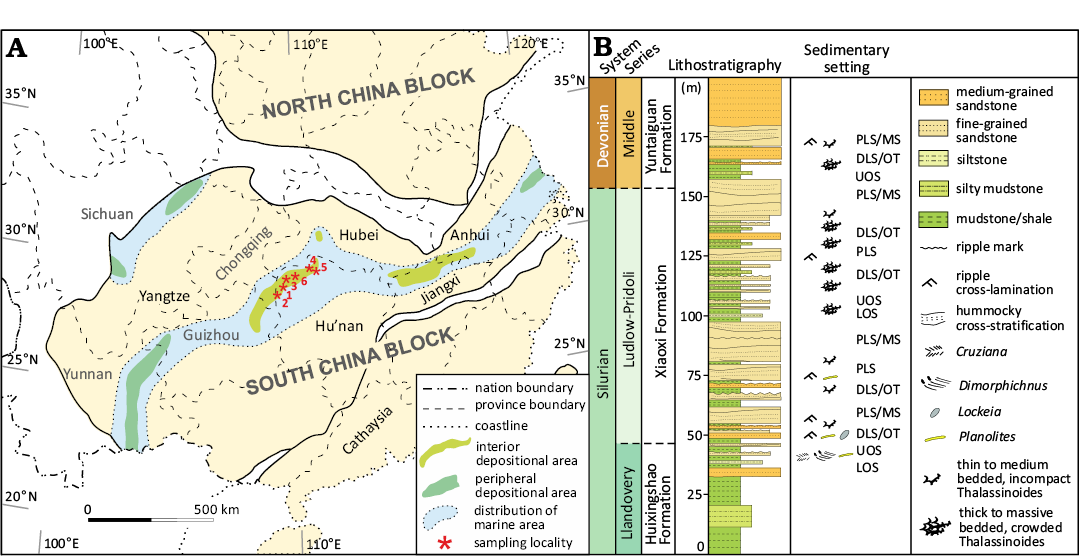
Fig. 1. Geological information. A. Distribution of the upper Silurian and sampling localities (after Wang et al. 2023). Outcrop sections: 1, Yayu; 2, Kapeng Reservoir; 3, Malao; 4, Shizinao; 5, Fengheshan; 6, Tongchaku. The light-yellow shaded areas denote the major tectonic blocks. B. Stratigraphic division, lithology, and sedimentary setting of Xiaoxi Formation at type section Yutan Reservoir (after Zhang et al. 2024). DLS, distal lower shoreface; LOS, lower offshore; MS, middle shoreface; OT, offshore transition; PLS, proximal lower shoreface; UOS, upper offshore.
Material and methods
Ten samples of silty shales collected from the upper Silurian Xiaoxi Formation at six sections in southern China (Fig. 1; sample details in SOM: table S1, Supplementary Online Material available at http://app.pan.pl/SOM/app71-Wang_etal_SOM.pdf) were prepared using HCl-HF-HCl acid maceration (Wood et al. 1996) at the microfossil lab of NIGPAS, CAS. Microfossils were mounted in glycerol jelly and sealed with paraffin wax for examination with an Olympus BX53 light microscope. Figured specimens are located on slides using England Finder (EF) Coordinates and stored at NIGPAS, CAS. The slide numbers and EF coordinates for each of the specimens are provided in SOM: table S2 (material mounted on 15 slides, with repository numbers: SZXL-1-1–5, 45, 76; SZXL-2-1, 2; HBKP-3-1–3; HBKP-10-1, 2; LSLM-S-3).
Results
Extraction recovered hundreds of well-preserved organic microfossils. Among the recovered microfossils were previously detected non-animal cuticle-like sheets, tubular palynomorphs (e.g., Laevitubulus), and acritarchs, with newly detected animal-derived components being present as a comparatively less numerous subset of the assemblage. Also detected in this assemblage were dispersed plant spores, for which a specialised investigation is underway. The focus here is on metazoan remains, alongside possible protistan fossils, delineated into the following categories.
Kiemenplatten.—Among the recovered SCFs are a distinct set of isolated cuticular fragments sharing a characteristic hexagonal microstructure (Fig. 2A–G, O). In specimens with intact tips, these cuticles terminate in a sclerotized and optically-dense spine tapering to an acute point (10–27 μm length, x̄ = 15.8 μm, n = 5; 3.3–14.6 μm basal width, x̄ = 6.6 μm, n = 5: Fig. 2A–D). Examination of the margins (Fig. 2A, D, G) reveals the hexagonal ornament is composed of triradial projections or columns that interlock to form the characteristic hexagonal pattern (3.5–13 μm in diameter, x̄ = 7.1 μm, n = 69).
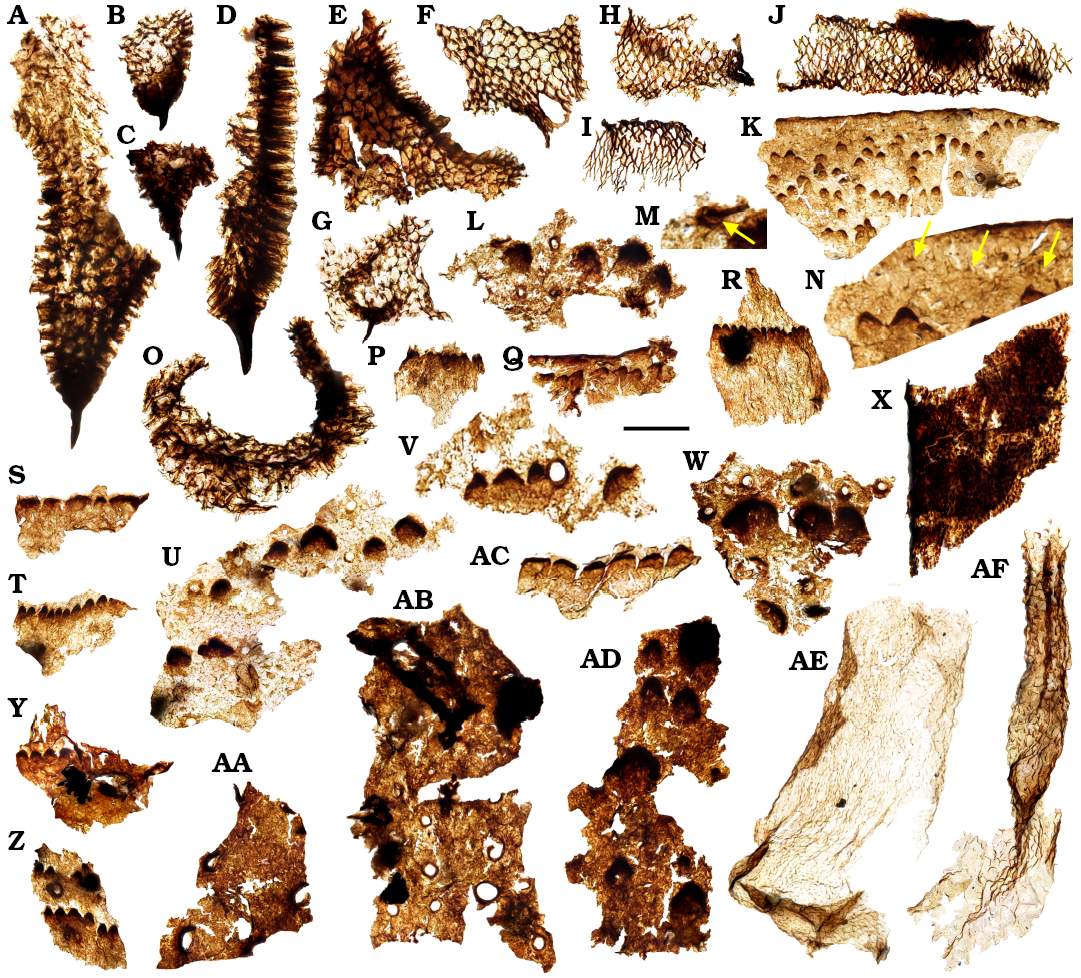
Fig. 2. SCFs from the Silurian Xiaoxi Formation of Hu’nan, southern China. A–G, O. Kiemenplatten (eurypterid respiratory organs). H–J. Lamellate book gills? K–N, P–AF. Ornamented cuticles. M, close up of L, showing truncated seta attached to circular perforation (yellow arrow); N close up of K, detailing minute cuticular spines (yellow arrows). Scale bar: A–L, O–AF, 50 μm; M, N, 20 μm. Repository numbers provided in SOM: table 2.
These distinctive SCFs are identifiable as eurypterid respiratory organs known as “kiemenplatten” (Manning and Dunlop 1995). Such structures described as “gill-tracts” or “spinules” are found in situ on eurypterid macrofossils (Wills 1965), and have since been identified among acid-isolated fragments from several Palaeozoic deposits including the Ludlow, upper Silurian of Canada (McGregor and Narbonne 1978), Pridoli, upper Silurian of Shropshire, UK (Manning and Dunlop 1995), Lower Devonian of Ukraine (Filipiak et al. 2012) and Poland (Filipiak and Zatoń 2011; Filipiak et al. 2022; Kondas et al. 2025). Eurypterid kiemenplatten have also recently been detected among SCFs from the lower Osterberg biota of North Dakota (Mussini and Butterfield 2025) alongside a range of eurypterid cuticular fragments, extending the record of this clade back to the Tremadocian within the lowermost Ordovician (though fragmentary bedding-plane eurypterid remains have now also recently been reported among bedding-plane macrofossils from the upper Tremadocian, Ordovician, Fezouata Lagerstätten of Morocco; Van Roy et al. 2025).
Lamellate book gills?—Several recovered SCFs occur as bi-layered sheets bearing diamond-shaped reticulation (2.2–6.8 μm in diameter, x̄ = 4.6 μm, n = 31; Fig. 2H–J). Ribs forming the reticulation are 0.9–3.6 μm wide (x̄ = 1.5 μm, n = 29) and are developed on a thin underlying cuticle (clearest in Fig. 2H). One relatively large specimen suggests these sheets were broadly rectangular in overall shape (Fig. 2J).
This morphology is reminiscent of lamellate book gills described from the Pridoli, upper Silurian of UK (Manning and Dunlop 1995), though in the latter ribs are near-parallel and irregularly connected by narrow cross-bars. Such book gills are also reported from articulated eurypterid macrofossils (Braddy et al. 1999).
Ornamented cuticles.—Xiaoxi SCFs also include ornamented cuticles covered with short blunt cones (5–33 μm at basal width, x̄ = 12 μm, n = 58; Fig. 2K–N, P–W, Y, Z, AD) or crescent-shaped structures (2–7 μm at basal width, x̄ = 4 μm, n = 37; Fig. 2X, AE, AF).
Comparisons can be drawn with similarly ornamented eurypterid and/or scorpion cuticle reported among acid-macerals elsewhere, for instance the Lower Devonian of Poland (Filipiak et al. 2022) and Egypt (Makled et al. 2021). The short cones covering the Xiaoxi Formation specimens are also reminiscent of those adorning the surface of known eurypterid taxa, for example, from the mesosomal and metasomal tergites of the Ordovician Pentecopterus decorahensis Lamsdell et al., 2015, of the Winneshiek Lagerstätten (Iowa), which exhibits similar rows of sub-rounded scale ornamentation (Lamsdell et al. 2015).
A subset of these SCF cuticles bear distinct elliptical-circular perforations or lacunae (4.5–16 μm diameter, x̄ = 7 μm, n = 16; Fig. 2L, U, W, AA, prominent in Fig. 2AB). Such cuticles are known from several Devonian deposits, and typically ascribed to eurypterids (Filipiak and Zatoń 2011; Filipiak et al. 2012, 2022; Makled et al. 2021).
Setae-bearing cuticles.—Some cuticular SCFs in the Xiaoxi assemblage can be discerned by a densely-distributed covering of fine setae (5.5–14.6 μm length, x̄ = 10.2 μm, n = 23; 0.75–3.1 μm basal width, x̄ = 1.4 μm, n = 39; Fig. 3C, E, I, M, N).
Cuticles bearing similar fine setae are figured among younger acid-isolated fragments from the Emsian, lower Devonian of Poland (Filipiak and Zatoń 2011; Filipiak et al. 2022) and the upper Devonian Ora Formation of Iraq, where they are attributed to eurypterids, though the latter possess somewhat stouter setae (Makled et al. 2025).
Sclerotized spines.—Among the various spinose SCFs detected here are a subset of robust sclerotized spines with an ovoid basal opening (39–141 μm length, x̄ = 81 μm, n = 10; 10–38 μm basal width, x̄ = 20.4 μm, n = 9; Fig. 3H, J, L) found in clusters of 3–6 individual spines connected by a basal cuticle. Adjacent spines tend to increase in length sequentially in one direction (Fig. 3H).
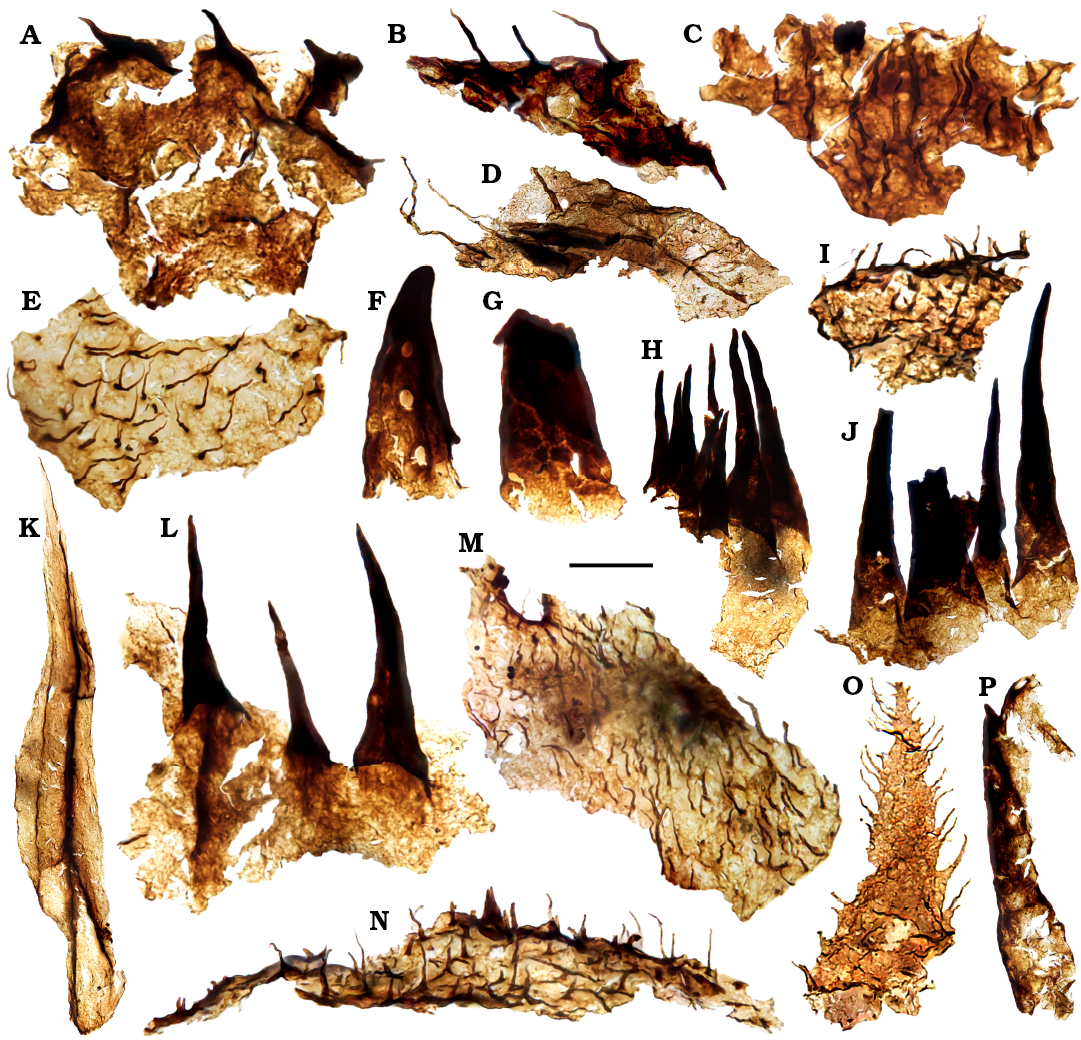
Fig. 3. SCFs from the Silurian Xiaoxi Formation of Hu’nan, southern China. A, H, J, L. Sclerotized spines. B–E, I, M, N. Setae-bearing cuticles. F, G, K. Spines. O. Fragment with symmetrical marginal spines. P. Unidentified fragment. Scale bar B, D, H, J, K, P 40 μm; A, C, E–G, I, L–O 20 μm. Repository numbers provided in SOM: table 2.
Comparable SCF sclerotized spines have been reported from younger Palaeozoic deposits, including the Emsian, Lower Devonian of Poland (Filipiak et al. 2022; Filipiak and Zatoń 2011), and Lower Devonian of Podolia, Ukraine (Filipiak et al. 2012). Elongate spines of a similar construction have also been detected in the Lower Devonian of Egypt (Makled et al. 2021) where they are again attributed to eurypterids. More broadly, SCF spines of a similar type are found in anatomical connection with arthropod cuticles exhibiting perforations or lacunae in various Cambrian deposits (e.g., Harvey and Butterfield 2022), and in association with acid-extracted phyllocarid crustacean cuticle directly macerated from macrofossil specimens found in Ordovician and Silurian strata of the Czech Republic (Kovář et al. 2024). The presence of comparable spines among a phylogenetically diverse array of clades suggests that such spines/cuticles could in principle be sourced from a wide variety of euarthropods.
Arthropod tactile setae.—A further distinct SCF morphotype recovered here comprise elongate ribbon-like shafts (70–395 μm length, n = 15; 4.6–18.4 μm maximum width, x̄ = 9.8 μm, n = 15) with margins fringed by densely packed spinose ornament oriented toward the apical portion (Fig. 4). The distal tip is often missing, but where intact appears as either a tapering point lacking fringing ornamentation (Fig. 4C, J, M), or as a second morphotype that terminates in a blunt rectangular truncation with spinose ornamentation identical to that fringing the shaft (Fig. 4H). The basal portion of these ribbon-like spinose shafts is frequently broken, but where complete is unornamented, and tapers to a constricted portion approximately a half to quarter the width of the main shaft (Fig. 4O). In one specimen, the density of spinose ornamentation is markedly sparser along the entire length (Fig. 4F).
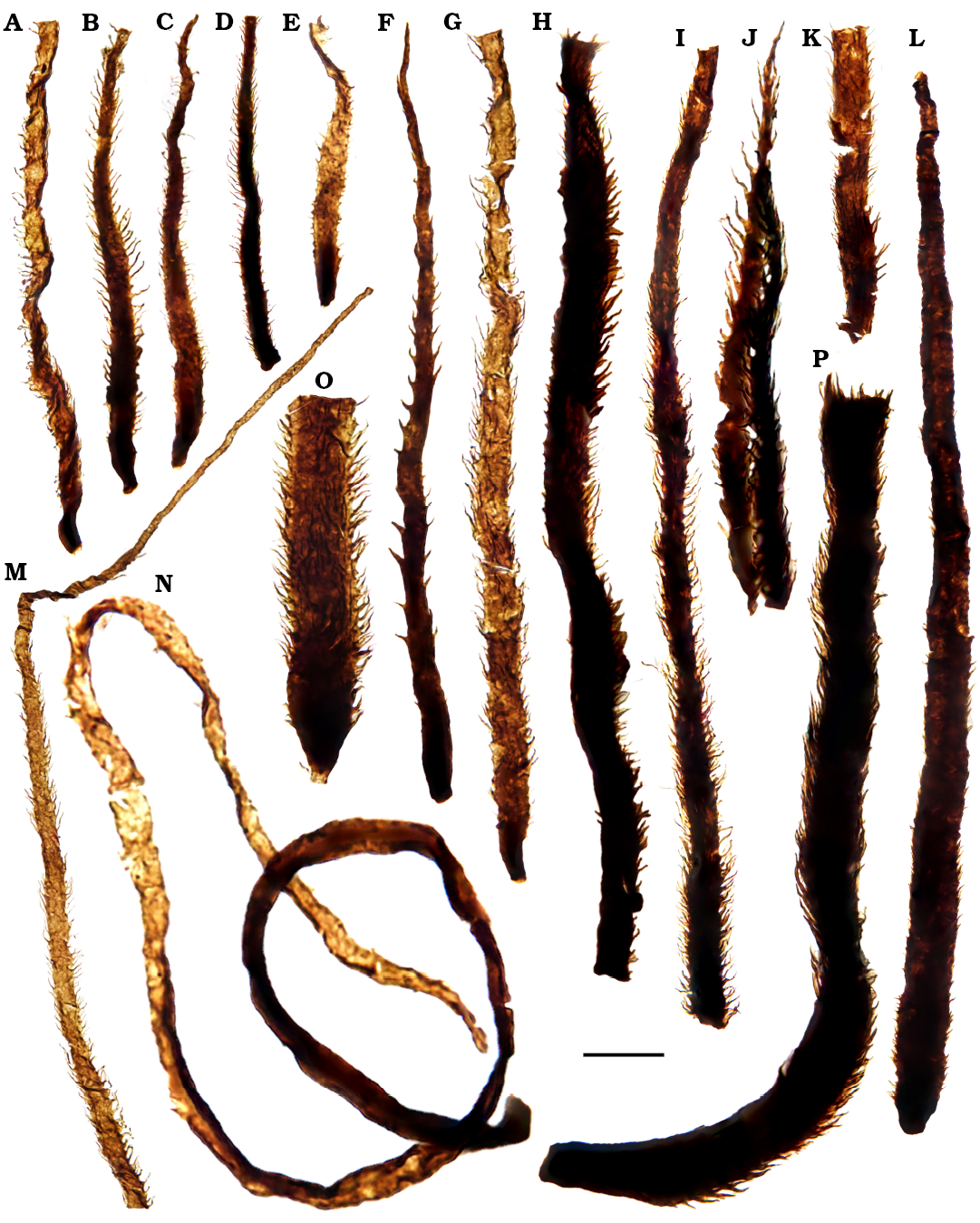
Fig. 4. SCFs likely representing arthropod sensory setae from the Silurian Xiaoxi Formation of Hu’nan, southern China. Scale bars: D, K, L, 30 μm; A, I, M, 25 μm; B, C, E–H, J, O, P, 20 μm; N, 10 μm. Repository numbers provided in SOM: table 2.
These SCFs find their closest comparison with fragmentary “seta-like structures” previously described from the early Silurian Tuscarora Formation of Pennsylvania (Gray and Shear 1992). Gray and Boucot (1994) note these fragments are particularly reminiscent of the bipectinate tactile sensory setae possessed by a range of arthropods.
Scolecodonts (jaws of polychaete annelids).—Organically preserved scolecodonts (i.e., the disarticulated jaws of polychaete annelids) recovered among the Xiaoxi SCFs are represented by several maxillary elements that share similar morphological characters (Fig. 5). They are bluntly rounded at the anterior part and distinctly tapered at the posterior portion (46–74 μm length, x̄ = 63.4 μm, n = 8; 20–32 μm maximum width, x̄ = 25.3 μm, n = 7). Myocoeles are visible, with the opening measuring two-thirds of the jaw in length. Approximately 8–10 denticles are arranged along the margin, showing a decrease in size toward the posterior part of the jaw.
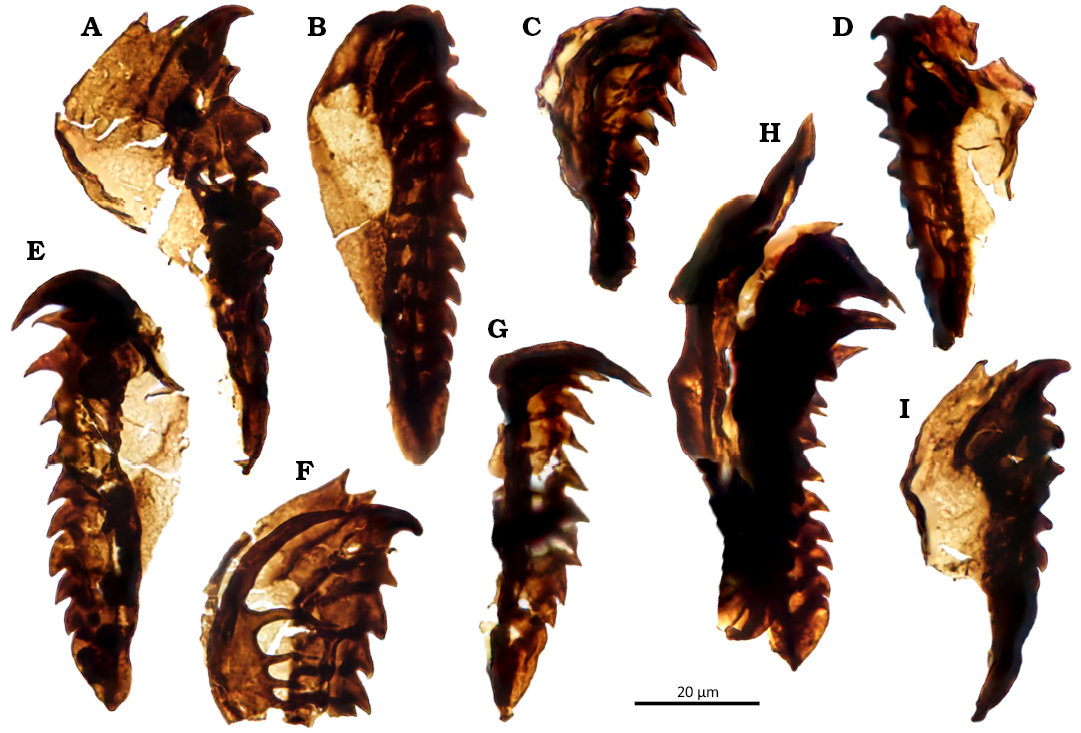
Fig. 5. Scolecodonts (jaws of eunicid polychaete annelids) from the Silurian Xiaoxi Formation of Hu’nan, southern China. Oenonites-like specimens. A. Right MI? B. Left MI? C. Left MII with its anterior part broken. D. Right MI? with its anterior part broken. E. Left MI in ventral view. F. Scolecodonta indet. G. A specimen with its myocoele opening broken. H. Left MI in dorsal view. I. Left MI in dorsal view. Scale bar 20 μm. Repository numbers provided in SOM: table 2.
Occurrences of scolecodonts in coeval rocks of China are known from the Yanglugou Formation of the western Qinling Mountains (Ye 1994) and the Miaogao Formation of Yunnan (Gao et al. 2025). In comparison to these previously reports, the Xiaoxi scolecodonts are of a much smaller size. Although certain forms in the Yanglugou Formation (e.g., Anisocerasites cheles Ye, 1994, and Lunoprionella lepida Ye, 1994) are less than 60 μm in length, they are either morphologically distinctly different from the Xiaoxi specimens, or they are poorly preserved, hampering any detailed comparison. Scolecodonts recovered here from the Xiaoxi Formation bear a close resemblance to known some known species of Oenonites (Polychaetaspidae), as exemplified by those from the lower Silurian of Gotland, Sweden (Eriksson 1997). Especially noteworthy is a specimen identified as a possible Oenonites from the Devonian (Eifelian) of Egypt, which exhibits an overall similar morphology to the Xiaoxi scolecodonts, except for being only slightly larger in size (108 μm in length) (El Shamma et al. 2019: pl. 1: 2).
Possible euglenids (flagellate eukaryotes).—Alongside the diverse range of animal-derived SCFs, processing of the Xiaoxi Formation material also recovered a distinctive set of ovoid vesicular fossils of probable protistan origin (Fig. 6), which were among the more common elements of the recovered assemblage. These specimens are united by their characteristic wall architecture, comprising a set of parallel striae that are arranged in a helical construction, where the striae converge at opposing apical poles (Fig. 6). These features identify these fossils as the taxon Moyeria (Thusu 1973; Gray and Boucot 1989; Strother et al. 2020, 2025), and specifically Moyeria cabottii (Cramer) Miller & Eames (Miller and Eames 1982), based on the manner in which the pellicle strips form a crenelated margin to the overall vesicle (Strother et al. 2025). Moyeria is a former “acritarch” known from mid-Ordovician through Silurian strata, that has since been suggested to represent the remains of eukaryotic flagellates assignable to the photosynthetic euglenids, based on their overall euglenid-like construction (Gray and Boucot 1989) and diagnostic pellicle ultrastructure (Strother et al. 2020). Despite the compelling structural similarity between Moyeria and euglenids, it is nevertheless difficult to explain on taphonomic grounds how a flagellated protist like a euglenid would preserve as a robust organic-walled fossil (see discussion on the preservation potential of unwalled protists as carbonaceous microfossils in Butterfield 2003, 2015a, b; Slater et al. 2020; Slater and Bohlin 2022). Proteinaceous euglenid pellicles are notably more robust than other cellular components, and can be isolated for study, in at least one incidence, taxa that produce a lorica (e.g., Trachelomonas) have been shown to survive acetolysis (Lindgren 1981; Strother et al. 2020). Delicate structures are known to preserve as organic fossils via fusion or imprinting into extraneous organic material prior to degradation (e.g., Slater et al. 2020; Slater et al. 2022), including even ciliates (e.g., Bomfleur et al. 2012), yet it remains unresolved whether a euglenid pellicle would preserve among acid-extractable palynomorphs. Alternative comparisons for the affinities of Moyeria include the spirally ornamented oogonia of charophyte algae (e.g., Soulié-Märsche and García 2015). Among organic microfossils, Moyeria has been compared to acritarchs of the Mesoproterozoic Kaltasy Formation from the Volgo-Ural region of Russia (Sergeev et al. 2016: fig. 5.10–12), it also shares features with the late Palaeoproterozoic taxon Filinexum torsivum Riedman et al., 2023 (Riedman et al. 2023: fig. 5) which exhibits a similar spirally twisted wall construction, and can also be compared to a relatively large ovoid SCF from the Terreneuvian, Cambrian age Voosi Formation of Estonia (Slater et al. 2018: fig. 9a) which likewise displays a helical wall architecture.
The presence of Moyeria further points to a freshwater influence in the deposition of the Xiaoxi Formation, complementing the sedimentological evidence suggesting that the Xiaoxi Formation was deposited in a nearshore setting. Indeed, based on its known fossil occurrence being restricted to terrestrial and nearshore palaeoenvironments (Gray and Boucot 1989; Strother et al. 2025), the frequent occurrence of Moyeria in the Xiaoxi Formation is consistent with the interpretation that this SCF assemblage is influenced by a terrestrial input.
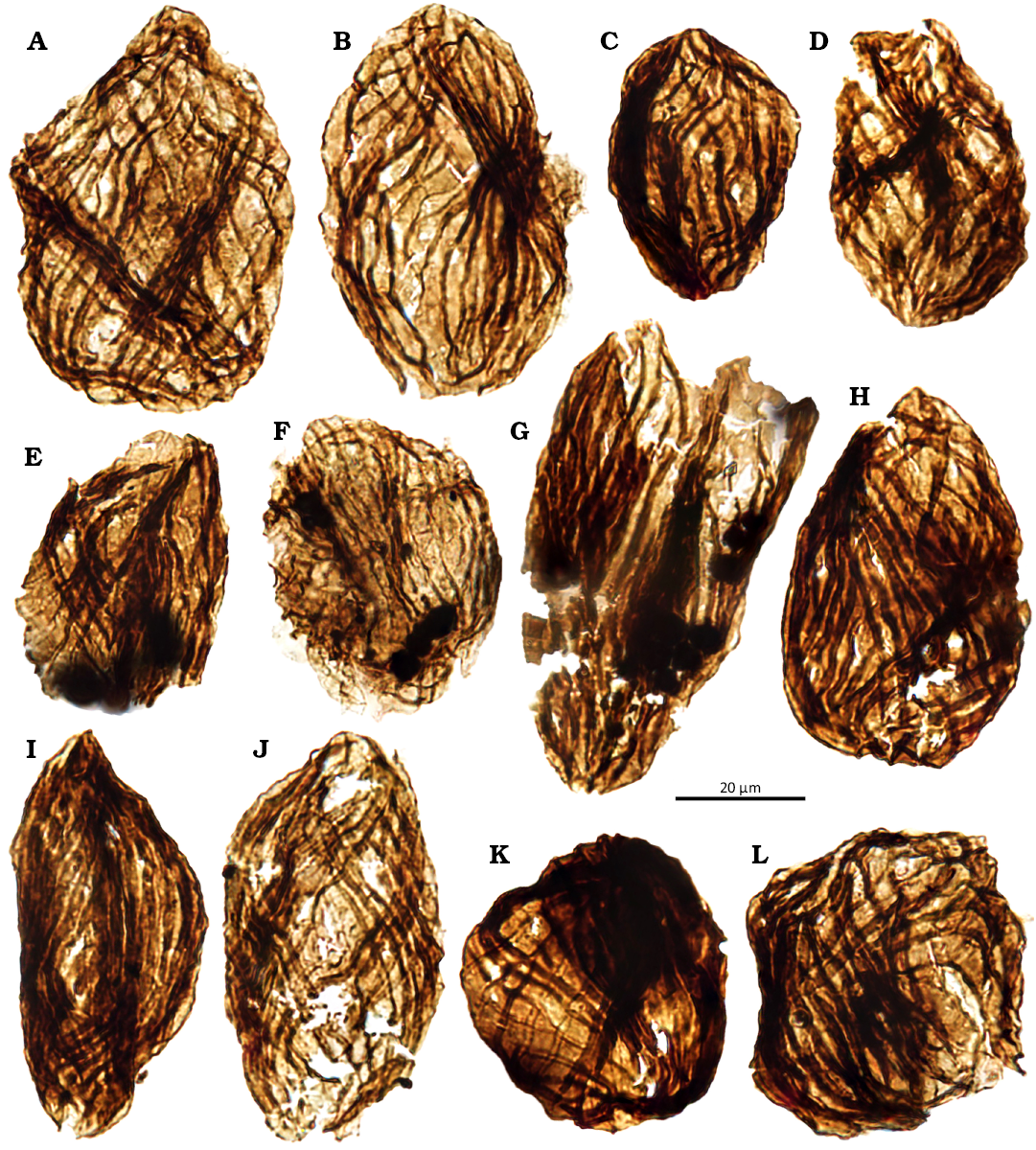
Fig. 6. Possible euglenid Moyeria cabottii (Cramer) Miller & Eames, from the Silurian Xiaoxi Formation of Hu’nan, southern China. Presence of well-preserved euglenids suggests significant terrestrial input for the Xiaoxi Formation. Scale bar 20 μm. Repository numbers provided in SOM: table 2.
Discussion
SCF sampling of shallow marine environments.—The fossil record is our primary resource for understanding ancient ecosystems. Fossilisation potential, however, varies widely across environments (Shaw et al. 2021), and is also strongly biased in favor of more easily preserved biomineralized organisms. SCFs can counter some of this bias by accessing novel data on non-mineralized animals from depositional environments not typically associated with the preservation of delicate non-mineralized taxa (such as shallow marine facies). The Xiaoxi Formation was deposited in a shallow marine setting (Wang et al. 2023). In shallow marine siliciclastic deposits of this kind, trace fossils are often the primary source of palaeobiological evidence. The Xiaoxi Formation is no exception, as evidenced by abundant arthropod traces such as Cruziana, Dimorphichnus, and Thalassinoides burrows (Zhang et al. 2024). It is plausible that eurypterid and other arthropod SCFs detected here from the Xiaoxi Formation may even be sourced from some of the taxa generating these traces (arthropod surface trackways). Outside trace fossils, SCFs are a novel way to acquire body-fossil information from otherwise poorly fossiliferous shallow marine sandstones, shales and mudrocks (Slater 2024) or even deposits with relatively rich shelly fossils. Indeed, it is to some extent rare to acquire body-fossil information in the same unit as trace fossils, and so SCFs are one means of bridging this gap, as has recently been demonstrated using SCFs in older shallow marine Cambrian deposits (Slater 2024; Mussini et al. 2025).
Moreover, an added benefit of targeting shallow marine deposits is that they have the advantage of sampling not only marine organisms, but also freshwater and terrestrial taxa that have been transported into littoral settings. This is particularly important since pre-Devonian terrestrial deposits (e.g., the Silurian Downton Castle Sandstone Formation, Jeram et al. 1990 and the littoral Burgsvik Sandstone, Smith and Butterfield 2013, which exhibits significant terrestrial input) remain comparatively rare. By the Silurian, terrestrial animals (primarily arthropods) begin to appear in the fossil record (Gray and Boucot 1994), and have been well documented occurring among organic microfossils in a select handful of terrestrial deposits (e.g., Jeram et al. 1990). SCF extraction from shallow marine deposits may therefore be considered an underexploited means of accessing a measure of terrestrial diversity, a property that may prove especially useful in regions and time windows where terrestrial deposits are lacking (or where dominated by poorly-fossiliferous red beds). Indeed, certain Xiaoxi Formation SCFs exhibit morphological adaptations to at least limited terrestrial excursions. Eurypterid respiratory organs for instance have been suggested to have served as air-breathing organs (Lamsdell et al. 2020). The hypothesized function of these structures being to retain water/moisture in order to facilitate respiration during temporary terrestrial activity (Manning and Dunlop 1995). In addition, a case can be made that the numerous arthropod sensory setae recovered here (Fig. 4) may even derive from terrestrial arthropods, notably such structures have previously only been found co-occurring with land plant spores and phytodebris (Gray and Shear 1992) indicating a potentially terrestrial origin. Frequently occurring nematophytes of Prototaxites? sp., as well as some cuticle-like sheets and tubes, have been reported from the Xiaoxi Formation (Wang et al. 2023). These fossils have been widely considered by palaeobotanists to originate from organisms inhabiting early terrestrial ecosystems (Edwards et al. 2013, 2018), though certain cuticular nematophytes have alternately been reconstructed as the remains of extinct rhodophytes (Smith and Butterfield 2013) and would therefore represent marine components found alongside terrestrial-derived spores and other phytodebris in Silurian marginal marine depositional settings. In this study, the case for a potential terrestrial/non-marine influence among the Xiaoxi SCF assemblage is further bolstered by the presence of abundant Moyeria. Indeed, if viewed as a photosynthetic euglenid (but keeping in mind the proviso that preservation of euglenids as organic microfossils has not yet been adequately explained) it is worth noting the overwhelmingly obligate freshwater (stenohaline) nature of extant euglenids (Gojdics 1953; Strother et al. 2020), offering a possible ecophysiological explanation for Moyeria being indicative of freshwater, and of a non-marine provenance (Gray and Boucot 1989; Strother et al. 2020).
The high quality of preservation among the Xiaoxi SCFs enables the resolution of fine-scale submicron anatomical details, and the study of semi-articulated clusters of spines and extensive portions of cuticle. In terms of taxonomy, the Xiaoxi SCFs are broadly comparable to other mid-Palaeozoic biotas where organic microfossils sourced from animals have been detected. Overall, the assemblage is predominantly composed of particularly recalcitrant organic structures that exhibit a somewhat lower threshold for preservation compared to the most delicate SCFs. These more robust structures include the cuticles of eurypterids and heavily sclerotized elements of the scolecodont jaw apparatus. In part, this may reflect the higher-energy depositional palaeoenvironment evident at the Xiaoxi Formation from the abundant ripple marks, ripple cross-laminations, and the presence of hummocky cross-stratification, attesting to substantial reworking of the sediments. However, the co-occurrence of intact elongate setae (Fig. 4), fragile Keimenplatten (Fig. 2A–G, O), a few weakly-sclerotized spines (e.g., Fig. 3O), and more extensive portions of cuticle show that SCF processing is also capable of capturing a broader array of more delicate animal structures even from such relatively higher-energy deposits.
Linking Early and Middle Palaeozoic SCF faunas.—Since there are relatively few reports or studies of SCFs from Silurian deposits when compared to younger Devonian and older Cambro-Ordovician rocks, the Silurian age of the Xiaoxi Formation is noteworthy. In part, this pattern mirrors the paucity of Silurian Lagerstätten noted in comparison to other periods of the Palaeozoic (Schiffbauer and Laflamme 2012). In Cambrian rocks, small organic fragments of animals constitute a relatively common component of palynological residues (Slater and Bohlin 2022). Recent increased attention toward Cambrian SCFs has helped expand the fossil records of a wide variety of metazoan groups, including the oldest occurrence data for multiple key clades (e.g. Chaetognatha, Annelida, Panarthropoda, stem-Crustacea, and Pterobranchia) (Slater 2025; Slater et al. 2018; Slater and Willman 2019; Palacios et al. 2018; Jankauskas et al. 1989; Harvey and Butterfield 2008; Harvey et al. 2012; Wallet et al. 2021; Kovář 2020; Kovář and Fatka 2025). Aside from scolecodonts (polychaete jaws), studies of Ordovician SCFs remain few, but are perhaps best represented by crustacean and chelicerate fragments of the Middle Ordovician Winneshiek Shale (Nowak et al. 2018), and the recently reported diverse SCF assemblages recovered from Cambro-Ordovician parts of the Deadwood Formation and Darriwilian age Winnipeg Formation of North Dakota (Mussini and Butterfield 2025). Reports from Silurian marine strata are arguably more limited still, consisting chiefly of rare eurypterid cuticles (e.g., Manning and Dunlop 1995), and a few crustacean derived fragments (Rolfe 1962; Kovář et al. 2024). The principal exception to this is perhaps the relatively diverse assemblage of terrestrially-sourced arthropod cuticles that have been extracted as organic remains from the Downton Castle Sandstone Formation at the base of the Pridoli at Ludlow Lane in Shropshire, UK (above the famous “Ludlow bone bed”; Jeram et al. 1990), a deposit that is more-or-less contemporaneous with that of the Xiaoxi assemblage recorded here (interestingly, both the Xiaoxi Formation and Ludlow Lane exhibit comparable sedimentology and depositional features, including an abundance of ripple marks, ripple cross-lamination, and hummocky cross-stratification). By contrast, reports from the Devonian are more extensive, where a number of groups, including eurypterids, arachnids, centipedes, and even insects are counted among organic microfossils (Shear et al. 1984, 1989; Labandeira et al. 1988; Makled et al. 2021; Filipiak et al. 2022). It is thus noteworthy that current Palaeozoic SCF records are not only temporally discontinuous but also represent two distinct locales of preservation, one restricted to marine deposits (Cambro-Ordovician) while younger Palaeozoic SCFs (Devonian) are chiefly derived from non-marine deposits. In this light, these newly detected Silurian SCFs bridge both a prominent stratigraphic gap, but also a major palaeoenvironmental divide by offering crucial insights into otherwise poorly understood Palaeozoic marginal marine faunas.
Conclusions
Processing for small carbonaceous fossils from the upper Silurian Xiaoxi Formation has yielded a rich assortment of exceptionally preserved metazoan remains, including eurypterid cuticles, respiratory organs (kiemenplatten), lamellate book gills, sensory setae, fragments from other euarthropods, scolecodonts, and a variety of unknown metazoans. Such fossils emphasize the largely untapped potential for SCFs in tracing macroevolutionary patterns among soft-bodied marine animals in post-Cambrian strata. In particular, the Xiaoxi Formation SCFs strongly suggest this style of preservation will become increasingly useful in capturing highly detailed remains of non-mineralized metazoans from Palaeozoic marginal marine settings, where Lagerstätten are lacking. Preservation of shallow water Silurian SCFs here is of particular significance, since only a limited set of post-Cambrian SCFs are reported from marine strata, but also because marginal marine settings may capture elements of the early terrestrial biota. The extent to which a broader SCF record can be developed among Silurian marine deposits remains to be seen, but their abundance in an otherwise poorly-fossiliferous, shallow-marine siliciclastic formation here hints that taphonomic demands are relatively relaxed, and that SCF preservation is substantially more widespread than previously expected.
Acknowledgements
We thank the Editor and Nicholas Butterfield (University of Cambridge, UK), and Petra Tonarová (Czech Geological Survey, Prague, Czech Republic) for helpful reviews. Hong-Yong Zhang (Nanjing Institute of Geology and Palaeontology, Chinese Academy of Sciences, Nanjing, China) is gratefully acknowledged for his assistance in palynological preparations. This study was supported by the National Key Research and Development Program (grant no. 2022YFF0800200); National Natural Science Foundation of China (grant no. 42372003 and 42172003). BJS acknowledges support from the Swedish Research Council (VR 2024-03937).
Editor: Adam T. Halamski
References
Bomfleur, B., Kerp, H., Taylor, T.N., Moestrup, Ø., and Taylor, E.L. 2012. Triassic leech cocoon from Antarctica contains fossil bell animal. Proceedings of the National Academy of Sciences 109: 20971–20974. Crossref
Braddy, S.J., Aldridge, R.J., Gabbott, S.E., and Theron, J.N. 1999. Lamellate book‐gills in a late Ordovician eurypterid from the Soom Shale, South Africa: support for a eurypterid‐scorpion clade. Lethaia 32: 72–74. Crossref
Burgess, N.D. and Edwards, D. 1991. Classification of uppermost Ordovician to Lower Devonian tubular and filamentous macerals from the AngloWelsh Basin. Botanical Journal of the Linnean Society 106 (1), 41–66. Crossref
Butterfield, N.J. 2003. Exceptional fossil preservation and the Cambrian explosion. Integrative and Comparative Biology 43: 166–177. Crossref
Butterfield, N.J. 2015a. Early evolution of the Eukaryota. Palaeontology 58: 5–17. Crossref
Butterfield, N.J. 2015b. Proterozoic photosynthesis—a critical review. Palaeontology 58: 953–972. Crossref
Butterfield, N.J., and Harvey, T.H.P. 2012. Small carbonaceous fossils (SCFs): a new measure of early Paleozoic paleobiology. Geology 40: 71–74. Crossref
Edwards, D. 1982. Fragmentary non-vascular plant microfossils from the late Silurian of Wales. Botanical Journal of the Linnean Society 84: 223–256. Crossref
Edwards, D., Axe, L., and Honegger, R. 2013. Contributions to the diversity in cryptogamic covers in the mid-Palaeozoic: Nematothallus revisited. Botanical Journal of the Linnean Society 173: 505–534. Crossref
Edwards, D., Honegger, R., Axe, L., and Morris, J.L. 2018. Anatomically preserved Silurian “nematophytes” from the Welsh Borderland (UK). Botanical Journal of the Linnean Society 187: 272–291. Crossref
El Shamma, A.G.A., Mostafa, T.F., and Makled, W.A. 2019. Discovery of Devonian scolecodonts from the subsurface Western Desert, Egypt. Palynology 43: 321–332. Crossref
Eriksson, M. 1997. Lower Silurian polychaetaspid polychaetes from Gotland, Sweden. GFF 119: 213–230. Crossref
Filipiak, P. and Zatoń, M. 2011. Plant and animal cuticle remains from the Lower Devonian of southern Poland and their palaeoenvironmental significance. Lethaia 44: 397–409. Crossref
Filipiak, P., Kenrick, P., Wawrzyniak, Z., Kondas, M., and Strullu-Derrien, C. 2022. Plants and palynomorphs from the Lower Devonian (upper Emsian) of the Holy Cross Mountains, Poland. Review of Palaeobotany and Palynology 302: 104666. Crossref
Filipiak, P., Zatoń, M., Szaniawski, H., Wrona, R., and Racki, G. 2012. Palynology and microfacies of Lower Devonian mixed carbonate-siliciclastic deposits in Podolia, Ukraine. Acta Palaeontologica Polonica 57: 863–877. Crossref
Gao, D.X., Shen, C., Huang, L.B., Chen, L.R.X., Zhang, S.T., Tian, Y.M., and Li, Y.J. 2025. New scolecodonts (polychaeta, annelida) from the Late Silurian of Yunnan, South China. Swiss Journal of Palaeontology 144: 22. Crossref
Geng, L.Y., Qian, Z.S., Ding, L.S., Wang, Y., Wang, G.X., and Cai, X.Y. 1997. Silurian chitinozoans from the Yangtze Region. Palaeoworld 8: 1–152.
Gojdics, M. 1953. The Genus Euglena. 268 pp. University of Wisconsin Press, Madison.
Gray, J. and Boucot, A.J. 1989. Is Moyeria a euglenoid? Lethaia 22: 447–456. Crossref
Gray, J. and Boucot, A.J. 1994. Early Silurian nonmarine animal remains and the nature of the early continental ecosystem. Acta Palaeontologica Polonica 38: 303–328.
Gray, J. and Shear, W. 1992. Early life on land. American Scientist 80: 444–456.
Hall, C.E. 1877. Contribution to palœontology from the Museum of the Second Geological Survey of Pennsylvania. Proceedings of the American Philosophical Society 16: 621–622.
Harvey, T.H.P. and Butterfield, N.J. 2008. Sophisticated particle-feeding in a large early Cambrian crustacean. Nature 452: 868–871. Crossref
Harvey, T.H.P. and Butterfield, N.J., 2022. A new species of early Cambrian arthropod reconstructed from exceptionally preserved mandibles and associated small carbonaceous fossils (SCFs). Papers in Palaeontology 8 (4): e1458. Crossref
Harvey, T.H.P., Velez, M.I., and Butterfield, N.J. 2012. Exceptionally preserved crustaceans from western Canada reveal a cryptic Cambrian radiation. Proceedings of the National Academy of Sciences 109: 1589–1594. Crossref
Jankauskas, T.V., Mikhailova, N., and Hermann, T.N. 1989. Mikrofossilii dokembriâ SSSR. 188 pp. Nauka, Lenningrad.
Jeram, A.J., Selden, P.A., and Edwards, D. 1990. Land animals in the Silurian: arachnids and myriapods from Shropshire, England. Science 250: 658–661. Crossref
Knaust, D. 2021. Balanoglossites-burrowed firmgrounds—the most common ichnofabric on earth? Earth-Science Reviews 220: 103747. Crossref
Kondas M., Camina S.C., Filipiak, P., and Tonarová, P. 2025. Non-pollen palynomorphs from the Devonian (Givetian/Frasnian) of south-central Poland. Comptes Rendus Palevol 24: 425–447. Crossref
Kovář, V. 2020. SCF in Lower Palaeozoic Sediments of the Barrandian Area. 95 pp. M.Sc. Thesis, Charles University, Prague.
Kovář, V. and Fatka, O. 2025. The first record of Hallucigenia-like lobopodians from the lower Jince Formation (Cambrian, Miaolingian) of the Příbram-Jince Basin. Swiss Journal of Palaeontology 144 (1): 38. Crossref
Kovář, V., Šilinger, M., Fatka, O. and Brocke, R. 2024. Chemical processing of fossil phyllocarid cuticle: a comparison of micro-and macrofossil remains. Palynology 48 (2): 2267642. Crossref
Labandeira, C.C., Beall, B.S., and Hueber, F.M. 1988. Early insect diversification: evidence from a Lower Devonian bristletail from Québec. Science 242: 913–916. Crossref
Lamsdell, J.C., Briggs, D.E., Liu, H.P., Witzke, B.J., and McKay, R.M. 2015. The oldest described eurypterid: a giant Middle Ordovician (Darriwilian) megalograptid from the Winneshiek Lagerstätte of Iowa. BMC Evolutionary Biology 15: 1–31. Crossref
Lamsdell, J.C., McCoy, V.E., Perron-Feller, O.A., and Hopkins, M.J. 2020. Air breathing in an exceptionally preserved 340-million-year-old sea scorpion. Current Biology 30: 4316–4321. Crossref
Lei, X. 2022. Silurian Eurypterida (Arthropoda: Chelicerata: Merostomata) from Southern China: Taxonomy, Palaeobiogeography and Paleoecology. 164 pp. Ph.D. Thesis, University of Science and Technology of China, Hefei.
Li, Q., Shan, X., Gai, Z., Chen, Y., Peng, L., Zheng, J., Lin, X., Zhao, W., and Zhu, M. 2024. New findings of Dunyu (Eugaleaspiformes, Galeaspida) from the Xiaoxi Formation in South China and their biostratigraphic significance. PeerJ 12: e18760. Crossref
Lindgren, S. 1981. Remarks on the taxonomy, botanical affinities, and distribution of leiospheres. Stockholm Contributions in Geology 38: 1–20.
Makled, W.A., Hints, O., Hosny, A.M., Shahat, W.I., and Gentzis, T. 2021. Exotic Devonian palynomorphs from the Sifa-1X well in the Western Desert, Egypt. Palynology 45: 363–380. Crossref
Makled, W.A., Al-Auqadi, R.S., Al-Juboury, A.I., El Garhy, M.M., Alarifi, N., Omar, N., and Mahmoud, A. 2025. Eurypterid setae and cuticle fragments from the Ora Formation (Upper Devonian) of Iraq. Palynology 49 (2): 2445034. Crossref
Manning, P.L., and Dunlop, J.A. 1995. The respiratory organs of eurypterids. Palaeontology 38: 287–298.
McGregor, D.C. and Narbonne, G.M. 1978. Upper Silurian trilete spores and other microfossils from the Read Bay Formation, Cornwallis Island, Canadian Arctic. Canadian Journal of Earth Sciences 15: 1292–1303. Crossref
Miller, M.A. and Eames, L.E. 1982. Palynomorphs from the Silurian Medina Group (lower Llandovery) of the Niagara Gorge, Lewiston, New York, U.S.A. Palynology 6 (1): 221–254. Crossref
Mussini, G., Veenma, Y.P., and Butterfield, N.J. 2025. A peritidal Burgess‐Shale‐type fauna from the middle Cambrian of western Canada. Palaeontology 68 (1): e70001. Crossref
Mussini, G. and Butterfield, N.J. 2025. Two exceptionally preserved biotas from North Dakota reveal cryptic Ordovician shelf ecologies. Proceedings of the National Academy of Sciences 122 (46): e2520246122. Crossref
Nowak, H., Harvey, T.H.P., Liu, H.P., McKay, R.M., and Servais, T. 2018. Exceptionally preserved arthropodan microfossils from the Middle Ordovician Winneshiek Lagerstätte, Iowa, USA. Lethaia 51: 267–276. Crossref
Palacios, T., Jensen, S., Barr, S.M., White, C.E., and Myrow, P.M. 2018. Organic-walled microfossils from the Ediacaran–Cambrian boundary stratotype section, Chapel Island and Random formations, Burin Peninsula, Newfoundland, Canada: Global correlation and significance for the evolution of early complex ecosystems. Geological Journal 53: 1728–1742. Crossref
Riedman, L.A., Porter, S.M., Lechte, M.A., Dos Santos, A., and Halverson, G.P. 2023. Early eukaryotic microfossils of the late Palaeoproterozoic Limbunya Group, Birrindudu basin, northern Australia. Papers in Palaeontology 9 (6): e1538. Crossref
Rolfe, W.D.I. 1962. The cuticle of some middle Silurian ceratiocaridid crustacea from Scotland. Palaeontology 5: 30–51.
Schiffbauer, J.D. and Laflamme, M. 2012. Lagerstätten through time: a collection of exceptional preservational pathways from the terminal Neoproterozoic through today. Palaios 27 (5): 275–278. Crossref
Sergeev, V.N., Knoll, A.H., Vorob’eva, N.G., and Sergeeva, N.D. 2016. Microfossils from the lower Mesoproterozoic Kaltasy Formation, East European Platform. Precambrian Research 278: 87–107. Crossref
Shaw, J.O., Briggs, D.E., and Hull, P.M. 2021. Fossilization potential of marine assemblages and environments. Geology 49: 258–262. Crossref
Shear, W.A., Bonamo, P.M., Grierson, J.D., Rolfe, W.D.I., Smith, E.L., and Norton, R.A. 1984. Early land animals in North America: Evidence from Devonian age arthropods from Gilboa, New York. Science 224: 492–494. Crossref
Shear, W.A., Palmer, J.M., Coddington, J.A., and Bonamo, P.M. 1989. A Devonian spinneret: early evidence of spiders and silk use. Science 246: 479–481. Crossref
Slater, B.J. 2024. Life in the Cambrian shallows: Exceptionally preserved arthropod and mollusk microfossils from the early Cambrian of Sweden. Geology 52: 256–260. Crossref
Slater, B.J. 2025. Cambrian carbonaceous protoconodonts and the early fossil record of the Chaetognatha. Proceedings of the Royal Society B-Biological Sciences 292: 20242386. Crossref
Slater, B.J. and Willman, S. 2019. Early Cambrian small carbonaceous fossils (SCFs) from an impact crater in western Finland. Lethaia 52: 570–582. Crossref
Slater, B.J. and Bohlin, M.S. 2022. Animal origins: the record from organic microfossils. Earth-Science Reviews 232: 104107. Crossref
Slater, B.J., Harvey, T.H., and Butterfield, N.J. 2018. Small carbonaceous fossils (SCFs) from the Terreneuvian (lower Cambrian) of Baltica. Palaeontology 61: 417–439. Crossref
Slater, B.J., Harvey, T.H., Bekker, A., and Butterfield, N.J. 2020. Cochleatina: an enigmatic Ediacaran–Cambrian survivor among small carbonaceous fossils (SCFs). Palaeontology 63: 733–752. Crossref
Slater, S.M., Bown, P., Twitchett, R.J., Danise, S., and Vajda, V. 2022. Global record of “ghost” nannofossils reveals plankton resilience to high CO2 and warming. Science 376: 853–856. Crossref
Smith, M.R. and Butterfield, N.J. 2013. A new view on Nematothallus: coralline red algae from the Silurian of Gotland. Palaeontology 56: 345–357. Crossref
Soulié-Märsche, I. and García, A. 2015. Gyrogonites and oospores, complementary viewpoints to improve the study of the charophytes (Charales). Aquatic Botany 120: 7–17. Crossref
Strother, P.K., Taylor, W.A., Van De Schootbrugge, B., Leander, B.S., and Wellman, C.H. 2020. Pellicle ultrastructure demonstrates that Moyeria is a fossil euglenid. Palynology 44: 461–471. Crossref
Strother, P., Vecoli, M., Cesari, C., and Wellman, C.H. 2025. A freshwater palynological assemblage from the Hirnantian of Saudi Arabia. Review of Palaeobotany and Palynology 338: 105322. Crossref
Tang, P., Huang, B., Wang, C.Y., Xu, H.H., and Wang, Y. 2010. Restudy and definition of the Ludlow Chejiaba Formation of the Guangyuan area, Sichuan Province. Journal of Stratigraphy 34: 241–253.
Thusu, B. 1973. Acritarches provenant de l’Ilion Shale (Wenlockien), Utica, New York. Revue de Micropaléontologie 16: 137–146.
Umnova, N.I. 1976. Structural types of the prosome and operculum in the Chitinozoa and their association with genera and species [in Russian]. Paleontologičeskij žurnal 1976 (4): 393–406.
Van Roy, P., Richards, J.C., and Ortega-Hernández, J. 2025. Early Ordovician sea scorpions from Morocco suggest Cambrian origins and main diversification of Eurypterida. Proceedings of the Royal Society B-Biological Sciences 292: 20252061. Crossref
Wallet, E., Slater, B.J., Willman, S., and Peel, J.S. 2021. Small carbonaceous fossils (SCFs) from North Greenland: new light on metazoan diversity in early Cambrian shelf environments. Papers in Palaeontology 7: 1403–1433. Crossref
Walliser, O.H. 1964. Conodonten des Silurs. Abhandlungen des Hessischen Landesamtes für Bodenforschung 41: 1–106.
Wang, G.X. and Zhang, C.F. 1985. On the geological age of the Xiaoxiyu Formation, northwestern Hunan. Bulletin of the Yichang Institute of Geology and Mineral Resources, Chinese Academy of Geological Sciences 10: 35–46.
Wang, Y., Jiang, Q., Tang, P., Zhang, X.L., Huang, B., and Zhan, R.B. 2017. The discovery of late Silurian strata in the Tongshan area, South China [in Chinese, with English abstract]. Journal of Stratigraphy 41: 386–391.
Wang, Y., Rong, J.Y., Tang, P., Zhang, X.L., and Zhao, W.J. 2023. The temporal-spatial distribution of latest Silurian strata on the Yangtze platform, South China [in Chinese, with English abstract]. Journal of Stratigraphy 47: 268–284.
Wang, Y., Rong, J.Y., Xu, H.H., Wang, C.Y., and Wang, G.X. 2010. On the Late Silurian stratigraphy of the Zhangjiajie area, Hunan Province, with a discussion on age of the Xiaoxi Formation [in Chinese, with English abstract]. Journal of Stratigraphy 34: 113–126.
Wang, Y., Zhang, X.L., Xu, H.H., Jiang, Q., and Tang, P. 2011. Discovery of the late Silurian Xiaoxi Formation in the Xiushan area, Chongqing city, China, and the revision of the Huixingshao Formation [in Chinese, with English abstract]. Journal of Stratigraphy 35: 113–121.
Wang, Y.X., Zhang, X.L., Wang, K., and Chen, Z.Q. 2024. Upper Silurian succession at the Sanhechang section, Yinjiang, Guizhou Province, and its implications to the spatial distribution of the Xiaoxi Formation and the lithology of features of the third Red Beds in the Qian-Yu-Xiang border region [in Chinese, with English abstract]. Journal of Stratigraphy 48 (2): 115–123.
Wills, L.J. 1965. A supplement to Gerhard Holm’s “Über die Organisation des Eurypterus fischeri Eichw.” with special reference to the organs of sight, respiration and reproduction. Arkiv för Zoologi 2: 18, 93–145.
Wood, G.D., Gabriel, A.M., and Lawson, J.C. 1996. Palynological Techniques-Processing and Microscopy. Chapter 3. In: J. Jansonius and D.C. McGregor (eds.), Palynology: Principles and Applications, 29–50. American Association of Stratigraphic Palynologists Foundation, Dallas.
Ye, X.R. 1994. Upper Silurian to Devonian scolecodont fossils from west Qinling mountains [in Chinese, with English abstract]. Acta Micropalaeontologica Sinica 11: 479–501.
Zhang, X.L., Wang, Y., and Wang, Y.X. 2024. Widespread Thalassinoides facies from the upper Silurian of South China: A case study from the northwestern Hunan Province, middle to upper Yangtze Block. Palaeoworld 33 (6): 1545–1563. Crossref
Acta Palaeontol. Pol. 71 (3): 605–617, 2026
https://doi.org/10.4202/app.01342.2026