
The first pterosaur fossil from Egypt
BELAL S. SALEM, PATRICK M. O’CONNOR, MATTHEW C. LAMANNA, WAEL A. THABET, SANAA EL-SAYED, and HESHAM M. SALLAM
Salem, B.S., O’Connor, P.M., Lamanna, M.C., Thabet, W.A., El-Sayed, S., and Sallam, H.M. 2026. The first pterosaur fossil from Egypt. Acta Palaeontologica Polonica 71 (2): 383–397.
Pterosaurs are known from multiple Cretaceous localities across northern Afro-Arabia and the southern Tethys margin, particularly Morocco, Tunisia, Lebanon, and Jordan. However, no confirmed pterosaur remains have previously been described from Egypt, leaving a significant geographic gap in our understanding of the distribution of the group during this time. Here, we report the first pterosaur fossil from Egypt (MUVP 507), an isolated, three-dimensionally preserved first wing phalanx (= left manual phalanx IV-1) recovered from fluvial-floodplain deposits of the lower Cenomanian Bahariya Formation of the Bahariya Oasis, Western Desert of Egypt. MUVP 507 belongs to a medium-sized pterosaur and shares key morphological features with representatives of Ornithocheiromorpha. The fused and ossified proximal extensor tendon process (ETP) indicates that the individual was osteologically mature at the time of death. MUVP 507 is similar to the first wing phalanx of members of the ornithocheiromorph subclade Ornithocheiriformes, displaying a sub-rectangular ETP, a prominent pneumatic foramen, small nutrient foramina, expanded curvature of the dorsal cotyle, thin cortical walls, and a posteriorly flared proximal articulation. By contrast, the new specimen differs from the first wing phalanx of penecontemporaneous azhdarchoids, which typically possess a sub-triangular ETP and weaker curvature of the dorsal cotyle. MUVP 507 represents the first confirmed pterosaur record from Egypt and adds to growing evidence of the high taxonomic diversity and broad geographic distribution of ornithocheiromorph pterosaurs in northern Africa and the then-conjoined Arabian Peninsula during the Late Cretaceous.
Key words: Pterosauria, Ornithocheiromorpha, Ornithocheiriformes, Bahariya Formation, Cretaceous, Egypt, Africa.
Belal S. Salem [belal.salem@mans.edu.eg, bs213421@ohio.edu, belal.salem@fsc.bu.edu.eg; ORCID: https://orcid.org/0000-0002-9403-8792], Mansoura University Vertebrate Paleontology Center, Faculty of Science, Mansoura University, Mansoura, Egypt. Department of Biological Sciences and Ohio Center for Ecological and Evolutionary Studies, Ohio University, 228 Irvine Hall, Athens, OH 45701, USA. Department of Geology, Faculty of Science, Benha University, Benha, Egypt.
Patrick M. O’Connor [patrick.oconnor@dmns.org, oconnorp@ohio.edu; ORCID: https://orcid.org/0000-0002-6762-3806], Ohio Center for Ecological and Evolutionary Studies, Department of Biomedical Sciences, Ohio University Heritage College of Osteopathic Medicine, Ohio University, 228 Irvine Hall, Athens, OH 45701, USA. Department of Earth Sciences, Denver Museum of Nature & Science, Denver, USA.
Matthew C. Lamanna [lamannam@carnegiemnh.org; ORCID: https://orcid.org/0000-0001-9845-0728], Section of Vertebrate Paleontology, Carnegie Museum of Natural History, 4400 Forbes Ave, Pittsburgh, PA 15213, USA.
Wael A. Thabet [mrconstant25@yahoo.com], Egyptian Environmental Affairs Agency, Cairo, Egypt.
Sanaa El-Sayed [sanaa_elsayed@mans.edu.eg, sanaael@umich.edu; ORCID: https://orcid.org/0000-0002-0092-6212], Mansoura University Vertebrate Paleontology Center, Faculty of Science, Mansoura University, El Gomhouria Street, Mansoura 35516, Egypt. Museum of Paleontology, University of Michigan, Ann Arbor, USA.
Hesham M. Sallam [sallam@mans.edu.eg; ORCID: https://orcid.org/0000-0001-6584-6312], Mansoura University Vertebrate Paleontology Center, Faculty of Science, Mansoura University, El Gomhouria Street, Mansoura 35516, Egypt.
Received 15 February 2026, accepted 21 April 2026, published online 30 June 2026.
Copyright © 2026 B.S. Salem et al. This is an open-access article distributed under the terms of the Creative Commons Attribution License (for details please see http://creativecommons.org/licenses/by/4.0/), which permits unrestricted use, distribution, and reproduction in any medium, provided the original author and source are credited.
Introduction
Pterosaurs were a highly diverse clade
of volant Mesozoic ornithodiran archosaurs, with a global
distribution and a chronostratigraphic range extending
from the Late Triassic to the very end of the Cretaceous.
In several respects, the pterosaur fossil record is geographically
biased, with most occurrences concentrated in the Northern Hemisphere
continents and South America (Dean et al. 2016). The
pterosaur record from Africa (and the Arabian Peninsula, which
together formed Afro-Arabia during the Mesozoic), Australia, and
Antarctica, by contrast, remains comparatively sparse.
Importantly, however, recent field efforts have significantly improved
the pterosaur fossil record from Afro-Arabia (e.g., Barrett
et al. 2008; Smith et al. 2023a).
The Afro-Arabian pterosaur record has been discussed in several recent reviews (Kellner et al. 2007; Barrett et al. 2008; Ibrahim et al. 2020; Pentland and Poropat 2023; Smith et al. 2023a). However, these are largely narrative, with only a few providing a quantified, horizon-level synthesis of this record (Pentland and Poropat 2023; Smith et al. 2023a). Despite the vast geographic extent of Afro-Arabia, the pterosaur record from this landmass is depauperate, and is dominated by isolated teeth, snout fragments, vertebrae, and limb elements.
Building upon the African pterosaur locality list published by Smith et al. (2023a), we provide an expanded synthesis that incorporates updated African occurrences and, for the first time, integrates pterosaur records from the Arabian Peninsula as well. Our compilation indicates that only 30 distinct pterosaur-bearing stratigraphic horizons distributed across 18 countries are currently known from Afro-Arabia (Table 1), in stark contrast to the much denser record of some other landmasses (e.g., over 55 localities in North America; Barrett et al. 2008). African and Arabian occurrences range in age from the Early Jurassic (Hettangian) to the Late Cretaceous (Maastrichtian), collectively spanning more than 120 Ma (Table 1). This patchy stratigraphic distribution likely reflects both the typically fragmentary nature of pterosaur preservation and the historically limited paleontological exploration of Africa and the Arabian Peninsula relative to other regions.
Table 1. Chronostratigraphic distribution (organized by landmass, from stratigraphically oldest to youngest) of pterosaur occurrences across continental Africa, the Arabian Peninsula, and Madagascar, listing formations, ages, taxa, paleoenvironments, and key references.
|
Location |
Formation and stratigraphy |
Taxa |
Environment |
References |
|
Africa — Jurassic and Cretaceous pterosaurs |
||||
|
South Africa, |
Upper Elliot Fm.; Hettangian–Sinemurian |
Pterosauria indet. |
fluvio- |
|
|
South Africa, Clarens Basin |
Clarens Fm.; Sinemurian– |
?pterosaur tracks (Saltirecarpipes tinleyi) |
aeolian to fluvio- |
Van Dijk 1978, 2001; Bordy et al. 2020; Van Dijk and Eriksson 2021 |
|
Morocco, |
Anoual Fm.; |
Rhamphorhynchidae indet.; ?Pterodactyloidea indet. |
continental- |
|
|
Tanzania, |
Tendaguru Fm.; Kimmeridgian– |
Tendaguripterus
recki; “Rhamphorhynchus”tendagurensis; “Pterodactylus”
maximus; “Dsungaripterus”
brancai; |
coastal lagoon/estuary |
Reck 1931;
Unwin and Heinrich 1999; |
|
DR Congo, |
Upper Lualaba Series; Lower Cretaceous |
Pterodactyloidea indet. |
fluvio-lacustrine |
|
|
Morocco, High Atlas (Talsinnt) |
Calcareous lens; Berriasian |
Ornithocheiridae or ?Gnathosaurinae indet. |
marginal marine |
|
|
Tunisia, Douiret |
Douiret Fm.; |
Pterosauria indet. (teeth) |
fluvial |
|
|
Niger, Elrhaz (Gadoufaoua) |
Elrhaz Fm.; |
Tapejaridae indet.; Ornithocheiridae indet. |
fluvial |
|
|
Tunisia, Chenini |
Chenini Fm.; |
Ornithocheiridae indet. |
fluvial |
|
|
Tunisia, Aïn el Guettar |
Aïn el Guettar Fm.; Albian |
Ornithocheiridae indet. |
fluvial |
|
|
Algeria, Gara Samani |
Gara Samani Fm.; upper
Albian– |
Ornithocheiridae indet. |
fluvial–deltaic |
|
|
Morocco, |
Ifezouane/Aoufous Fm.; upper Albian–lower Cenomanian |
Ornithocheiriformes: Akharhynchus
martilli; Anhanguera cf. piscator;
Nicorhynchus (= Coloborhynchus)
fluviferox; Azhdarchoidea (non-tapejarid): Xericeps curvirostris; Leptostomia begaaensis Tapejaridae: Afrotapejara zouhrii Azhdarchidae: Alanqa saharica ?Chaoyangopteridae: Apatorhamphus gyrostega |
fluvial–deltaic |
Ibrahim et al. 2010, 2020; Smith et al. 2021, 2022; Martill et al. 2018b; McPhee et al. 2020; Jacobs et al. 2019, 2020, 2025 |
|
Egypt, Bahariya |
Bahariya Fm.; |
Ornithocheiriformes indet. (MUVP 507) |
fluvial |
this study |
|
Kenya, Turkana |
Turkana Grits; Turonian–lower Campanian |
?Azhdarchidae indet. (cervical vertebra) |
alluvial |
|
|
Morocco, Anza |
Anza tracksite; |
pterosaur trackway; cf. Pteraichnus, Agadirichnus |
coastal sandstone |
|
|
Senegal, |
Paki Fm.; |
Azhdarchidae indet. |
shallow marine |
|
|
Cameroon, |
Logbadjeck Fm.; lower Campanian |
Pterosauria indet. |
shallow marine |
|
|
Morocco, Tagragra |
Tagragra Fm.; Maastrichtian |
Pterosaur tracks (Pteraichnus, Agadirichnus) |
coastal |
|
|
Angola, |
Mocuio Fm.; lower Maastrichtian |
Epapatelo
otyikokolo; Pteranodontia indet.; |
shallow marine |
|
|
Morocco, |
“Couche III”; |
Phosphatodraco
mauritanicus; Tethydraco
regalis; Simurghia robusta;
Alcione elainus; Barbaridactylus
|
marine |
Pereda-Suberbiola et al. 2003; Longrich et al. 2018; Labita and Martill 2021 |
Table 1. (continued)
|
Arabian Peninsula |
||||
|
Palestine, |
lower |
Pterosauria indet. (hind limb) |
Shallow marine |
|
|
Lebanon, Hâqel |
Sannine Fm; |
Ornithocheiroidea indet. (partial forelimb) |
marine |
|
|
Lebanon, Hjoûla |
Sannine Fm; |
Azhdarchoidea: Microtuban altivolans; Istiodactyliformes: Mimodactylus libanensis |
marine |
|
|
Israel, Mishash |
Mishash Fm; |
?Azhdarchidae indet. (endocasts and limb bones) |
marine |
|
|
Jordan, Ruseifa |
Ruseifa Fm; Maastrichtian |
Arambourgiania philadelphiae; Azhdarchidae indet. |
marine |
Arambourg 1954;
Frey and Martill 1996; |
|
Jordan, Tal Inab |
Muwaqqar Fm.; Maastrichtian |
Inabtanin alarabia |
open marine |
|
|
Syria, Palmyrides Mountain Chain (Al Sawaneh el Charquieh mine B) |
Sawaneh Fm.; lower |
Azhdarchidae indet. (giant form) |
marine |
|
|
Jordan, Harrana |
Muwaqqar Chalk Fm.; upper |
?Nyctosauridae indet.; Pterosauria indet. |
marine chalk |
|
|
Madagascar |
||||
|
Madagascar, |
Isalo III Fm.; Bathonian |
“Rhamphorhynchoidea” indet. |
shallow |
|
|
Madagascar, |
Morondava Basin; Campanian |
cf. Azhdarchidae |
nearshore |
|
Until recently, relatively little was known about pterosaurs from Afro-Arabia, or from the mid-Cretaceous globally. Over the past two decades, however, a substantial number of pterosaur fossils have been recovered from the mid-Cretaceous (?Albian–Cenomanian) Kem Kem Group of southeastern Morocco (e.g., Mader and Kellner 1999; Ibrahim et al. 2010, 2020; Martill and Ibrahim 2015; Martill et al. 2018b, 2020; Jacobs et al. 2019, 2020, 2025; McPhee et al. 2020; Smith et al. 2021, 2023a–c), and also from the uppermost Cretaceous (Maastrichtian) phosphatic deposits of the Oulad Abdoun Basin of northern Morocco (Pereda-Suberbiola et al. 2003; Longrich et al. 2018; Labita and Martill 2021). As a result, these stratigraphic units are rapidly becoming some of the most important sources for understanding the diversity and evolution of pterosaurs in Afro-Arabia during the late Mesozoic.
In addition to the emerging Moroccan record, the Arabian Peninsula has yielded important pterosaur discoveries, providing further insight into the diversity and distribution of these flying reptiles in the Cretaceous of Afro-Arabia. The fossil record of Arabian pterosaurs extends from the Cenomanian to the Maastrichtian and is known from multiple sites, including the lower Cenomanian Ein-Yabrud locality, central West Bank, near Jerusalem (Polcyn et al. 1999), the Cenomanian Hâqel and Hjoûla Lagerstätten of Lebanon (Dalla Vecchia et al. 2001; Elgin and Frey 2011; Kellner et al. 2019a), the upper Campanian Mishash Formation of Israel (Lewy et al. 1992), the Maastrichtian phosphate and chalk deposits of Jordan (Arambourg 1954; Frey and Martill 1996; Kaddumi 2006, 2009; Martill and Moser 2018; Rosenbach et al. 2024), and the lower Maastrichtian Sawaneh Formation of Syria (Alhalabi et al. 2025). Notable taxa from these regions include the istiodactyliform lanceodontian Mimodactylus libanensis (Kellner et al. 2019a) and the azhdarchoid Microtuban altivolans (Elgin and Frey 2011) from the upper Cenomanian of Lebanon, as well as the gigantic azhdarchid Arambourgiania philadelphiae (Arambourg 1954; Frey and Martill 1996; Martill and Moser 2018) and the recently described azhdarchoid Inabtanin alarabia from the Maastrichtian of Jordan (Rosenbach et al. 2024). Collectively, these discoveries document the presence of pterosaurs along the northeastern margin of Afro-Arabia and emphasize the importance of strata exposed on the Arabian Peninsula for reconstructing Cretaceous pterosaur assemblages.
Despite these discoveries from Morocco and the Arabian Peninsula, the intervening area, including present-day Egypt and adjacent areas of northeastern and north-central Africa, has yet to contribute significantly to our understanding of pterosaur diversity or distribution. The lower Cenomanian Bahariya Formation of the Bahariya Oasis, Western Desert of Egypt, is broadly coeval with the Kem Kem Group, and was likewise deposited within a coastal plain paleoenvironment along the northern margin of the Afro-Arabian landmass. Deposits of the Bahariya Formation represent a mosaic of fluvial floodplains, lagoons, tidal flats and channels, oyster reefs, and tree fern-dominated mangroves (Lacovara et al. 2003; Catuneanu et al. 2006; Khalifa and Catuneanu 2008), with most of the non-avian dinosaur material derived from a basal sandstone horizon (Stromer 1914). Faunal assemblages of the Bahariya Formation and the Kem Kem Group exhibit considerable taxonomic overlap, with the latter being generally better known. Shared taxa comprise invertebrates such as oysters and gastropods and vertebrates including elasmobranchs, actinopterygians, sarcopterygians, snakes, plesiosaurs, turtles, crocodylomorphs, titanosaurian sauropods, and several large-bodied non-avian theropods (Ibrahim et al. 2020; Salem et al. 2022).
Despite this overarching faunal similarity, pterosaurs have yet to be recovered from the Bahariya Formation. In stark contrast, however, numerous pterosaurs are known from the Kem Kem Group (Smith et al. 2023a; Jacobs et al. 2025). Specifically, following the higher-level taxonomy employed by Andres et al. (2014), Andres (2021), and Pêgas (2025), along with the detailed reviews of Kem Kem Group pterosaurs by Smith et al. (2023a) and Jacobs et al. (2025), the pterosaur fauna of this unit includes five named, tooth-bearing taxa assigned to Ornithocheiriformes: Siroccopteryx moroccensis (Mader and Kellner 1999), Anhanguera cf. piscator (Kellner and Tomida 2000; Jacobs et al. 2020), Nicorhynchus fluviferox (Holgado and Pêgas 2020; Pêgas 2025; Coloborhynchus fluviferox according to Jacobs et al. 2019, 2020; Smith et al. 2023a), Ornithocheirus cf. simus (Jacobs et al. 2020), and Akharhynchus martilli (Jacobs et al. 2025). The Kem Kem Group has also yielded five named edentulous taxa assigned to Azhdarchoidea: Alanqa saharica (Ibrahim et al. 2010), Xericeps curvirostris (Martill et al. 2018b), Afrotapejara zouhrii (Martill et al. 2020), Apatorhamphus gyrostega (McPhee et al. 2020), and Leptostomia begaaensis (Smith et al. 2021). Additional material of uncertain taxonomic assignment includes a partial ornithocheiriform rostrum regarded as belonging to either a potential unnamed species of Coloborhynchus (Jacobs et al. 2020) or to Nicorhynchus fluviferox (Holgado and Pêgas 2020; Pêgas 2025), along with three additional azhdarchoid morphotypes that may also represent new species (Smith et al. 2023a). This brings the total number of pterosaur taxa in the Kem Kem Group to between ten and 14; see Ibrahim et al. 2020; Jacobs et al. 2020; Smith et al. 2021, 2023a).
Here, we describe the first pterosaur material from Egypt and northeastern Africa more generally, a discovery that accentuates the considerable diversity and broad geographic distribution of these flying reptiles in the mid-Cretaceous of northern Africa and the Arabian Peninsula.
Institutional abbreviations.—AMNH, American Museum of Natural History, New York, USA; BSP, Bayerische Staatssammlung für Paläontologie und Geologie, Munich, Germany; FSAC, Faculté de Sciences Aïn Chock, Laboratoire de Géosciences, Université Hassan II, Casablanca, Morocco; MSNM, Museo Civico di Storia Naturale di Milano, Italy; MUVP, Mansoura University Vertebrate Paleontology Center, Egypt; NSM, National Science Museum, Tokyo, Japan; ZIN, Zoological Institute of the Russian Academy of Sciences, St. Petersburg, Russia.
Other abbreviations.—BOV, Bahariya Oasis Vertebrate Pro-ject; ETP, extensor tendon process; maxws, maximized wingspan; nws, normal wingspan.
Material and methods
Field collection.—A 2018 expedition to the Bahariya Oasis by the Mansoura University Vertebrate Paleontology Center (MUVP) team recovered multiple archosaurian fossils from the Bahariya Formation, including the pterosaur wing phalanx (MUVP 507) described herein. The specimen was surface collected from a site near Gebel El Dist in the northern part of the oasis (Figs. 1, 2). The phalanx was originally recovered as four pieces located next to each other within an area of approximately one square meter. It has since been prepared, reassembled, and reposited in the permanent collection of the MUVP under catalog number MUVP 507.
3D laser scanning.—MUVP 507 was scanned in four separate stages corresponding to its original four fragments, using an MD-ID0300 Artec Micro 3D scanner housed at the MUVP. Each fragment was scanned individually due to the fragmented state of the specimen at the time of collection. The scans were then digitally aligned and merged using Artec Studio 17 software to reconstruct the complete morphology of the wing phalanx. The scanner provides a 3D point accuracy of up to 0.01 mm, a 3D resolution of up to 0.029 mm, and a texture resolution of 6.4 megapixels. The final 3D model of MUVP 507 is available for viewing and download on MorphoSource, a United States National Science Foundation-supported repository for 3D digital morphological data (https://www.morphosource.org/concern/media/000751612?locale=en).
Taxonomic nomenclature.—We utilize the PhyloCode-compliant taxonomic scheme for ornithocheiriform pterosaurs, integrating work by Andres et al. (2014), Longrich et al. (2018), Pentland et al. (2019), Andres (2021), and Pêgas (2025). In this usage, Ornithocheiriformes encompasses two main lineages: Ornithocheiridae, defined by Pêgas (2025) as the least inclusive clade containing Ornithocheirus simus and Thapunngaka shawi, and Anhangueroidea, an apomorphy-based clade (diagnosed by, among other features, a posterodorsally reflected palatal tip with the anterior-most premaxillary alveolus facing markedly anteroventrally) that includes Anhangueria (= Hamipteridae + Anhangueridae) and Targaryendraconia. Within Anhangueridae, Pêgas (2025) recognized three subclades: Anhanguerinae (comprising Anhanguera blittersdorffi, A. piscator, A. robustus, Brasileodactylus araripensis, Caulkicephalus trimicrodon, Guidraco venator, Liaoningopterus gui, Ludodactylus sibbicki, and Maaradactylus kellneri), Tropeognathinae (Aerodraco sedgwickii, Akharhynchus martilli, Ferrodraco lentoni, Haliskia peterseni, Siroccopteryx moroccensis, and Tropeognathus mesembrinus), and Coloborhynchinae (Coloborhynchus clavirostris, Nicorhynchus capito, N. fluviferox, Uktenadactylus rodriguesae, and U. wadleighi). Ornithocheiridae as presently constituted includes Ornithocheirus simus and Thapunngaka shawi, along with an additional ornithocheirid from the Kem Kem Group of Morocco (identified as Ornithocheirus cf. simus by Jacobs et al. 2020). In contrast to earlier schemes (e.g., Andres 2021), Mythunga camara is now regarded as a nomen dubium and excluded from the list of valid ornithocheiriform taxa (Pêgas 2025). When relevant, we also recognize Targaryendraconia (including Cimoliopteridae and Targaryendraconidae) following Pêgas (2025).
Geological setting
MUVP 507 was recovered from the same site (BOV16-10; Fig. 2A, B) that produced MUVP 477, the abelisaurid theropod dinosaur cervical vertebra described by Salem et al. (2022). The site was discovered in 2016 by the MUVP team, and its facies represent a fluvial floodplain paleoenvironment (Facies Association 3 of Catuneanu et al. 2006). These facies consist of packages of gray, yellowish, and reddish claystones overlain by iron-rich paleosol (ferricrete) horizons followed by a thick, cross-bedded, fine-grained sandstone interval (Fig. 2A, B). Roots, leaves, and wood fragments bearing iron oxides are widespread in both the ferricrete layers and in the claystone intervals that are intercalated among them. Iron concretions are sometimes associated with paleosol layers and often include three-dimensionally preserved leaves. In addition to fossil leaves, the abelisaurid vertebra (MUVP 477), the pterosaur phalanx (MUVP 507), and a variety of isolated fish and other non-avian dinosaur remains were also recovered from the site (Fig. 2C, D). All fossils from BOV16-10 are well preserved, underscoring the considerable potential of the site to cast important new light on the Cretaceous fauna, flora, and paleoenvironment of the Bahariya Formation.
Systematic palaeontology
Pterosauria Owen, 1842
Pterodactyloidea Plieninger, 1901
Pteranodontoidea Kellner, 2003
Ornithocheiromorpha Andres et al., 2014 (sensu Andres 2021)
Ornithocheiriformes Andres, 2021 (sensu Pêgas 2025)
Ornithocheiriformes indet.
Fig. 3.
Material.—MUVP 507, a nearly complete, three-dimensionally preserved left first wing phalanx from the fourth digit (left manual phalanx IV-1) from the Upper Cretaceous (lower Cenomanian) Bahariya Formation, Gebel El Dist region, northern part of Bahariya Oasis (site BOV16-10), Western Desert of Egypt (Fig. 1).
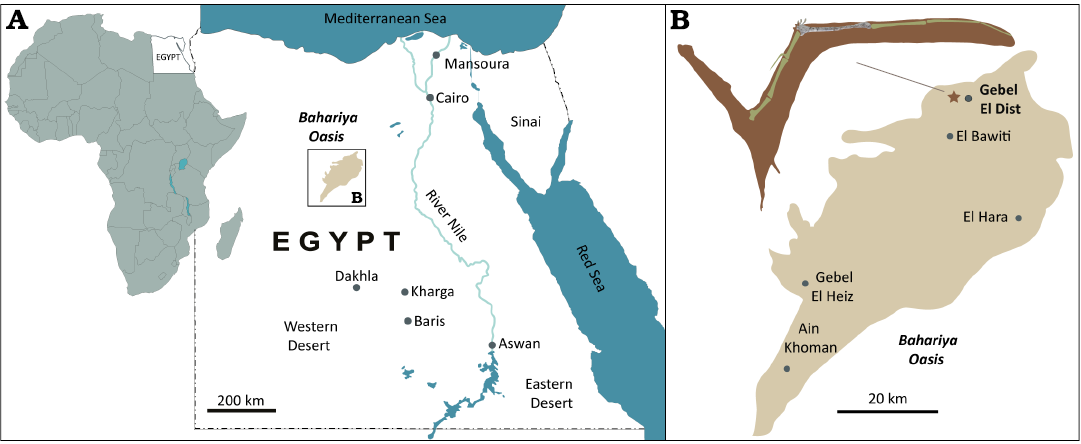
Fig. 1. Geographic setting of the pterosaur-bearing locality in the Bahariya Oasis, Western Desert of Egypt. A. Map of Egypt showing the location of the Bahariya Oasis. B. Detail map of the Bahariya Depression highlighting the Gebel El Dist region and indicating the locality that produced the pterosaurian (Ornithocheiriformes indet.) first wing phalanx MUVP 507 (indicated by star and pterosaurian silhouette).
Description.—Preservation: MUVP 507 (Figs. 2E, 3) is an isolated, three-dimensionally preserved left first wing phalanx (= left manual phalanx IV-1) of a medium-sized pterosaur. The specimen is pervasively ferruginized, as indicated by its dark reddish coloration consistent with the abundance of iron concretions at locality BOV16-10. The phalanx was originally recovered in four separate fragments (Fig. 2E) that were reassembled based on their precise fit. Both the proximal and distal articular ends are preserved. The cortical bone on the anterior surface of the distal shaft has been eroded, obscuring the original cross-sectional outline in that region, whereas the surface bone of the proximal end is intact and retains its original shape.
Osteology: The proximal and distal extremities of MUVP 507 are enlarged relative to the shaft (Fig. 3A1–A4, A7–A10). The extensor tendon process (ETP) is fused to the proximal end with a faint but visible suture, suggesting that the individual had attained skeletal maturity at the time of death (Bennett 1992; Frey and Martill 1998). The proximal and distal regions of the shaft appear sub-oval in cross-section (Fig. 3A5, A6, A11, A12). In proximal cross-section, the bone measures 66.3 mm anteroposteriorly and approximately 33.3 mm dorsoventrally (Table 2). Near the distal-most extent of the distal articular surface, the shaft measures approximately 40.8 mm anteroposteriorly and 24.5 mm dorsoventrally (Table 2). The cortical bone is ~1 mm thick in the proximal part of the shaft.
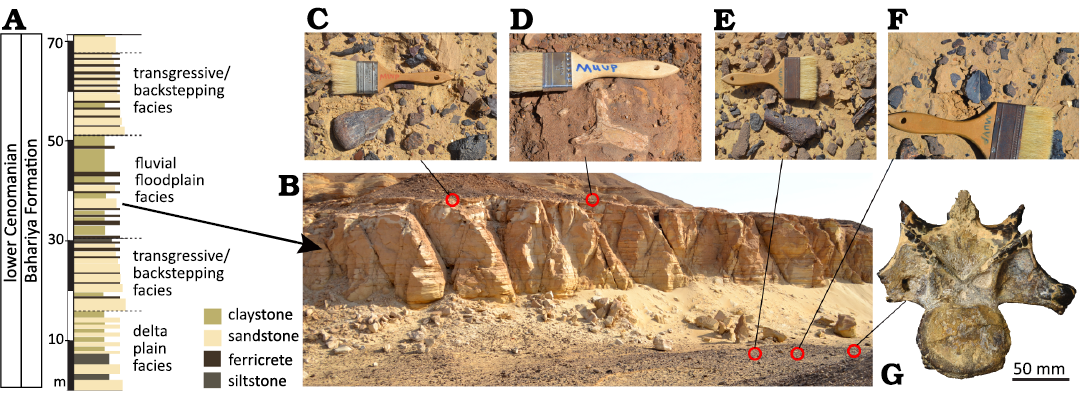
Fig. 2. Sedimentological context and fossil content of the Bahariya Formation in the Gebel El Dist region, Bahariya Oasis, Egypt. A. Lithological section of the Bahariya Formation at the Gebel El Dist locality, illustrating the first four facies associations of Catuneanu et al. (2006), including alternating sandstone, siltstone, claystone, and ferricrete horizons. B. Panoramic view of locality BOV16-10, which has yielded a diverse assemblage of vertebrate and plant fossils (C–G; specific recovery locations indicated by red circles). C, D. Osteichthyan ?cranial elements. E. Ornithocheiriform pterosaur wing phalanx (MUVP 507) as it appeared upon discovery. F. Exceptionally preserved angiosperm leaves contained within ferruginous concretions. G. Previously described abelisaurid theropod dinosaur cervical vertebra (MUVP 477; see Salem et al. 2022). All photos taken by MUVP personnel.
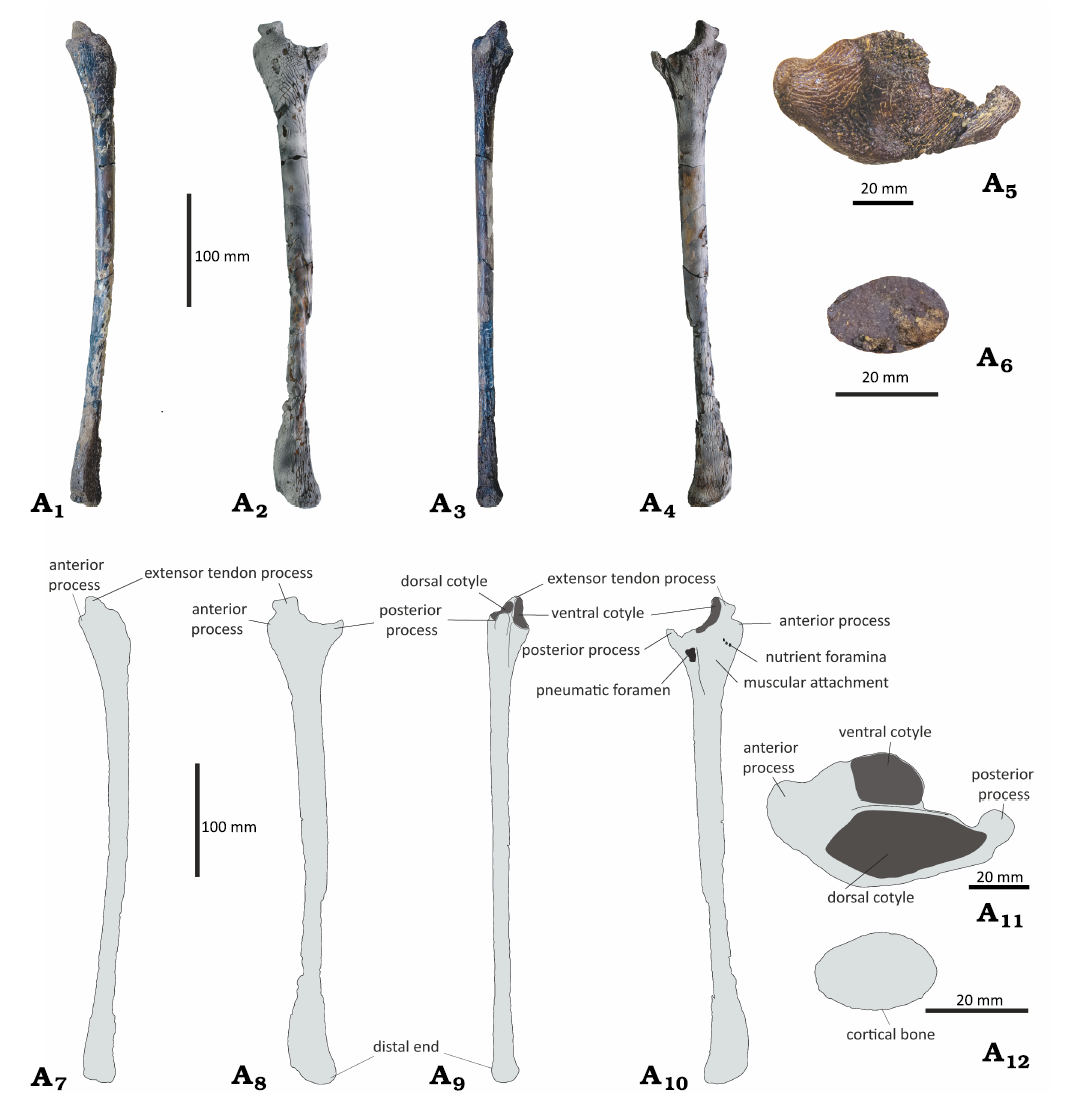
Fig. 3. Pterosaurian left first wing phalanx (= left manual phalanx IV-1) referred to Ornithocheiriformes indet. from the Upper Cretaceous (lower Cenomanian) Bahariya Formation of the Bahariya Oasis (site BOV16-10), Western Desert of Egypt (MUVP 507) in anterior (A1, A7), dorsal (A2, A8), posterior (A3, A9), ventral (A4, A10), proximal (A5, A11), and midshaft (A6, A12) cross-sectional views (A1–A6, photographs; A7–A12, interpretive drawings). Dark gray color in bottom row indicates articular cotyles for metacarpal IV.
Remarks.—The maximum anteroposterior (AP) breadth of the proximal articular surface of MUVP 507 is 66.3 mm (Table 2). For comparison, manual phalanx IV-1 of the holotype of Anhanguera piscator Kellner and Tomida, 2000 (NSM-PV 19892) has a reported proximal AP breadth of ~65 mm, and this specimen was noted to be comparable in size to the holotype of Araripedactylus dehmi Wellnhofer, 1977 (BSP 1975 I 166; Kellner and Tomida 2000). MUVP 507 is relatively straight in overall profile (Fig. 3) and measures 432.5 mm in proximodistal length (Table 2). The shaft is sub-oval to sub-triangular in cross-section.
Table 2. Measurements (in mm) of Ornithocheiriformes indet. (MUVP 507), a left first wing phalanx (= manual phalanx IV-1) from the Upper Cretaceous (lower Cenomanian) Bahariya Formation of Egypt.
|
Osteometric parameter |
Measurement |
|
|
Proximodistal length |
432.5 |
|
|
Proximal cross-section |
anteroposterior |
66.3 |
|
dorsoventral |
~33.3 |
|
|
Midshaft cross-section |
anteroposterior |
22.6 |
|
dorsoventral |
14.4 |
|
|
Distal cross-section |
anteroposterior |
~40.8 |
|
dorsoventral |
24.5 |
|
|
Midshaft bone wall thickness |
0.9 |
|
The extensor tendon process (ETP) of
MUVP 507 conforms to the ornithocheiriform condition
rather than that of azhdarchoids (Fig. 4). Its base is anteroposteriorly
expanded and bears two protuberances, one large and projecting
proximally, the other small and projecting anteriorly, as in
A. piscator (Kellner and Tomida 2000), Ferrodraco
lentoni Pentland et al., 2019 (Pentland
et al. 2019, 2022), and the indeterminate
ornithocheiriform AMNH 22552 (Wellnhofer 1991). In
MUVP 507, as in Ferrodraco, the ETP is
trapezoidal in outline in dorsal or ventral view, and its tip bears a
small depression. The ETP of MUVP 507 is less robust than that of
A. piscator and
less posteriorly deflected than in AMNH 22552 (Fig. 4). The posterior
margin of the ETP is defined by a sharp
ridge, like A. piscator
and Ferrodraco, though its slope is gentler
than in AMNH 22552. The anterior margin of the ETP appears less
constricted than in the holotype of A. piscator. These differences are expected given
that the ETP of the latter is unfused, whereas MUVP 507 preserves a
fused ETP indicative of osteological maturity.
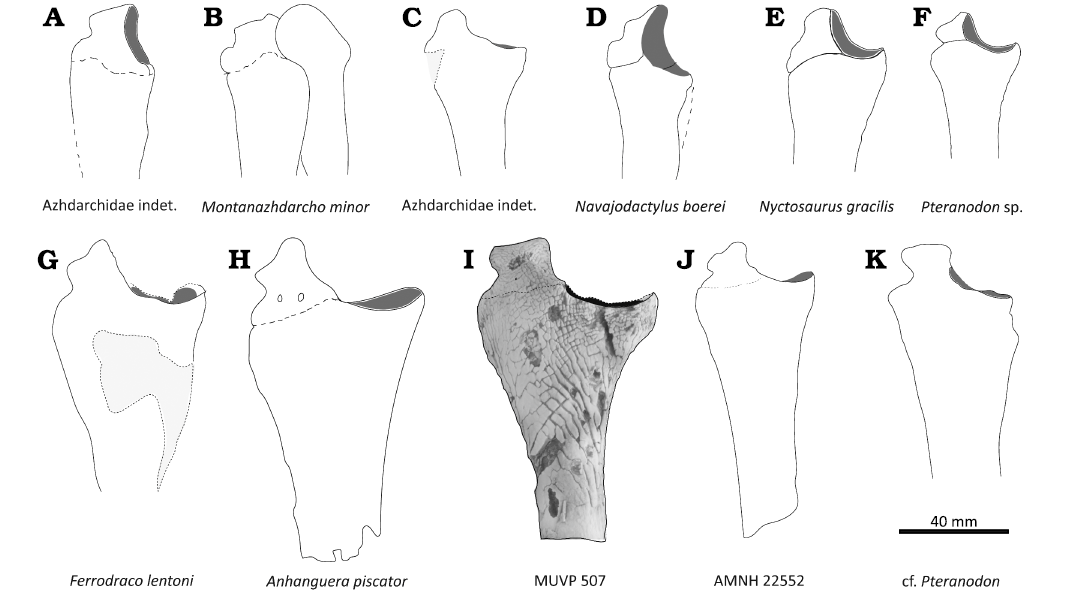
Fig. 4. Line drawings of
the proximal end of the first wing phalanx in selected pterosaurs in
dorsal view showing differences in morphology of the extensor
tendon process. Dark gray color indicates dorsal cotyle, whereas light
gray color indicates damaged area. A.
Azhdarchidae indet. (ZIN PH 47/43; after Averianov 2007).
B. Montanazhdarcho
minor (after Padian et al. 1995). C.
Azhdarchidae indet. (FSAC-KK 5212; after Smith et al.
2023a). D. Navajodactylus
boerei (after Sullivan and Fowler 2011). E. Nyctosaurus gracilis (after Wellnhofer 1978).
F. Pteranodon
sp. (after Wellnhofer 1978). G.
Ferrodraco lentoni (after Pentland
et al. 2022). H. Anhanguera
piscator (after Kellner and Tomida 2000).
I. Ornithocheiriformes indet. (MUVP 507;
this study). J. Ornithocheiriformes indet.
(AMNH 22552; after Wellnhofer 1991). K.
cf. Pteranodon (after Myers
2010).
Proximally, the dorsal cotyle constitutes the larger of the two articular surfaces (Fig. 3A5, A11). In contrast, the ventral cotyle, although proportionally smaller in overall articular extent, occupies most of the ETP in posterior and ventral views (Fig. 3A3, A4, A9, A10), extending along nearly its entire proximodistal length and continuing slightly onto the shaft, as in Anhanguera piscator and AMNH 22552. The dorsal cotyle is positioned more posteriorly, resulting in comparatively limited coverage of the ETP surface. A distinct oval pneumatic foramen opens on the ventral surface of the proximal end of the phalanx within a sulcus that continues distally between the cotyles.
In ornithocheiriform pterosaurs, the dorsal cotyle is typically symmetrical, subtends a greater arc, and occupies ~50% of the anteroposterior breadth of the proximal articulation (Smith et al. 2023a). This contrasts with azhdarchids (e.g., Azhdarcho, Quetzalcoatlus, and an azhdarchid manual phalanx IV-1 from the Kem Kem Group; FSAC-KK 5212; Smith et al. 2023a: fig. 10), in which the dorsal cotyle extends across >66% of the anteroposterior breadth. Moreover, in azhdarchoids (e.g., Quetzalcoatlus, Zhejiangopterus), phalanx IV-1 typically comprises ≥40% of the total wing-finger length and exhibits markedly elongate proportions, with length-to-width ratios commonly exceeding 4 (i.e., the width represents less than one-third of the total length). In MUVP 507 and other ornithocheiriforms, the phalanx is comparatively less elongate, with lower length-to-width ratios (<4), reflecting more robust proportions.
The recently described Australian anhanguerian Haliskia peterseni Pentland et al., 2024 (Pentland et al. 2024) provides another clade-appropriate comparator. Manual phalanx IV-1 of this taxon preserves a fused ETP in which the suture remains traceable; immediately distal to the ETP, there is a large pneumatic foramen, and muscle scars occur in the same topographic position reported for A. piscator (Kellner and Tomida 2000). Proximally, phalanx IV-1 of H. peterseni exhibits an anteroposterior breadth in the same range as MUVP 507 and A. piscator, and the overall proximodistal length of the bone is also close to that of MUVP 507 (432.5 mm in the Egyptian form; see Table 2). All these attributes are consistent with ornithocheiriform and specifically anhanguerian morphology (Pentland et al. 2024) and further support the interpretation that MUVP 507 matches the ornithocheiriform pattern much more closely than the azhdarchoid condition.
By contrast, the azhdarchoid Inabtanin alarabia Rosenbach et al., 2024, from the Maastrichtian of Jordan (Rosenbach et al. 2024) exhibits a proportionally longer and more gracile manual phalanx IV-1 alongside markedly elongate distal wing elements, edentulous jaws, and azhdarchoid-type pectoral girdle anatomy, underscoring the separation between Azhdarchoidea and the ornithocheiriform condition seen in MUVP 507 (Rosenbach et al. 2024). Together with the morphology of the Kem Kem azhdarchid phalanx IV-1 (FSAC-KK 5212), these comparisons reinforce the exclusion of MUVP 507 from Azhdarchoidea.
In summary, features that distinguish the Egyptian manual phalanx IV-1 MUVP 507 from the same bone in selected pterodactyloids include: (i) the cross-sectional area of the phalangeal wall (i.e., cortical bone) is approximately 5% of the total cross-sectional area of the shaft. A cross-sectional proportion of approximately 55% is diagnostic of dsungaripterids (Young 1964; Unwin 1995; Unwin et al. 1996); consequently, MUVP 507 does not show affinity to that clade; (ii) the shaft is sub-oval to sub-triangular in cross-section, similar to the condition in manual phalanx IV-1 of pteranodontids (Bennett 2001), istiodactylids (Hooley 1913), and AMNH 22552 (Wellnhofer 1991); (iii) the ventral cotyle dominates the ETP, extending along its entire proximodistal length and partly onto the phalangeal shaft, whereas the dorsal cotyle is comparatively less developed and restricted to the proximal aspect of the posterior process (Fig. 3A5, A11); this configuration is more consistent with ornithocheiriform morphology than with the broader dorsal articular condition seen in azhdarchid manual phalanges (Smith et al. 2023a); (iv) the distal end of the shaft is enlarged, terminating in a large distal articular end comparable to that in pteranodontids (Bennett 2001) and AMNH 22552 (Wellnhofer 1991), rather than the more elongate and gracile condition seen in azhdarchoids (Elgin and Frey 2011); (v) the distal articular end is angled at approximately 45° to the long axis of the shaft, a condition broadly comparable to that seen in anhanguerian ornithocheiriforms and pteranodontids (Wellnhofer 1991; Bennett 2001) and differing from the nearly 90° condition reported in Istiodactylus sinensis Andres and Ji, 2006 (Andres and Ji 2006); (vi) prominent pneumatic and small nutrient foramina are present; this condition is consistent with broader ornithocheiriform morphology, although it is not regarded here as diagnostic on its own, as comparable foramina also occur in the tapejaromorph azhdarchoid Keresdrakon vilsoni Kellner et al. 2019b (Kellner et al. 2019b), the tapejarid Sinopterus dongi Wang and Zhou, 2003 (Shen et al. 2021), and the pteranodontid Pteranodon Marsh, 1876 (Bennett 2001).
Results
Wingspan estimation.—To estimate the wingspan of the individual represented by MUVP 507, we employed the method proposed by Kellner et al. (2013). Because the specimen consists of only a manual phalanx IV-1, we reconstructed the lengths of the missing wing elements by scaling from two of the most completely described ornithocheiriform individuals with articulated forelimbs: (i) NSM-PV 19892, the holotype of the anhanguerid Anhanguera piscator (Kellner and Tomida 2000); and (ii) AMNH 22552, treated here as an indeterminate ornithocheiriform without adopting a potentially contentious generic or specific referral (cf. Kellner et al. 2013; Andres et al. 2014). Scapular length was derived from NSM-PV 19892, whereas metacarpal IV and phalanges IV-2 to IV-4 were scaled from AMNH 22552; the lengths of the humerus, ulna, and combined carpals were estimated from both these specimens to bracket plausible values (Tables 3–5). Following Kellner et al. (2013), we report: the maximized wingspan (maxws), computed as the straight-line sum of the maximum lengths of the serial wing elements (including the scapula and carpals), multiplied by two; and the normal wingspan (nws), obtained by applying (to the estimated maxws) a reduction factor of 0.95 (~5%), appropriate for ornithocheiriform pterosaurs to account for dorsoventral positioning and natural flexures in life posture.
Table 3. Length ( in mm) of the preserved forelimb elements of Anhanguera piscator (NSM-PV 19892) and Ornithocheiriformes indet. (AMNH 22552) after Kellner and Tomida (2000) and Wellnhofer (1991), respectively. Abbreviation: ~, estimated.
|
Element |
NSM-PV 19892 |
AMNH 22552 |
|
Scapula |
112 |
– |
|
Humerus |
255 |
170 |
|
Ulna |
390 |
243 |
|
Carpals |
~42 |
~25 |
|
Metacarpal IV |
256 |
172 |
|
Manual phalanx IV-1 |
– |
372 |
|
Manual phalanx IV-2 |
– |
324 |
|
Manual phalanx IV-3 |
– |
252 |
|
Manual phalanx IV-4 |
– |
~160 |
Table 4. Ratios based on the bone lengths of Anhanguera piscator (NSM-PV 19892) and
Ornithocheiriformes indet. (AMNH 22552)
after Kellner and Tomida (2000) and Wellnhofer (1991),
respectively. Abbreviation: ~, estimated
|
Element |
NSM-PV 19892 |
AMNH 22552 |
|
Scapula – metacarpal IV |
0.438 |
– |
|
Humerus – metacarpal IV |
0.996 |
0.988 |
|
Ulna – metacarpal IV |
1.523 |
1.410 |
|
Carpals – metacarpal IV |
~0.164 |
~0.145 |
|
Manual phalanx IV-1 – metacarpal IV |
– |
2.163 |
|
Manual phalanx IV-2 – metacarpal IV |
– |
1.884 |
|
Manual phalanx IV-3 – metacarpal IV |
– |
1.465 |
|
Manual phalanx IV-4 – metacarpal IV |
– |
~0.930 |
Using NSM-PV 19892 as the primary scaler, the proximodistal length of MUVP 507 yields maxws = 4.22 m and nws = 4.01 m; using AMNH 22552 as the scaler yields maxws = 4.17 m and nws = 3.96 m (Tables 3–5). We interpret these concordant results to indicate a medium-sized ornithocheiriform with a wingspan of ~4.0 m (range ~4.0 ± 0.1 m), broadly comparable to an Anhanguera-like form. This estimate is qualitatively consistent with the size spectrum documented among pterosaurs from the Kem Kem Group, where both very large and small teeth, jaw fragments, cervical vertebrae, ulnae, and femora indicate the presence of both ornithocheiriform and azhdarchoid pterosaurs, including individuals larger and smaller than MUVP 507, though these Kem Kem comparisons are based on non-overlapping, often isolated elements and are used here only for qualitative context (Smith et al. 2023a).
Table 5. Measurements and estimates (in mm) of the length of pectoral girdle and wing elements of Ornithocheiriformes indet. (MUVP 507) from the Bahariya Formation of Egypt. Abbreviation: ~, estimated
|
Element |
Preserved length |
Estimated length based on |
|
|
Anhanguera
|
Ornithocheiriformes indet. |
||
|
Scapula |
– |
87.58 |
– |
|
Humerus |
– |
199.15 |
197.55 |
|
Ulna |
– |
304.52 |
281.93 |
|
Carpals |
– |
~32.79 |
~28.99 |
|
Metacarpal IV |
– |
– |
199.95 |
|
Manual phalanx IV-1 |
432.50 |
– |
– |
|
Manual phalanx IV-2 |
– |
– |
376.70 |
|
Manual phalanx IV-3 |
– |
– |
292.93 |
|
Manual phalanx IV-4 |
– |
– |
185.95 |
Notes on uncertainty.—To reflect estimator sensitivity to interspecific proportional differences, we present both scaler solutions and recommend citing the mean ± half-range (maxws ≈ 4.20 ± 0.03 m; nws ≈ 3.99 ± 0.03 m). Given the lack of craniodental material, we refrain from finer-scale taxonomic assignment (e.g., Anhangueridae vs. Ornithocheiridae); that stated, the proportions, pneumaticity, and ETP morphology of MUVP 507 are consistent with referral to Ornithocheiriformes sensu Andres (2021) and Pêgas (2025).
Taxonomic conclusion.—MUVP 507 is referred to an indeterminate member of Ornithocheiriformes (sensu Andres 2021; Pêgas 2025) as it shares several morphological characters with that clade, including a similarly shaped ETP, proximal articular cotyles, distal articular end, and shaft cross-section. Thin cortical bone walls and the presence of pneumatic foramina are also anatomically consistent with this interpretation, although neither feature is here regarded as diagnostic on its own. Assuming that the specimen does belong to an ornithocheiriform, it constitutes the first appendicular element of that clade to be recovered from the mid-Cretaceous of northern Africa (given that ornithocheiriforms from the Kem Kem Group and similarly aged deposits in Algeria and Tunisia are currently collectively represented only by cranial bones, isolated teeth, and a notarium; see Smith et al. 2023a).
Discussion
Affinities of the Bahariya Formation pterosaur (MUVP 507).—MUVP 507, an isolated, three-dimensionally preserved left first wing phalanx (i.e., manual phalanx IV-1), represents the first pterosaur fossil described from Egypt. The element closely resembles the first wing phalanx of ornithocheiriform pterosaurs such as Anhanguera piscator (Kellner and Tomida 2000), Ferrodraco lentoni (Pentland et al. 2019, 2022), and AMNH 22552 (referred to Santanadactylus pricei by Wellnhofer 1991, but see Kellner and Tomida 2000 and Kellner et al. 2013 for alternative interpretations). The combination of features exhibited by MUVP 507 (including the trapezoidal, fused ETP, proportions of the dorsal and ventral cotyles, total proximodistal length-to-width ratio < 20, and relatively thin cortical walls) supports referral to Ornithocheiriformes sensu Andres (2021) and Pêgas (2025). Within this clade, the overall proportions of the bone, the shape and degree of fusion of the ETP, and the sub-oval shaft cross-section are most consistent with anhanguerian-like ornithocheiriforms (Pêgas 2025), differing from the more elongate and gracile wing phalanges seen in azhdarchoids (Elgin and Frey 2011).
Implications for mid-Cretaceous pterosaur diversity in northern Afro-Arabia.—The pterosaur fauna of the mid-Cretaceous Kem Kem Group of Morocco is the most diverse yet recovered from any fluvial deposit and one of the richest globally (Ibrahim et al. 2020; Smith et al. 2023a). Over 400 specimens have been reported, including rostra, mandibular symphyses, vertebrae, limb bones, and a notarium (FSAC-KK 5208; Smith et al. 2023c). The assemblage comprises at least ten taxa and several distinct jaw morphotypes, reflecting a remarkable taxonomic breadth. It includes representatives of two major pterodactyloid lineages, the toothed Ornithocheiriformes and the edentulous Azhdarchoidea. The five named Kem Kem ornithocheiriforms Siroccopteryx moroccensis (Mader and Kellner 1999), Anhanguera cf. piscator (Kellner and Tomida 2000), Nicorhynchus fluviferox (Holgado and Pêgas 2020; = Coloborhynchus fluviferox, Jacobs et al. 2019), Ornithocheirus cf. simus (Jacobs et al. 2020; the “Kem Kem ornithocheirid” of Pêgas 2025), and Akharhynchus martilli (Jacobs et al. 2025) are all based primarily on cranial material. No unequivocal appendicular elements have yet been recovered for any Kem Kem ornithocheiriform, underscoring the strong taphonomic bias of this assemblage toward the preservation of robust jaw elements (Smith et al. 2023b). This bias likely reflects a combination of hydrodynamic sorting, the mechanical resilience of rostral bones, selective predation, and collection history.
Additional mid-Cretaceous pterosaur records are known from other parts of North Africa and the Levant (Fig. 5). The upper Albian–lower Cenomanian Gara Samani Formation of Algeria (Benyoucef et al. 2022) and the slightly older (Albian) Aïn el Guettar Formation of Tunisia (Martill et al. 2018a) have produced isolated teeth and rostral fragments assignable to Ornithocheiridae. Farther east, the Cenomanian Hâqel and Hjoûla Lagerstätten of Lebanon have produced three articulated specimens that preserve manual phalanx IV-1. The first, MSNM V 3881, represents a small-bodied ornithocheiroid (Dalla Vecchia et al. 2001) with a preserved phalanx IV-1 length of 202 mm, less than half that of MUVP 507 (432.5 mm), indicating a markedly smaller individual. The azhdarchoid Microtuban altivolans (Elgin and Frey 2011) exhibits a proportionally more elongate and slenderer IV-1 with an unfused ETP, contrasting with the fused, robust morphology of MUVP 507. Phalanx IV-1 of the istiodactyliform Mimodactylus libanensis (Kellner et al. 2019a) has a broader shaft and thicker cortical walls than the Bahariya specimen. Collectively, these comparisons reinforce the interpretation that MUVP 507 represents a distinct ornithocheiriform morphotype, separate from the azhdarchoid and istiodactyliform taxa known from Lebanon. Together, these taxa reveal a diverse mid-Cretaceous pterosaur assemblage along the southern Tethyan margin, encompassing both toothed and toothless lineages (Martill and Smith 2025; Pêgas 2025).
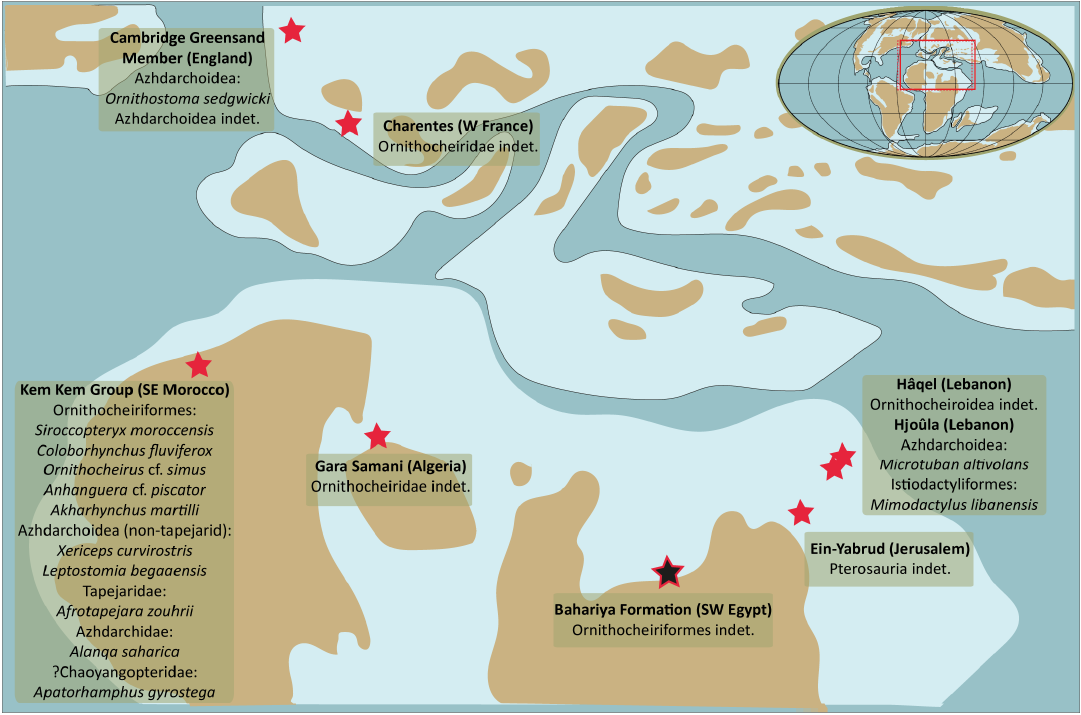
Fig. 5. Paleogeographic distribution and taxonomic composition (higher-level clades and identified species) of Cenomanian (including Albian–Cenomanian) peri-Tethyan pterosaur sites (map redrawn after Scotese 2002 and Da Silva and Gallo 2007).
The morphology and internal structure of MUVP 507 indicate a thin-walled, pneumatic wing phalanx consistent with those of large, soaring pterosaurs typical of coastal settings in the mid-Cretaceous (Martill and Smith 2025). The overall proportions, the degree of fusion of the ETP, and the robust yet lightweight construction of the bone match the functional range documented in anhanguerian ornithocheiriforms such as Anhanguera and Ferrodraco (Pentland et al. 2019; Pêgas 2025), without implying a specific aerodynamic specialization. Comparably lightweight architectures have also evolved convergently in other large-bodied pterodactyloids, including azhdarchoids such as Inabtanin alarabia from the Maastrichtian of Jordan (Rosenbach et al. 2024), underscoring the repeated development of gracile, high-aspect wing elements in Cretaceous pterosaurs inhabiting northern Africa and Arabia. Within this broader functional landscape, MUVP 507 provides rare Cenomanian evidence for large, soaring pterosaurs in northern Africa, supplementing the otherwise fragmentary record of mid-Cretaceous pterosaurs from Afro-Arabian coastal paleoecosystems, without suggesting any deviation from global lineage trajectories.
Taphonomic
observations.—The ferruginized cortex and
three-dimensional preservation of MUVP 507 are consistent with
diagenetic processes characteristic of the Bahariya Formation. Studies
of the fluvial-deltaic sandstones of this unit have documented pervasive
iron enrichment driven by iron-rich groundwater movement,
water table fluctuations, and early diagenetic precipitation of goethite
and hematite, producing ferricretes and iron-cemented horizons (Tanner
and Khalifa 2010). Similar models from elsewhere in the Western
Desert of Egypt highlight the role of redox oscillations and
groundwater-mediated iron cycling in generating iron-coated vertebrate
remains and localized ferruginous concretions (Afify et al.
2015). These mechanisms explain both the iron-encrusted exterior
of the specimen and its unusually intact three-dimensional morphology,
reflecting
early-stage mineral stabilization prior to compaction.
Together, these patterns indicate that MUVP 507 conforms to a
broader regional taphonomic regime in which iron-rich groundwater
dynamics exerted a major control on fossil preservation
within Cretaceous coastal floodplains in what is now Egypt.
The taphonomic characteristics of MUVP 507 also contrast with patterns documented for pterosaurs from the mid-Cretaceous Kem Kem Group of Morocco. The Kem Kem assemblage, despite yielding the richest and taxonomically broadest pterosaur fauna from any fluvial deposit worldwide, is overwhelmingly dominated by robust cranial elements, particularly jaw fragments, whereas appendicular remains are exceedingly rare or absent (Smith et al. 2023c). This strong anatomical bias has been attributed to hydrodynamic sorting, differential transport, and the mechanical resilience of rostral bones in high-energy fluvial systems. By contrast, the Bahariya Formation has preserved a delicate, thin-walled wing phalanx in three dimensions with extensive ferruginous mineralization, a preservational mode far less common in the Kem Kem deposits. These differences highlight distinct taphonomic regimes between the two regions: the Kem Kem acting as a transport-dominated Konzentrat-Lagerstätte, whereas the Bahariya Formation favored early diagenetic stabilization through iron-rich groundwater processes. The presence of MUVP 507, therefore, provides a rare glimpse into a less transport-affected, chemically-mediated pathway for pterosaur preservation along the southern Tethyan margin.
Conclusions
MUVP 507, a left first wing phalanx from the lower Cenomanian Bahariya Formation, represents the first confirmed pterosaur record from Egypt and northeastern Africa overall. The phalanx closely resembles the equivalent element in the ornithocheiriforms Anhanguera piscator (Kellner and Tomida 2000), Ferrodraco lentoni (Pentland et al. 2019, 2022), and AMNH 22552 (Wellnhofer 1991), and differs from azhdarchoid manual phalanges in its proportions and cotylar morphology. The thin cortical walls and fused extensor tendon process indicate a lightweight, mature ornithocheiriform individual optimized for sustained soaring (Pentland et al. 2019; Pêgas 2025). The discovery of MUVP 507 expands the known geographic range of Ornithocheiriformes and underscores that mid-Cretaceous Afro-Arabian pterosaur diversity remains substantially undersampled.
Acknowledgments
We thank the Egyptian Environmental Affairs Agency (EEAA) for facilitating fieldwork in the Bahariya Protectorate. We are also grateful to members of the Sallam Lab for their enthusiastic support and assistance with collecting, preparing, and photographing the specimen, and to the Science and Technology Development Fund (STDF) (Project 38284) for supporting the purchase of equipment. We further acknowledge colleagues at Ohio University for assistance with the computed tomographic scanning of the specimen, even though the results were not usable for analysis. We thank Eudald Mujal (Staatliches Museum für Naturkunde Stuttgart, Stuttgart, Germany) for editorial handling, and Rubi V. Pêgas (Laboratório de Paleontologia, Museu de Zoologia da Universidade de São Paulo, Brazil) and Michael O’Sullivan (University of Portsmouth, Portsmouth, UK) for their constructive reviews, which helped improve the manuscript. This project was supported by the Mansoura University Research Fund and the National Geographic Society Committee for Research and Exploration (Grant 9144-12 to MCL).
Editor: Eudald Mujal Grané
References
Afify, A.M., Sanz-Montero, M.E., Calvo, J.P., and Wanas, H.A. 2015. Diagenetic origin of ironstone crusts in the lower Cenomanian Bahariya Formation, Bahariya Depression, Western Desert, Egypt. Journal of African Earth Sciences 101: 333–349. Crossref
Alhalabi, W.A., Pinheiro, F.L., Jaoude, I.B., Ismail, M.J., Pereda Suberbiola, X., Bardet, N., and Langer, M.C. 2025. Recovering lost time in Syria: a gigantic latest Cretaceous azhdarchid pterosaur from the Palmyrides mountain chain. The Science of Nature 112: 1–8. Crossref
Ambroggi, R. and Lapparent, A.F. de. 1954. Les empreintes de pas fossiles du Maestrichtien d’Agadir. Notes du Service Géologique du Maroc 10: 43–57.
Andres, B. 2021. Phylogenetic systematics of Quetzalcoatlus Lawson 1975 (Pterodactyloidea: Azhdarchoidea). Society of Vertebrate Paleontology Memoir 19: 203–217. Crossref
Andres, B. and Ji, Q. 2006. A new species of Istiodactylus (Pterosauria, Pterodactyloidea) from the Lower Cretaceous of Liaoning, China. Journal of Vertebrate Paleontology 26: 70–78. Crossref
Andres, B., Clark, J., and Xu, X. 2014. The earliest pterodactyloid and the origin of the group. Current Biology 24: 1011–1016. Crossref
Arambourg, C. 1954. Sur la présence d’un ptérosaurien gigantesue dans les phosphates de Jordanie. Comptes Rendus de l’Académie des Sciences 238: 133–134.
Averianov, A.O. 2007. New records of azhdarchids (Pterosauria, Azhdarchidae) from the Late Cretaceous of Russia, Kazakhstan, and Central Asia. Paleontological Journal 41: 189–197. Crossref
Barrett, P.M., Butler, R.J., Edwards, N.P., and Milner, A.R. 2008. Pterosaur distribution in time and space: an atlas. Zitteliana B 28: 61–107.
Bennett, S.C. 1992. Sexual dimorphism of Pteranodon and other pterosaurs, with comments on cranial crests. Journal of Vertebrate Paleontology 12: 422–434. Crossref
Bennett, S.C. 2001. The osteology and
functional morphology the Late Cretaceous pterosaur Pteranodon.
Palaeontographica Abteilung A 260:
1–153. Crossref
Benton, M.J., Bouaziz, S., Buffetaut, E., Martill, D.M., Ouaja, M., Soussi, M., and Trueman, C. 2000. Dinosaurs and other fossil vertebrates from fluvial deposits in the Lower Cretaceous of southern Tunisia. Palaeogeography, Palaeoclimatology, Palaeoecology 157: 227–246. Crossref
Benyoucef, M., Pérez-García, A., Bendella, M., Ortega, F., Vullo, R., Bouchemla, I., and Ferré, B. 2022. The “mid”-Cretaceous (lower Cenomanian) continental vertebrates of Gara Samani, Algeria. Sedimentological framework and palaeodiversity. Frontiers in Earth Science 10: 927059. Crossref
Blackbeard, M. and Yates, A.M. 2007. The taphonomy of an Early Jurassic dinosaur bonebed in the Northern Free State (South Africa). Journal of Vertebrate Paleontology 27: 49A.
Blackburn, D. 2002. Two Early Cretaceous pterosaurs from Africa. Journal of Vertebrate Paleontology 22: 37A.
Bordy, E.M., Abrahams, M., Sharman, G.R., Viglietti, P.A., Benson, R.B.J., McPhee, B.W., Barrett, P.M., Sciscio, L., Condon, D., and Mundil, R. 2020. A chronostratigraphic framework for the upper Stormberg Group: implications for the Triassic–Jurassic boundary in southern Africa. Earth-Science Reviews 203: 103120. Crossref
Burch, S. and Sertich, J. 2011. Giant pterosaur remains from the Campanian of the Morondava Basin, western Madagascar. Journal of Vertebrate Paleontology 31: 80A.
Cahen, L. 1954. Géologie du Congo Belge. 577 pp. Vaillant-Carmanne, Liège.
Cai, Z. and Wei, F. 1994. On a new pterosaur (Zhejiangopterus linhaiensis gen. et sp. nov.) from Upper Cretaceous in Linhai, Zhejiang, China. Vertebrata PalAsiatica 32: 181–194.
Catuneanu, O., Khalifa, M.A., and Wanas, H.A. 2006. Sequence stratigraphy of the lower Cenomanian Bahariya Formation, Bahariya Oasis, Western Desert, Egypt. Sedimentary Geology 190: 121–137. Crossref
Costa, F.R. and Kellner, A.W.A. 2009. On two pterosaur humeri from the Tendaguru Beds (Upper Jurassic, Tanzania). Anais da Academia Brasileira de Ciências 81: 813–818. Crossref
Costa, F.R., Sayão, J.M., and Kellner, A.W.A. 2015. New pterosaur material from the Upper Jurassic of Tendaguru (Tanzania), Africa. Historical Biology 27: 646–655. Crossref
Da Silva, H.M., and Gallo, V. 2007. Parsimony analysis of endemicity of enchodontoid fishes from the Cenomanian. Carnets de Géologie L01: 1–8. Crossref
Dal Sasso, C. and Pasini, G. 2003. First record of pterosaurs (Diapsida, Archosauromorpha, Pterosauria) in the Middle Jurassic of Madagascar. Atti della Societa Italiana di Scienze Natuali e del Museo Civico di Storia Naturale de Milano 144: 281–296.
Dalla Vecchia, F.M., Arduini, P., and Kellner, A.W.A. 2001. The first pterosaur from the Cenomanian (Late Cretaceous) Lagerstätten of Lebanon. Cretaceous Research 22: 219–225. Crossref
Dean, C.D., Mannion, P.D., and Butler, R.J. 2016. Preservational bias controls the fossil record of pterosaurs. Palaeontology 59: 225–247. Crossref
Elgin, R.A. and Frey, E. 2011. A new azhdarchoid pterosaur from the Cenomanian (Late Cretaceous) of Lebanon. Swiss Journal of Geosciences 104: 21–33. Crossref
Fanti, F., Miyashita, T., Cantelli, L., Mnasri, F., Dridi, J., Contessi, M., and Cau, A. 2016. The largest thalattosuchian (Crocodylomorpha) supports teleosaurid survival across the Jurassic–Cretaceous boundary. Cretaceous Research 61: 263–274. Crossref
Fernandes, A.E., Mateus, O., Andres, B., Polcyn, M.J., Schulp, A.S., Gonçalves, A.O., and Jacobs, L.L. 2022. Pterosaurs from the Late Cretaceous of Angola. Diversity 14: 1–27. Crossref
Frey, E. and Martill, D. 1996. A reappraisal of Arambourgiania (Pterosauria, Pterodactyloidea): one of the world’s largest flying animals. Neues Jahrbuch für Geologie und Paläontologie-Abhandlungen 199: 221–247. Crossref
Frey, E. and Martill, D.M. 1998. Late ontogonetic fusion of the processus tendinis extensoris in Cretaceous pterosaurs from Brazil. Neues Jahrbuch für Geologie und Paläontologie-Monatshefte 1998 (10): 587–594. Crossref
Haddoumi, H., Allain, R., Meslouh, S., Metais, G., Monbaron, M., Pons, D., Rage, J.C., Vullo, R., Zouhri, S., and Gheerbrant, E. 2016. Guelb el Ahmar (Bathonian, Anoual Syncline, eastern Morocco): first continental flora and fauna including mammals from the Middle Jurassic of Africa. Gondwana Research 29: 290–319. Crossref
Holgado, B. and Pêgas, R.V. 2020. A taxonomic and phylogenetic review of the anhanguerid pterosaur group Coloborhynchinae and the new clade Tropeognathinae. Acta Palaeontologica Polonica 65: 743–761. Crossref
Hooley, R.W. 1913. On the skeleton of Ornithodesmus latidens; an ornithosaur from the Wealden Shales of Atherfield (Isle of Wight). Quarterly Journal of the Geological Society 69: 372–422. Crossref
Ibrahim, N., Unwin, D.M., Martill, D.M., Baidder, L., and Zouhri, S. 2010. A new pterosaur (Pterodactyloidea: Azhdarchidae) from the Upper Cretaceous of Morocco. PLoS ONE 5: e10875. Crossref
Ibrahim, N., Sereno, P.C., Varricchio, D.J., Martill, D.M., Dutheil, D.B., Unwin, D.M., Baidder, L., Larsson, H.C.E., Zouhri, S., and Kaoukaya, A. 2020. Geology and paleontology of the Upper Cretaceous Kem Kem Group of eastern Morocco. ZooKeys 928: 1–216. Crossref
Jacobs, M.L., Martill, D.M., Ibrahim, N., and Longrich, N. 2019. A new species of Coloborhynchus (Pterosauria, Ornithocheiridae) from the mid-Cretaceous of North Africa. Cretaceous Research 95: 77–88. Crossref
Jacobs, M.L., Smith, R.E., and Zouhri, S. 2025. A new ornithocheirid pterosaur (Pterosauria: Ornithocheiridae) from the mid-Cretaceous Ifezouane Formation, Kem Kem Group of Morocco. Cretaceous Research 166: 106015. Crossref
Jacobs, M.L., Martill, D.M., Unwin, D.M., Ibrahim, N., Zouhri, S., and Longrich, N.R. 2020. New toothed pterosaurs (Pterosauria: Ornithocheiridae) from the middle Cretaceous Kem Kem beds of Morocco and implications for pterosaur palaeobiogeography and diversity. Cretaceous Research 110: 104413. Crossref
Kaddumi, H.F. 2006. A new genus and species of gigantic marine turtles (Chelonioidea: Cheloniidae) from the Maastrichtian of the Harrana Fauna, Jordan. PalArch 3: 1–13.
Kaddumi, H.F. 2009. On the remains of the first pterosaur (Ornithocheiroidea: Nyctosauridae) from the Muwaqqar Chalk Marl Formation of Harrana. In: Kaddumi, H.F. (ed.), Fossils of the Harrana Fauna and the Adjacent Areas, 241–247. Eternal River Museum of Natural History, Amman.
Kellner, A.W.A. 2003. Pterosaur phylogeny and comments on the evolutionary history of the group. Geological Society, London, Special Publications 217: 105–137. Crossref
Kellner, A.W.A. and Tomida, Y. 2000. Description of a new species of Anhangueridae (Pterodactyloidea) with comments on the pterosaur fauna from the Santana Formation (Aptian–Albian), northeastern Brazil. National Science Museum Monographs 17: 1–135.
Kellner, A.W.A., Caldwell, M.W., Holgado, B., Dalla Vecchia, F.M., Nohra, R., Sayão, J.M., and Currie, P.J. 2019a. First complete pterosaur from the Afro-Arabian continent: insight into pterodactyloid diversity. Scientific Reports 9: 17875. Crossref
Kellner, A.W.A., Campos, D.A., Sayão, J.M., Saraiva, A.A.F., Rodrigues, T., Oliveira, G., Cruz, L.A., Costa, F.R., Silva, H.P., and Ferreira, J.S. 2013. The largest flying reptile from Gondwana: a new specimen of Tropeognathus cf. T. mesembrinus Wellnhofer, 1987 (Pterodactyloidea, Anhangueridae) and other large pterosaurs from the Romualdo Formation, Lower Cretaceous, Brazil. Anais da Academia Brasileira de Ciências 85: 113–135. Crossref
Kellner, A.W.A., Mello, A.M.S., and Ford, T.L. 2007. A survey of pterosaurs from Africa with the description of a new specimen from Morocco. Paleontologia: Cenários de Vida 1: 257–267.
Kellner, A.W.A., Weinschütz, L.C., Holgado, B., Bantim, R.A., and Sayão, J.M. 2019b. A new toothless pterosaur (Pterodactyloidea) from southern Brazil with insights into the paleoecology of a Cretaceous desert. Anais da Academia Brasileira de Ciências 91(suppl. 2): e20190768. Crossref
Khalifa, M.A. and Catuneanu, O. 2008. Sedimentology of the fluvial and fluvio-marine facies of the Bahariya Formation (early Cenomanian), Bahariya Oasis, Western Desert, Egypt. Journal of African Earth Sciences 51: 89–103. Crossref
Knoll, F. 2000. Pterosaurs from the Lower Cretaceous (?Berriasian) of Anoual, Morocco. Annales de Paléontologie 86: 157–164. Crossref
Labita, C. and Martill, D.M. 2021. An articulated pterosaur wing from the Upper Cretaceous (Maastrichtian) phosphates of Morocco. Cretaceous Research 119: 104679. Crossref
Lacovara, K.J., Smith, J.R., Smith, J.B., and Lamanna, M.C. 2003. The Ten Thousand Islands coast of Florida: a modern analog to low-energy mangrove coasts of Cretaceous epeiric seas; pp. 1773–1784 in Davis Jr., R.A. (ed.), Proceedings of the 5th International Conference on Coastal Sediments, Clearwater Beach, Florida.
Lewy, Z., Milner, A.C., and Patterson, C. 1992. Remarkably preserved natural endocranial casts of pterosaur and fish from the Late Cretaceous of Israel. Geological Survey of Israel Current Research 7: 31–35.
Lkebir, N., Masrour, M., Pascual-Arribas, C., de Ducla, M., Hernández-Medrano, N., and Pérez-Lorente, F. 2020. The Anza tracksite: ichnological heritage and geoeducational significance of dinosaur and pterosaur tracks in coastal Morocco. Journal of African Earth Sciences 171: 103949. Crossref
Longrich, N.R., Martill, D.M., and Andres, B. 2018. Late Maastrichtian pterosaurs from North Africa and mass extinction of Pterosauria at the Cretaceous-Paleogene boundary. PLoS Biology 16: e2001663. Crossref
Mader, B.J., and Kellner, A.W.A. 1999. A new anhanguerid pterosaur from the Cretaceous of Morocco. Boletim do Museu Nacional, Geologia 45: 1–11.
Marsh, O.C. 1876. Notice of a new sub-order of Pterosauria. American Journal of Science (Series 3) 11: 507–509. Crossref
Martill, D.M. and Ibrahim, N. 2015. An unusual modification of the jaws in cf. Alanqa, a mid-Cretaceous azhdarchid pterosaur from the Kem Kem Beds of Morocco. Cretaceous Research 53: 59–67. Crossref
Martill, D.M. and Moser, M. 2018. Topotype specimens probably attributable to the giant azhdarchid pterosaur Arambourgiania philadelphiae (Arambourg 1959). Geological Society, London, Special Publications 455: 159–169. Crossref
Martill, D.M. and Smith, R.E. 2025. Cretaceous pterosaur history, diversity and extinction. Geological Society, London, Special Publications 544: 501–524. Crossref
Martill, D.M., Ibrahim, N., and Bouaziz, S. 2018a. A giant pterosaur in the Early Cretaceous (Albian) of Tunisia. Journal of African Earth Sciences 147: 331–337. Crossref
Martill, D.M., Unwin, D.M., Ibrahim, N., and Longrich, N. 2018b. A new edentulous pterosaur from the Cretaceous Kem Kem Beds of south eastern Morocco. Cretaceous Research 84: 1–12. Crossref
Martill, D.M., Smith, R., Unwin, D.M., Kao, A., McPhee, J., and Ibrahim, N. 2020. A new tapejarid (Pterosauria, Azhdarchoidea) from the mid-Cretaceous Kem Kem beds of Takmout, southern Morocco. Cretaceous Research 112: 104424. Crossref
Masrour, M., de Ducla, M., Billon-Bruyat, J.-P., and Mazin, J.-M.. 2018. Rediscovery of the Tagragra tracksite (Maastrichtian, Agadir, Morocco): Agadirichnus elegans Ambroggi and Lapparent 1954 is pterosaurian ichnotaxon. Ichnos 25: 285–294. Crossref
Masrour, M., Pascual-Arribas, C., de Ducla, M., Hernández-Medrano, N., and Pérez-Lorente, F. 2017. Anza palaeoichnological site. Late Cretaceous. Morocco. Part I. The first African pterosaur trackway (manus only). Journal of African Earth Sciences 134: 766–775. Crossref
Mateus, O., Polcyn, M.J., Jacobs, L.L., Araújo, R., Schulp, A.S., Marinheiro, J., Pereira, B., and Vineyard, D. 2012. Cretaceous amniotes from Angola: dinosaurs, pterosaurs, mosasaurs, plesiosaurs, and turtles. In: V Jornadas Internacionales sobre Paleontología de Dinosaurios y su Entorno, Abstracts, 71–105.
McPhee, J., Ibrahim, N., Kao, A., Unwin, D.M., Smith, R., and Martill, D.M. 2020. A new ?chaoyangopterid (Pterosauria: Pterodactyloidea) from the Cretaceous Kem Kem beds of southern Morocco. Cretaceous Research 110: 104410. Crossref
Monteillet, J., Lappartient, J.R., and Taquet, P. 1982. Un ptérosaurien géant dans le Crétacé supérieur de Paki (Sénégal). Comptes Rendus de l´Académie des Sciences, Paris 295: 167–172.
Myers, T.S. 2010. Earliest occurrence of the Pteranodontidae (Archosauria: Pterosauria) in North America: new material from the Austin Group of Texas. Journal of Paleontology 84: 1071–1081. Crossref
Nessov, L.A. 1984. Pterosaurs and birds from the Late Cretaceous of Middle Asia [in Russian]. Paleontologicheskii Zhurnal 1: 47–57.
Ntamak Nida, M.J., Ketchemen-Tandia, B., Ewane, R.V., Lissok, J.P., and Courville, P. 2006. Nouvelles données sur les mollusques et autres macro-organismes campaniens de Sikoum (Centre-Est du sous bassin de Douala-Cameroun): intérêts bio-chronologiques et paléo-écologiques. Africa Geoscience Review 13: 385–394.
O’Connor, P.M., Sertich,
J.J.W., and Manthi, F.K. 2011. A pterodactyloid
pterosaur from the Upper Cretaceous Lapurr Sandstone, West Turkana,
Kenya. Anais da Academia Brasileira de
Ciências 83: 309–315. Crossref
Owen, R. 1842. Report on British Fossil Reptiles, Part II: In Report of the Eleventh Meeting of the British Association for the Advancement of Science 1841, 60–204. John Murray, Plymouth.
Padian, K., de Ricqlès, A.J., and Horner, J.R. 1995. Bone histology determines identification of a new fossil taxon of pterosaur (Reptilia: Archosauria). Comptes Rendus de l’Academie des Sciences Paris, série IIa 320: 77–84.
Pêgas, R.V. 2025. On the systematics and phylogenetic nomenclature of the Ornithocheiriformes (Pterosauria, Pteranodontoidea). Palaeontologia Electronica 25: 1–21. Crossref
Pentland, A.H. and Poropat, S.F. 2023. A review of the Jurassic and Cretaceous Gondwanan pterosaur record. Gondwana Research 119: 341–383. Crossref
Pentland, A.H., Poropat, S.F., Duncan, R.J., Kellner, A.W.A., Bantim, R.A., Bevitt, J.J., Tait, A.M., and Grice, K. 2024. Haliskia peterseni, a new anhanguerian pterosaur from the late Early Cretaceous of Australia. Scientific Reports 14: 11789. Crossref
Pentland, A.H., Poropat, S.F., Tischler, T.R., Sloan, T., Elliott, R.A., Elliott, H.A., Elliott, J.A., and Elliott, D.A. 2019. Ferrodraco lentoni gen. et sp. nov., a new ornithocheirid pterosaur from the Winton Formation (Cenomanian–lower Turonian) of Queensland, Australia. Scientific Reports 9: 13454. Crossref
Pentland, A.H., Poropat, S.F., White, M.A., Rigby, S.L., Bevitt, J.J., Duncan, R.J., Sloan, T., Elliott, R.A., Elliott, H.A., Elliott, J.A., and Elliott, D.A. 2022. The osteology of Ferrodraco lentoni, an anhanguerid pterosaur from the mid-Cretaceous of Australia. Journal of Vertebrate Paleontology 41: e2038182. Crossref
Pereda-Suberbiola, X., Bardet, N., Jouve, S., Iarochène, M., Bouya, B., and Amaghzaz, M. 2003. A new azhdarchid pterosaur from the Late Cretaceous phosphates of Morocco. Geological Society, London, Special Publications 217: 79–90. Crossref
Plieninger, F. 1901. Beiträge zur Kenntnis der Flugsaurier. Palaeontographica 48: 65–90.
Polcyn, M.J., Tchernov, E., and Jacobs, L.L. 1999. The Cretaceous biogeography of the eastern Mediterranean with a description of a new basal mosasauroid from ‘Ein Yabrud, Israel. National Science Museum Monographs 15: 259–290.
Reck, H. 1931. Die deutschostafrikanischen Flugsaurier. Centralblatt für Mineralogie und Paläontologie B 7: 321–336.
Rosenbach, K.L., Goodvin, D.M., Albshysh, M.G., Azzam, H.A., Smadi, A.A., Mustafa, H.A., Zalmout, I.S.A., and Wilson Mantilla, J.A. 2024. New pterosaur remains from the Late Cretaceous of Afro-Arabia provide insight into flight capacity of large pterosaurs. Journal of Vertebrate Paleontology 44: e2385068. Crossref
Salem, B.S., Lamanna, M.C., O’Connor, P.M., El-Qot, G.M., Shaker, F., Thabet, W.A., El-Sayed, S., and Sallam, H.M. 2022. First definitive record of Abelisauridae (Theropoda: Ceratosauria) from the Cretaceous Bahariya Formation, Bahariya Oasis, Western Desert of Egypt. Royal Society Open Science 9: 220106. Crossref
Scotese, C.R. 2002. PALEOMAP website (http://www.scotese.com/).
Sereno, P.C. and Brusatte, S.L. 2008. Basal abelisaurid and carcharodontosaurid theropods from the Lower Cretaceous Elrhaz Formation of Niger. Acta Palaeontologica Polonica 53: 15–46. Crossref
Shen, C., Pêgas, R.V., Gao, C.,
Kundrát, M., Zhang, L., Wei, X., and Zhou, X. 2021. A new
specimen of Sinopterus dongi (Pterosauria,
Tapejaridae) from the Jiufotang Formation (Early Cretaceous, China).
PeerJ 9: e12360. Crossref
Sigogneau-Russell, D., Evans, S.E., Levine, J.F., and Russell, D.A. 1998. The Early Cretaceous microvertebrate locality of Anoual, Morocco: a glimpse at the small vertebrate assemblages of Africa. Bulletin of the New Mexico Museum of Natural History and Science 14: 177–181.
Smith, R.E., Chinsamy, A., Unwin, D.M., Ibrahim, N., Zouhri, S., and Martill, D.M. 2022. Small, immature pterosaurs from the Cretaceous of Africa: implications for taphonomic bias and palaeocommunity structure in flying reptiles. Cretaceous Research 130: 105061. Crossref
Smith, R.E., Ibrahim, N., Longrich, N., Unwin, D.M., Jacobs, M.L., Williams, C.J., Zouhri, S., and Martill, D.M. 2023a. The pterosaurs of the Cretaceous Kem Kem Group of Morocco. PalZ 97: 519–568. Crossref
Smith, R.E., Martill, D.M., and Zouhri, S. 2023b. Distinctive azhdarchoid pterosaur jaws from the mid-Cretaceous Cambridge Greensand of eastern England and the Kem Kem Group of Morocco. Proceedings of the Geologists’ Association 134: 269–275. Crossref
Smith, R.E., Martill, D.M., Kao, A., Zouhri, S., and Longrich, N. 2021. A long-billed, possible probe-feeding pterosaur (Pterodactyloidea: ?Azhdarchoidea) from the mid-Cretaceous of Morocco, North Africa. Cretaceous Research 118: 104643. Crossref
Smith, R.E., Martill, D.M., Longrich, N., Unwin,
D.M., Ibrahim, N., and Zouhri, S. 2023c. Comparative taphonomy of Kem
Kem Group
(Cretaceous) pterosaurs of southeast Morocco. Evolving
Earth 1: 100006.
Stromer, E. 1914. Ergebnisse der Forschungsreisen Prof. E. Stromers in den Wüsten Ägyptens. I. Die Topographie und Geologie der Strecke Gharaq-Baharîje nebst Ausführungen über die geologische Geschichte Ägyptens. Abhandlungen der Königlich Bayerischen Akademie der Wissenschaften, Mathematisch – physikaliche Klasse 26, Band 11, Abhandlung: 1–78.
Sullivan, R.M. and Fowler, D.W. 2011. Navajodactylus boerei, n. gen., n. sp. (Pterosauria, ?Azhdarchidae) from the Upper Cretaceous Kirtland Formation (upper Campanian) of New Mexico. New Mexico Museum of Natural History and Science Bulletin 53: 393–404.
Swinton, W.E. 1948. A Cretaceous pterosaur from the Belgian Congo. Bulletin de la Societé Belge de Géologie, Paléontologie, et Hydrologie 47: 234–238.
Tanner, L.H., and Khalifa, M.A. 2010. Origin of ferricretes in fluvial-marine deposits of the lower Cenomanian Bahariya Formation, Bahariya Oasis, Western Desert, Egypt. Journal of African Earth Sciences 56: 179–189. Crossref
Unwin, D.M. 1995. Preliminary results of a phylogenetic analysis of the Pterosauria (Diapsida: Archosauria); pp. 69–72 in Sun, A. and Wang, Y. (eds.), Sixth Symposium on Mesozoic Terrestrial Ecosystems and Biota. China Ocean Press, Beijing.
Unwin, D.M. and Heinrich, W.-D. 1999. On a pterosaur jaw from the Upper Jurassic of Tendaguru (Tanzania). Mitteilungen aus dem Museum für Naturkunde Berlin, Geowissenschaftliche Reihe 2: 121–134. Crossref
Unwin, D.M., Manabe, M., Shimizu, K., and Hasegawa, Y. 1996. First record of pterosaurs from the Early Cretaceous Tetori Group: a wing-phalanx from the Amagodani Formation in Shokawa, Gifu Prefecture, Japan. Bulletin of the National Science Museum, Tokyo, Series C: Geology and Paleontology 22: 37–46.
Van Dijk, D.E. 1978. Trackways in the Stormberg. Palaeontologia Africana 21: 113–120.
Van Dijk, D.E. 2001. Jurassic bipeds that could hop? perch? pounce? fly? South African Journal of Science 97: 373–374.
Van Dijk, D.E., and Eriksson, P.G. 2021. Bipedal leaping Jurassic vertebrates in southern Africa: proposed new ichnotaxon and inferred palaeoenvironment. Transactions of the Royal Society of South Africa 76: 235–245. Crossref
Wang, X. and Zhou, Z. 2003. A new pterosaur (Pterodactyloidea, Tapejaridae) from the Early Cretaceous Jiufotang Formation of western Liaoning, China and its implications for biostratigraphy. Chinese Science Bulletin 48: 16–23. Crossref
Wellnhofer, P. 1977. Araripedactylus dehmi nov. gen., nov. sp., ein neuer Flugsaurier aus der Unterkreide von Brasilien. Mitteilungen der Bayerischen Staatssammlung für Paläontologie und historische Geologie 17: 157–167.
Wellnhofer, P. 1978. Pterosauria. Handbuch der Paläoherpetologie 19. Gustav Fischer-Verlag, Stuttgart: 82 p.
Wellnhofer, P. 1991. Weitere Pterosaurierfunde aus der Santana-Formation (Apt) der Chapada do Araripe, Brasilien. Palaeontographica Abteilung A, Paläozoologie, Stratigraphie 215: 43–101.
Yates, A.M., Bonnan, M.F., Neveling, J., Chinsamy, A., and Blackbeard, M.G. 2010. A new transitional sauropodomorph dinosaur from the Early Jurassic of South Africa and the evolution of sauropod feeding and quadrupedalism. Proceedings of the Royal Society B: Biological Sciences 277: 787–794. Crossref
Yates, A.M., Hancox, P.J., and Rubidge, B.S. 2004. First record of a sauropod dinosaur from the upper Elliot Formation (Early Jurassic) of South Africa. South African Journal of Science 100: 504–506.
Young, C.-C. 1964. On a new pterosaurian from Sinkiang, China. Vertebrata PalAsiatica 8: 221–255.
Acta Palaeontol. Pol. 71 (2): 383–397, 2026
http://doi.org/10.4202/app.1344.2026