

An unusual new palaeoscolecidomorph worm from the Cambrian Stage 3 Sirius Passet Lagerstätte in North Greenland
THOMAS P. FARRELL, MIRINAE LEE, MORTEN LUNDE NIELSEN, LUKE A. PARRY, ARNE T. NIELSEN, TAE-YOON S. PARK, GREGORY D. EDGECOMBE, and JAKOB VINTHER
Farrell, T.P., Lee, M., Nielsen, M.L., Parry, L.A., Nielsen, A.T., Park, T.-Y.S. Edgecombe, G.D., and Vinther, J. 2026. An unusual new palaeoscolecidomorph worm from the Cambrian Stage 3 Sirius Passet Lagerstätte in North Greenland. Acta Palaeontologica Polonica 71 (3): 619–636.
Palaeoscolecidomorphs are vermiform fossils of debated affinity within Ecdysozoa known from the Cambrian to Silurian. Their body plan includes a spine-bearing introvert, an eversible, toothed pharynx, paired posterior hooks and a slender, annulated trunk usually bearing biomineralized sclerites. While at least superficially scalidophoran-like, they have been assigned to various positions within Ecdysozoa, including to the stem-groups of Panarthropoda and Nematoida. Here, we present a new palaeoscolecidomorph from the Sirius Passet Lagerstätte of North Greenland, Avannaascolex apalos gen. et sp. nov. Its morphology is typical of Palaeoscolecida, with a high length-to-width ratio, a small introvert with a small number of spines in each row and terminal paired hooks flanking the anus, but it is unusual in lacking any apparent trunk sclerites. We interpret this as a primary absence based on comparative preservation of other ecdysozoans from Sirius Passet. Introvert spines preserved in relief in Avannaascolex provide shape details (e.g., triangular collar spines) that potentially inform on palaeoscolecidomorph affinities. The holotype preserves an unpaired ventral nerve cord, lending support to the presence of an unpaired ventral nerve cord in the ecdysozoan last common ancestor.
Key words: Ecdysozoa, Cycloneuralia, Palaeoscolecidomorpha, Palaeoscolecida, Scalidophora, Cambrian Explosion, Sirius Passet, Greenland.
Thomas P. Farrell [thomas.farrell@bristol.ac.uk; ORCID: https://orcid.org/0000-0002-5005-3536] (corresponding author), Palaeobiology Research Group, School of Earth Sciences, University of Bristol, Wills Memorial Building, Queens Road, BS8 1RJ, Bristol, UK; The Natural History Museum, Cromwell Road, London SW7 5BD, UK.
Mirinae Lee [mirinae.lee@kopri.re.kr; ORCID: https://orcid.org/0000-0003-4415-2447 ], Division of Glacier and Earth Sciences, Korea Polar Research Institute, 26 Songdomirae-ro, Yeonsu-gu, Incheon 21990, Republic of Korea.
Morten Lunde Nielsen [mortenlunde@gmail.com; ORCID: https://orcid.org/0000-0002-4719-6317], Jakob Vinther [jakob.vinther@bristol.ac.uk; ORCID: https://orcid.org/0000-0002-3584-9616] (corresponding author), Palaeobiology Research Group, School of Earth Sciences, University of Bristol, Wills Memorial Building, Queens Road, BS8 1RJ, Bristol, UK.
Luke A. Parry [luke.parry@seh.ox.ac.uk; ORCID: https://orcid.org/0000-0002-3910-0346 ], Department of Earth Sciences, University of Oxford, S Parks Road, OX1 3AN, Oxford, UK.
Arne T. Nielsen [arnet@ign.ku.dk; ORCID: https://orcid.org/0000-0001-8194-8546 ], Department of Geoscience and Natural Resource Management, University of Copenhagen, Rolighedsvej 23, 1958 Frederiksberg C, Copenhagen DK-1350, Denmark.
Tae-Yoon S. Park [typark@kopri.re.kr; ORCID: https://orcid.org/0000-0002-8985-930X ], Division of Glacier and Earth Sciences, Korea Polar Research Institute, 26 Songdomirae-ro, Yeonsu-gu, Incheon 21990, Republic of Korea; University of Science and Technology, 217 Gajeong-ro, Daejeon 34113, Republic of Korea.
Gregory D. Edgecombe [g.edgecombe@nhm.ac.uk; ORCID: https://orcid.org/0000-0002-9591-8011], The Natural History Museum, Cromwell Road, London SW7 5BD, UK.
Received 29 May 2026, accepted 6 August 2026, published online 24 September 2026.
Copyright © 2026 T.P. Farrell et al. This is an open-access article distributed under the terms of the Creative Commons Attribution License (for details please see http://creativecommons.org/licenses/by/4.0/), which permits unrestricted use, distribution, and reproduction in any medium, provided the original author and source are credited.
Introduction
Palaeoscolecidomorphs are ecdysozoan worms known from Cambrian to Silurian united by a spinose introvert, an annulated, slender trunk and paired terminal hooks (Shi et al. 2021). Initially thought to be annelids based on compressed trunk material (Bather 1920; Whittard 1953), the discovery of the tripartite proboscis (consisting of an introvert, collar and toothed pharynx) and paired terminal spines suggested a cycloneuralian affinity (Hou and Bergström 1994), and thus membership in the moulting animal clade later named as Ecdysozoa Aguinaldo et al., 1997.
As a consequence of their recalcitrant and sometimes biomineralized cuticles, palaeoscolecidomorphs are known from a variety of preservation modes, including isolated sclerites in phosphatic small shelly fossil assemblages (Bengtson 2004), phosphatised Orsten-type cuticle fragments and embryos (Müller and Hinz-Schallreuter 1993; Dong et al. 2010, 2022; Duan et al. 2012), small carbonaceous fossils (Butterfield and Harvey 2012), and compressed body fossils (Conway Morris and Robison 1986; Hou and Bergström 1994; Conway Morris and Peel 2010; Smith 2015; Martin et al. 2016; Shi et al. 2021).
Some recent focus has been on the significance of palaeoscolecidomorphs as possible stem-group panarthropods, revisiting the hypothetical vermiform panarthropod ancestor proposed by Dzik and Krumbiegel (1989) as an intermediate between priapulidans and lobopodians. In formal phylogenetic analyses palaeoscolecidomorph worms are generally resolved as stem-group priapulidans (Wills 1998; Harvey et al. 2010; Ma et al. 2014; Shi et al. 2021), although this may be a systematic error derived from the inappropriate handling of inapplicable characters (Smith and Dhungana 2022). “Inapplicable-aware” parsimony optimises serially repeated ventrolateral outgrowths in cricocosmiid palaeoscolecidomorphs (Shi et al. 2021) as homologous with panarthropod appendages (Smith and Dhungana 2022), and fossil panarthropods variably exhibit some cycloneuralian traits (Smith and Caron 2015). These shared characters support the vermiform cycloneuralian body plan underpinning panarthropod ancestry, and by inference being plesiomorphic for ecdysozoans as a whole. Furthermore, there are additional anatomical features that might tie palaeoscolecidomorphs with panarthropods, considering the common presence of serially repeated phosphatic sclerites in Cambrian lobopodians (Steiner et al. 2012; Caron et al. 2013).
The erection of Palaeoscolecidomorpha Shi et al., 2021, formally recognised the distinction between Palaeoscolecida sensu stricto and Palaeoscolecida sensu lato proposed by Harvey et al. (2010). Palaeoscolecida Conway Morris & Robison, 1986, is limited to those palaeoscolecid-like worms with a tessellating, phosphatic scleritome, within the wider palaeoscolecidomorph clade that also includes Cricocosmiidae Hou et al., 1999, Maotianshania Sun & Hou, 1987, and the fossil embryo Markuelia Val’kov in Khomentovsky et al., 1983.
The first description of palaeoscolecidomorphs was from Silurian material (Bather 1920; Whittard 1953; Howard et al. 2024) but they are particularly well-known known from the Lower Ordovician (Conway Morris 1997) and all the major Cambrian Konservat-Lagerstätten whose taphonomic conditions fall along the spectrum of “Burgess Shale-type preservation”, including the Chengjiang Biota (Hou et al. 2017), the Emu Bay Shale (García-Bellido et al. 2013), the Burgess Shale (Smith 2015) and Sirius Passet (Conway Morris and Peel 2010) (for an alternative way of classifying these Lagerstätten, see Kimmig and Schiffbauer 2024).
In many respects the Sirius Passet fauna differs from other classically known sites in terms of the morphological diversity of its vermiform ecdysozoans. Two “palaeoscolecids” have previously been described from Sirius Passet: Chalazoscolex pharkus Conway Morris & Peel, 2010, and Xystoscolex boreogyrus Conway Morris & Peel, 2010. These taxa are unusual because of their low length-to-width ratio and lack of paired terminal hooks. In both taxa the introverts are armed with hundreds of roughly triangular—rather than acicular—spines and their introverts represent a higher percentage of their body length than those of other palaeoscolecidomorphs. Other vermiform ecdysozoan taxa reported from this site include the putative stem-group loriciferan Sirilorica Peel, 2010, and a putative priapulidan Singuuriqia simoni Peel, 2017. In this paper, we describe a new vermiform organism from Sirius Passet, Avannaascolex apalos gen. et sp. nov., with a more typical palaeoscolecidomorph body plan and unpaired ventral nerve cord (VNC), but with a smooth trunk lacking any sclerites, further expanding the known diversity of palaeoscolecidomorph worms.
Institutional abbreviations.—NHMD (MGUH), Natural History Museum of Denmark, Copenhagen, Denmark; KOPRI, Korea Polar Research Institute, Incheon, Republic of Korea.
Other abbreviations.—ML, maximum likelihood; VNC, ventral nerve cord (throughout).
Nomenclatural acts.—This published work and the nomenclatural acts it contains have been registered in ZooBank: urn:lsid:zoobank.org:pub:138D7361-E42E-4B96-B4A3-87F0ABE16435.
Geological setting
All specimens were collected from fossiliferous horizons of the Sirius Passet Lagerstätte (coordinates 82°47.6’N, 42°13.3’W), beside J.P. Koch Fjord, Peary Land, North Greenland (Ineson and Peel 2011; Harper et al. 2019). Maps of the location of the Lagerstätte can be found in Le Boudec et al. (2014) and Harper et al. (2019). The most recent stratigraphic log for the outcrop is available in Harper et al. (2019). The trilobite Buenellus higginsi (Blaker, 1988) is present in Sirius Passet. Its range is correlated with the Nevadella Trilobite Biozone of North America, which corresponds to the middle to upper Cambrian Stage 3, or 515–518 Ma (Harper et al. 2019).
Exceptional fossils in Sirius Passet are preserved in finely grained laminated black/grey mudstones (Ineson and Peel 2011). Chloritoid porphyroblasts are distributed randomly through the mudstones, indicative of low greenschist-facies metamorphism due local effects of the Devonian Ellesmerian orogeny (Soper and Higgins 1987; Strang et al. 2016). Grading, planar lamination and cross-lamination suggest that deposition occurred through low-density gravity flows on a low gradient shelf/slope break below the storm wave base (Strang et al. 2016; Harper et al. 2019). Trilobites and halkieriids are preserved in high relief (Strang et al. 2016) but most animals are preserved as a combination of low topographical relief and kerogenous films (Budd 2011; Vinther et al. 2011). Previous work suggested that Sirius Passet preserves an autochthonous, microbial mat-dwelling community of trilobites and halkieriids mixed with allochthonous nektonic or infaunal taxa which had undergone transport (Hammarlund et al. 2019; Harper et al. 2019). However, more recent work suggests that the community is almost entirely autochthonous/parautochthonous and experienced little transport (Nielsen 2023).
Material and methods
Material.—The material was collected during 2016 and 2017 expeditions by the Korea Polar Research Institute (KOPRI)-Copenhagen-Bristol collaboration. The specimens (SP-2017-234, SP-2017-331) were prepared using an AUTOMEL Electric Engraver (Dong Yang Electric Co.). All fossil material described here is accessioned to the Natural History Museum of Denmark, Copenhagen, Denmark. Undescribed material in Fig. 11 is held at the Korea Polar Research Institute, Incheon, Republic of Korea (SP-2017-234, SP-2016-331) and the University of Bristol, UK (JV-2025-0008). The description below is based on the type material only.
Imaging.—To examine structures preserved in relief, specimens were coated with magnesium oxide fume (Rasetti 1947) and photographed under low-angle, unidirectional lighting. To examine structures preserved as reflective films, specimens were cleaned then photographed while submerged in water and lit from a high angle to enhance reflectivity, using a polarizing filter where necessary. Latex peels were produced and photographed to simulate counterparts where they were not available, using Polycraft Liquid Latex reinforced with muslin and tinted with black acrylic paint (Parsley 1989). Photographs were taken using a Nikon D850 or D800 DSLR camera with either a Nikon AF-S VR Micro-Nikkor 105mm f/2.8G IF-ED lens, Tamron SP 90mm F/2.8 Di VC USD Macro lens or Laowa 25 mm f/2.8 2.5-5X Ultra Macro lens. All photographs presented here are focus stacks acquired using an UltraMacro/WeMacro Auto-Rail operated through Helicon Remote v.4.4.8 and processed in Helicon Focus 8.2.18 Pro.
Scanning Electron Microscopy (SEM).—Scanning electron microscopy (SEM) of NHMD002051392 was performed at KOPRI using a JEOL JSM-7200F Field Emission scanning electron microscope with accelerating voltage = 15 kV. The specimen was thoroughly cleaned and gold-coated before analysis. Gold was removed after microscopy using potassium cyanide (Leslie and Mitchell 2007).
Element mapping.—All specimens were thoroughly cleaned before elemental analyses. NHMD002051391, NHMD 002051392, and NHMD002051394, were gold-coated before wavelength dispersive spectroscopy (WDS) and energy dispersive spectroscopy (EDS) maps were produced through electron probe microanalysis (EPMA) using a JEOL JXA-8530F Field-Emission Electron Probe Microanalyzer at KOPRI. The analytical conditions for each specimen were as follows: NHMD002051391 and NHMD002051392, 15 kV, 100 nA, step size 12.0 μm, dwell time 10.0 ms; NHMD002051394, 15 kV, 100 nA, step size 21.0 μm, dwell time 10.0 ms. Gold was removed after microscopy using potassium cyanide (Leslie and Mitchell 2007). An EDS titanium map of NHMD002051392 (uncoated) was produced using a Hitachi S-3500N scanning electron microscope under variable pressure at the University of Bristol, UK.
Reflectance transformation imaging.—Reflectance transformation imaging (RTI) was performed using a Nikon D850 DSLR camera and a Nikon AF-S Micro Nikkor 105 mm f/2.8G lens or a Canon Eos 6D camera and Canon MP-E 65 mm f/2.8 1-5x Macro Photo lens. We used a 30 cm diameter dome from FlyDome SAS with 52 lights or a custom dome built at the University of Bristol, UK with 54 lights. The resulting images were processed in RTIbuilder 2.02, Relight 2024.1144 (Ponchio et al. 2019) or RelightLab-2026.01 (Ponchio et al. 2019). The resulting polynomial texture maps were visualised using RTIviewer v1.1.045 (Palma et al. 2010).
Interpretation.—Interpretative line drawings were produced by comparing images of fossils under varied lighting directions in Adobe Photoshop 26.0.0.
Morphometrics.—Measurements were taken from photographs using ImageJ 1.54g (Abràmoff et al. 2004).
Phylogenetic analyses.—To test the phylogenetic position of Avanaascolex apalos gen. et sp. nov. we added it to the phylogenetic matrix of Shi et al. (2021). We removed Acosmia Chen & Zhou, 1997, after Smith and Dhungana (2022), and Louisella Walcott, 1911b, because its anatomy is uncertain. Kinorhynchus Sheremetevskij, 1974, has been rendered paraphyletic since the original version of this matrix (Wills 1998) was published (Sørensen et al. 2015), so the taxon name was replaced by Setaphyes kielensis (Zelinka, 1928), for which the coding is identical. We updated the coding of Characters 151 (ventral nerve cord unpaired throughout its length = present) and 159 (nerve cord lateralised = absent) for Mafangscolex (Hou & Sun, 1988) to reflect its unpaired VNC (Wang et al. 2025).
Analyses under maximum parsimony were performed in TNT 1.6 (Goloboff and Morales 2023) using new Technology Search with default settings. We repeated the analysis for equal character weights (k = ∞) and implied character weights (k = 3). Clade support was tested in TNT by jackknife resampling (k = ∞) (Farris et al. 1996) or symmetrical resampling (k = 3) (Goloboff et al. 2003) using the default settings.
Inapplicable-aware parsimony analyses were performed following Brazeau et al. (2019). We used the R package TreeSearch v.1.1.0 (Smith 2023) in RStudio 2024.09.1, R version 4.4.1 (R Core Team 2025). We repeated the analysis for k = ∞ and k = 3.
A maximum likelihood analysis was performed using IQ-Tree3 (Wong et al. 2026) with default settings. ModelFinder (Kalyaanamoorthy et al. 2017) determined the best-fitting model to be MK+FQ+R2. Statistical support was assessed using 1000 ultrafast bootstrap replicates (Hoang et al. 2018).
Bayesian inference was performed using MrBayes 3.2.7 (Ronquist et al. 2012), using the Mkv+Γ model (Lewis 2001) and default settings. The analysis converged after 1.35×10⁶ generations, when standard deviation of split frequencies <0.01, potential scale reduction factor = 1 and average effective sample size ≥ 200.
In all cases phylogenetic trees were rooted on the branch leading to the clade including Nematoida and Panarthropoda (= Cryptovermes, Howard et al. 2022).
Character state changes were optimized in Mesquite 4.03 (Maddison and Maddison 2026) using the “Trace All Changes (by Parsimony)” function.
Phylogenetic trees were visualised in TreeViewer (Bianchini and Sánchez-Baracaldo 2024).
Figure preparation.—Figures were prepared using Adobe Illustrator 29.0. Interpretative drawings produced in Adobe Photoshop were vectorised in Adobe Illustrator using the “Image trace” function.
SOM.—Supplementary Online Material available at http://app.pan.pl/SOM/app71-Farrell_etal_SOM.pdf includes photos of NHMD002051391 (counterpart) and NHMD 002051395 (SOM 1: fig. S1, S2), the phylogenetic character list SOM 2, complete phylogenetic consensus trees (SOM 1: fig. S3–S8), the phylogenetic character matrix SOM 3, the RTI datasets SOM 4 used to produce the images in this manuscript and all element maps SOM 5 produced for the studied specimens.
Systematic palaeontology
Ecdysozoa Aguinaldo et al., 1997
Palaeoscolecidomorpha Shi et al., 2021
Genus Avannaascolex nov.
Zoobank LSID: urn:lsid:zoobank.org:act:7297E41F-6747-48B2-86F7-615A641F1156.
Type species: Avannaascolex apalos sp. nov.; monotypic, see below.
Etymology: From Greenlandic (Kalaallisut) avannaa, north, and Ancient Greek, skṓlēx (σκώληξ), worm. Referring to the high latitude of Sirius Passet.
Diagnosis.—As for the type and only known species.
Avannaascolex apalos sp. nov.
Figs. 1–8.
ZooBank LSID: urn:lsid:zoobank.org:act:65D4AEDB-55F1-42CE-B9 DF-29956A0980CA.
Etymology: From Ancient Greek apalós (απαλός), soft or smooth; referring to the absence of hard sclerites ornamenting the trunk cuticle.
Type material: Holotype: NHMD002051391 (Figs. 1, 4, 7A, 8, SOM 1: fig. S1), nearly complete specimen missing tip of everted pharynx. Paratypes: NHMD002051392 (Figs. 2A, 5B, 6, 7B), complete specimen; NHMD002051393 (Figs. 2B, 5A), nearly complete specimen missing anterior of everted pharynx and posterior termination of trunk; NHMD002051394 (Fig. 3), partial specimen missing anterior of everted pharynx and posterior trunk, all from the type locality and horizon.
Type locality: Sirius Passet, Peary Land, North Greenland (82°47.6’N, 42°13.3’W).
Type horizon: Lower Buen Formation (Cambrian Series 2, Stage 3). Correlated with the Nevadella Biozone of North America.
Material.—Type material and NHMD002051395 partial specimen representing anteriormost trunk, introvert and collar (SOM 1: fig. S2), from the type locality and horizon.
Diagnosis.—Annulated, slender vermiform organism, adult 20–30 times longer than wide, anteriorly bearing spiny proboscis containing terminal mouth. Proboscis consists of (distal to proximal): mostly smooth pharynx bearing one region of stout teeth proximally; collar subtended by triangular spines; introvert bearing one anterior circlet of long spines and at least four posterior circlets of shorter spines; unarmed region. Trunk homonomously annulated. Trunk sclerites absent. Gut straight, of uniform width. Ventral nerve cord unpaired in trunk. Trunk terminating in pair of lobes, each bearing one large and one small posterior hook.
Avannaascolex gen. nov. differs from all described palaeoscolecidomorphs except Markuelia in lacking trunk sclerites (Shi et al. 2021). Markuelia lacks collar spines, has uniform introvert spine anatomy, and its species all bear three pairs of posterior hooks (Dong et al. 2010), rather than two in Avannaascolex gen. nov.
Description.—General morphology: The holotype, NHMD 002051391, is 78 mm long including the everted pharynx, with an average trunk width of 2.7 mm (Fig. 1). The incomplete trunk of NHMD002051394 is 82.3 mm long, indicating a larger maximum size (Fig. 3). The proboscis consists of an introvert bearing spines and an everted pharynx bearing teeth (Figs. 1–5). The trunk is vermiform and homonomously annulated (Figs. 1–3) The annuli lack sclerites (Fig. 6). The posterior termination bears two pairs of hooks, each hook is broad basally and tapers to a curved point (Figs. 1, 2A, 7).
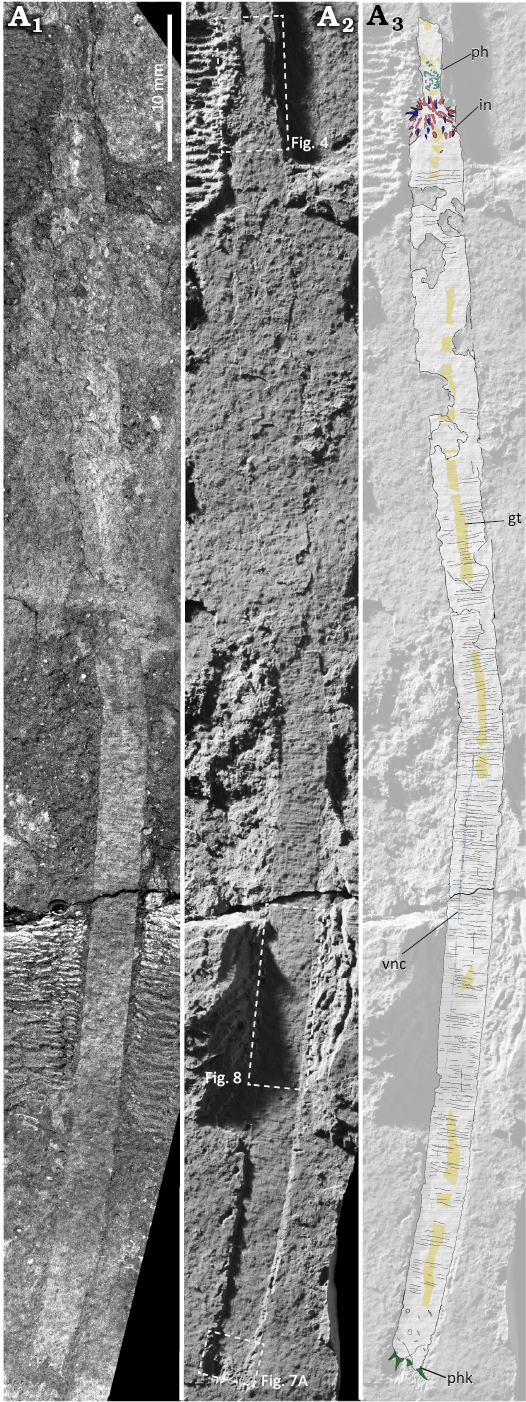
Fig. 1. Palaeoscolecidomorph worm Avannaascolex apalos gen. et sp. nov. holotype, NHMD002051391, Sirius Passet, North Greenland, Cambrian Stage 3. Photograph under high angle illumination, specimen submerged in water (A1); under low angle illumination from northwest, specimen coated with magnesium oxide (A2); interpretative drawing (A3), gut coloured yellow. Abbreviations: gt, gut; phk, posterior hook; in, introvert; ph, pharynx; vnc, ventral nerve cord.
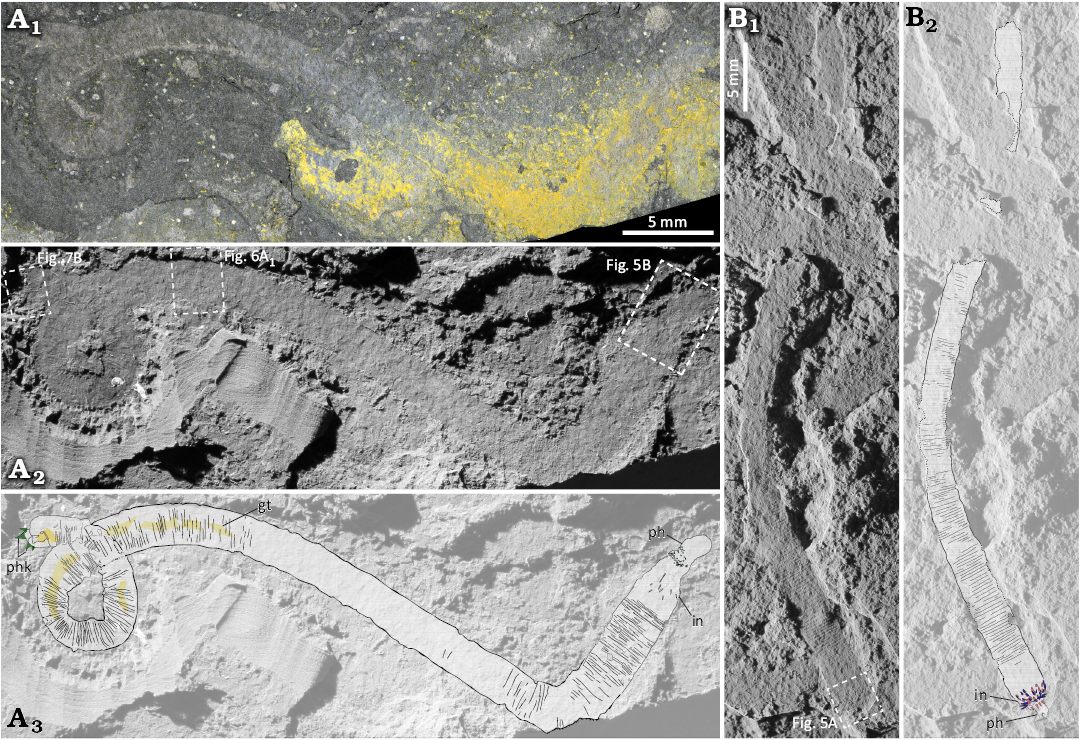
Fig. 2. Palaeoscolecidomorph worm Avannaascolex apalos gen. et sp. nov. paratypes, Sirius Passet, North Greenland, Cambrian Stage 3. A. NHMD 002051392, under high angle illumination, specimen submerged in water (A1); under low angle illumination from northwest, specimen coated with magnesium oxide (A2); interpretative drawing (A3), gut coloured yellow. B. NHMD002051393, under low angle illumination from northwest, specimen coated with magnesium oxide (B1); interpretative drawing (B2). Abbreviations: co, collar; gt, gut; in, introvert; phk, posterior hook; ph, pharynx; vnc, ventral nerve cord.
Proboscis: The proboscis can be divided into three zones (Zones I–III, proximal-to-distal) corresponding to the introvert, collar and pharynx, respectively (Conway Morris 1977; Yang et al. 2020).
In the holotype the incomplete everted pharynx (Zone III) is 5.3 mm long and broadens, proximally to distally, from 1.0 mm to 1.5 mm (Fig. 4). It is unclear whether the pharynx could be everted to this extent in life or whether this is a death response (Maas et al. 2007). Most of the pharynx is smooth and unornamented except for the most proximal region, 1.64 mm long in the holotype and approximately one-third of the preserved pharynx length, which bears teeth (Figs. 1, 2, 4, 5). The pharyngeal teeth are arranged quincunxially (Fig. 4). Tooth microanatomy is not preserved. The teeth are approximately as wide as they are long, 70 μm in the holotype (Fig. 4). In NHMD002051394 the everted foregut is extremely long (24.7 mm, anterior termination missing) but shows no evidence of ornamentation beyond the tooth region, confirming that teeth were only present proximally (Fig. 3). The extreme pharynx length in NHMD002051394 is associated with an irregular carbonaceous gut trace continuing from the trunk through the introvert and to the extreme end of the everted foregut, which may indicate that it is the result of a traumatic disarticulation of the gut rather than the life habit (Fig. 3A3).
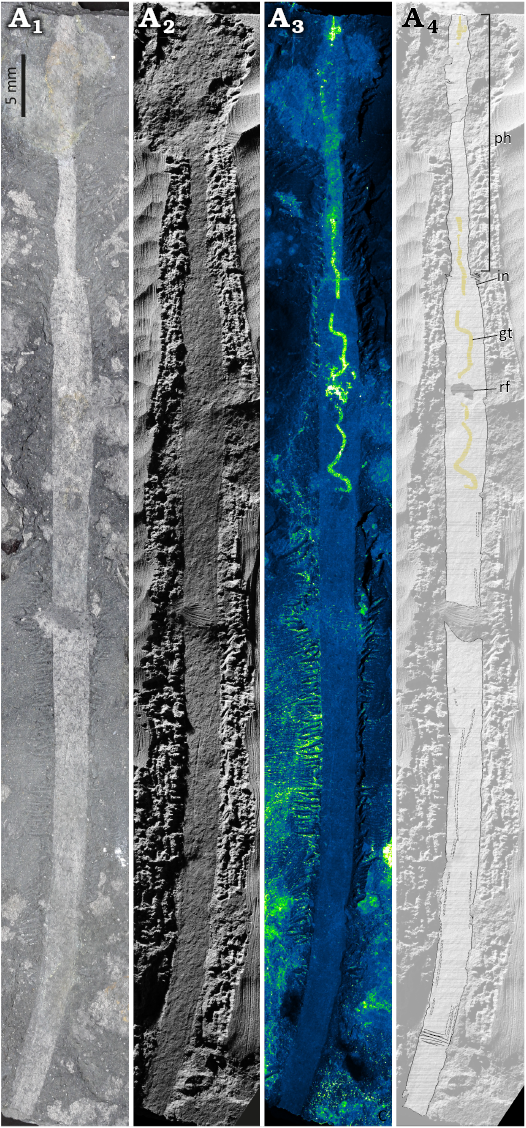
Fig. 3. Palaeoscolecidomorph worm Avannaascolex apalos gen. et sp. nov. paratype NHMD002051394, Sirius Passet, North Greenland, Cambrian Stage 3. Photograph under high angle illumination, specimen submerged in water (A1); under low angle illumination from northwest, specimen coated with magnesium oxide (A2); EPMA carbon map (A3), note the high concentration of carbon in the axial region corresponding to the gut; interpretative drawing (A4), indicating the extremely long everted pharynx; gut coloured yellow. Abbreviations: gt, gut; in, introvert; ph, pharynx; rf, indeterminate reflective region.
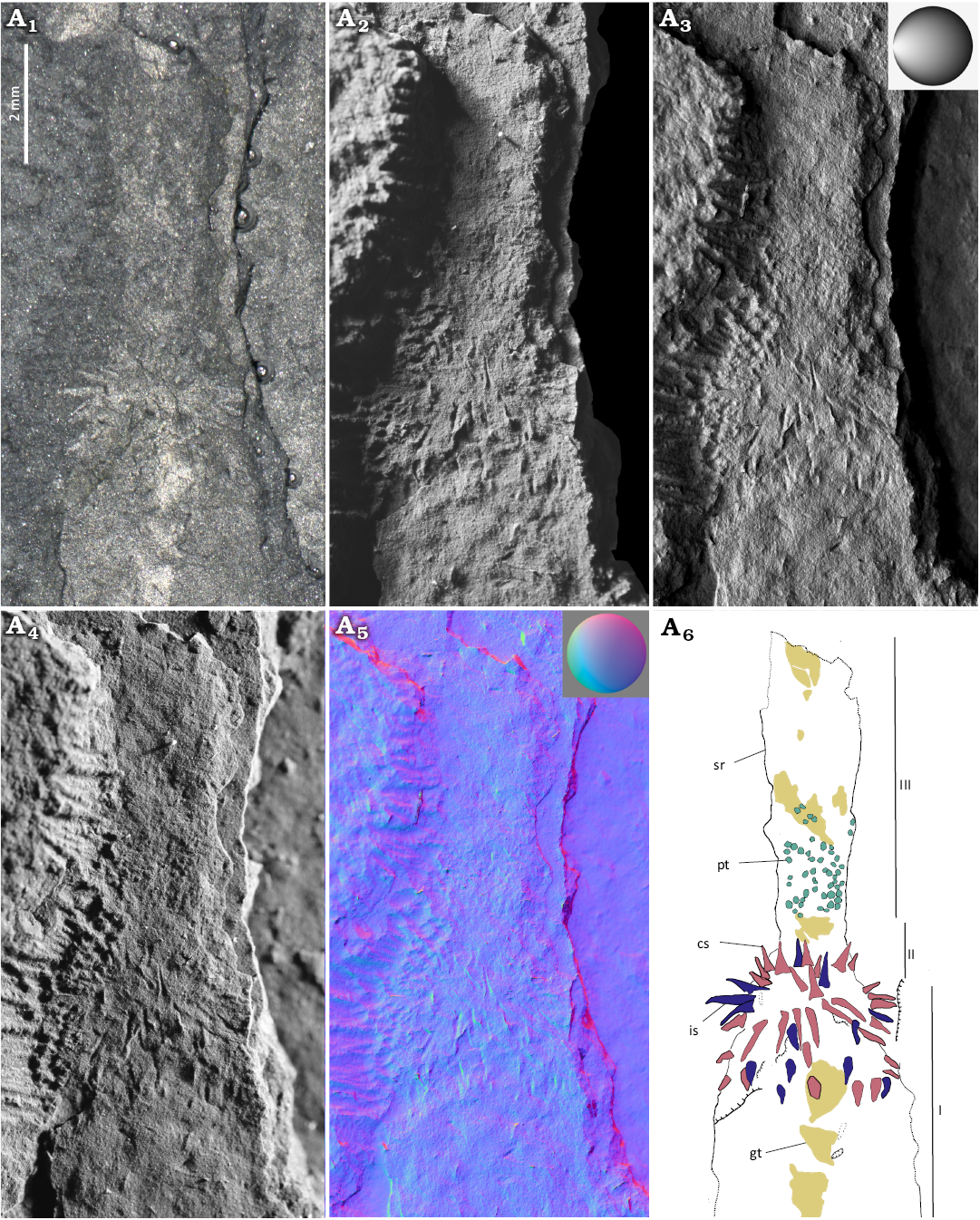
Fig. 4. The introvert, collar, and pharynx of palaeoscolecidomorph worm Avannaascolex apalos gen. et sp. nov. holotype NHMD002051391, Sirius Passet, North Greenland, Cambrian Stage 3. Pharyngeal teeth are limited to the proximal pharynx, beyond which the pharynx is smooth. At least eight triangular collar spines subtend the collar. The anterior circlet of introvert spines are long and slender, subsequent circlets contain shorter, stout spines. Photograph under high angle illumination, specimen submerged in water, with polarizer (A1); under low angle illumination from northwest, specimen coated with magnesium oxide (A2). RTI specular enhancement visualisation (A3); under low angle illumination from east northeast, specimen coated with magnesium oxide (A4); RTI normals visualisation (A5). Interpretative drawing (A6); introvert spines preserved in negative relief coloured in red, introvert spines preserved in positive relief coloured in purple. Spheres indicate virtual illumination directions. Abbreviations: cs, collar spines; gt, gut; is, introvert spine; pt, pharyngeal tooth; sr, smooth region.
Posterior of the toothed region is the collar (Zone II). The collar consists of a short, unarmed region, 0.1 mm long in the holotype, with a circlet of anteriorly directed spines at its base (Figs. 4, 5A). These spines have an isosceles triangle shape, around 0.3 mm long and 0.2 mm wide at the base in the holotype (Figs. 4, 5A).
Posterior of the collar is the introvert (Zone I) (Figs. 1–5). The introvert is at least partially inversible (Fig. 5A). The anterior half of the introvert bears spines while the posterior half is smooth (Figs. 1–5). Although no specimen preserves a full complement of spines, they are arranged radially surrounding the introvert in five transverse circlets, such that the spines also form longitudinal rows (Figs. 4, 5). The introvert spines of the anteriormost circlet are longer than those of the more posterior circlets (Figs. 1, 2, 4, 5). In NHMD002051391 these longer spines are on average 0.6 mm long, while the shorter spines are on average 0.35 mm long (Fig. 4). The apparent length of a preserved spine will be affected by its orientation relative to the bedding plane, from heavily foreshortened if perpendicular to the bedding plane, or the true length if completely parallel to it (Briggs and Williams 1981). The longest anterior spine in the holotype, preserved in profile and therefore the closest to a true representation of their morphology, is 0.8 mm long. The anterior spines are slender, slightly wider at the base but otherwise tapering uniformly to a point (Figs. 4, 5A). In profile, their dorsal side is smoothly curved while their ventral side is bulbous, proximal to the attachment point, followed by a constriction, after which they curve gently to form a recurved point (Figs. 4, 5A). The spines of the posterior rings are stouter, of typical palaeoscolecid morphology (Figs. 1, 2, 4, 5).
Trunk: The trunk is long and slender, narrowing slightly posteriorly (Figs. 1–3). The trunk bears homonomous annuli (Figs. 1, 2, 6A1). Annuli are 180–200 μm wide and separated by furrows c. 50 μm wide in the holotype (Fig. 1). Approximately 230 annuli are preserved in NHMD002051391 (Fig. 1). By comparison of the annulus width to the trunk length, at least 300 would have been present in life. Apart from the annuli, the trunk is smooth, without sclerites (Fig. 6).
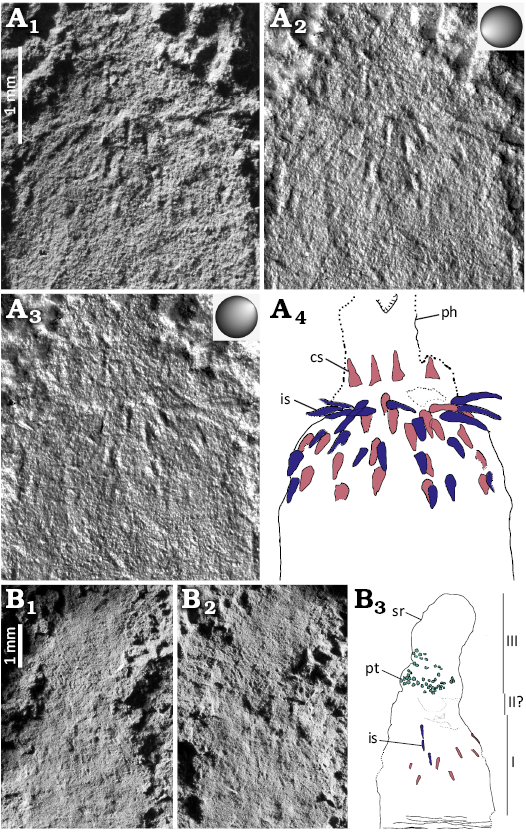
Fig. 5. The introvert, collar, and pharynx of palaeoscolecidomorph worm Avannaascolex apalos gen. et sp. nov. paratypes, Sirius Passet, North Greenland, Cambrian Stage 3. Introvert spines preserved in negative relief coloured in red, introvert spines preserved in positive relief coloured in purple. A. NHMD002051393 (box in Fig. 2B1), photograph under low angle illumination from northwest, specimen coated with magnesium oxide (A1); RTI specular enhancement visualisation(A2); RTI specular enhancement visualisation, alternative lighting (A3); interpretative drawing (A4). B. NHMD002051392 (box in Fig. 2A2) specimen coated with magnesium oxide, photograph under low angle illumination from northwest (B1); under low angle illumination from east (B2); interpretative drawing (B3). Spheres indicate virtual illumination directions. Abbreviations: cs, collar spine; gt, gut; is, introvert spine; pt, pharyngeal tooth; sr, smooth region.
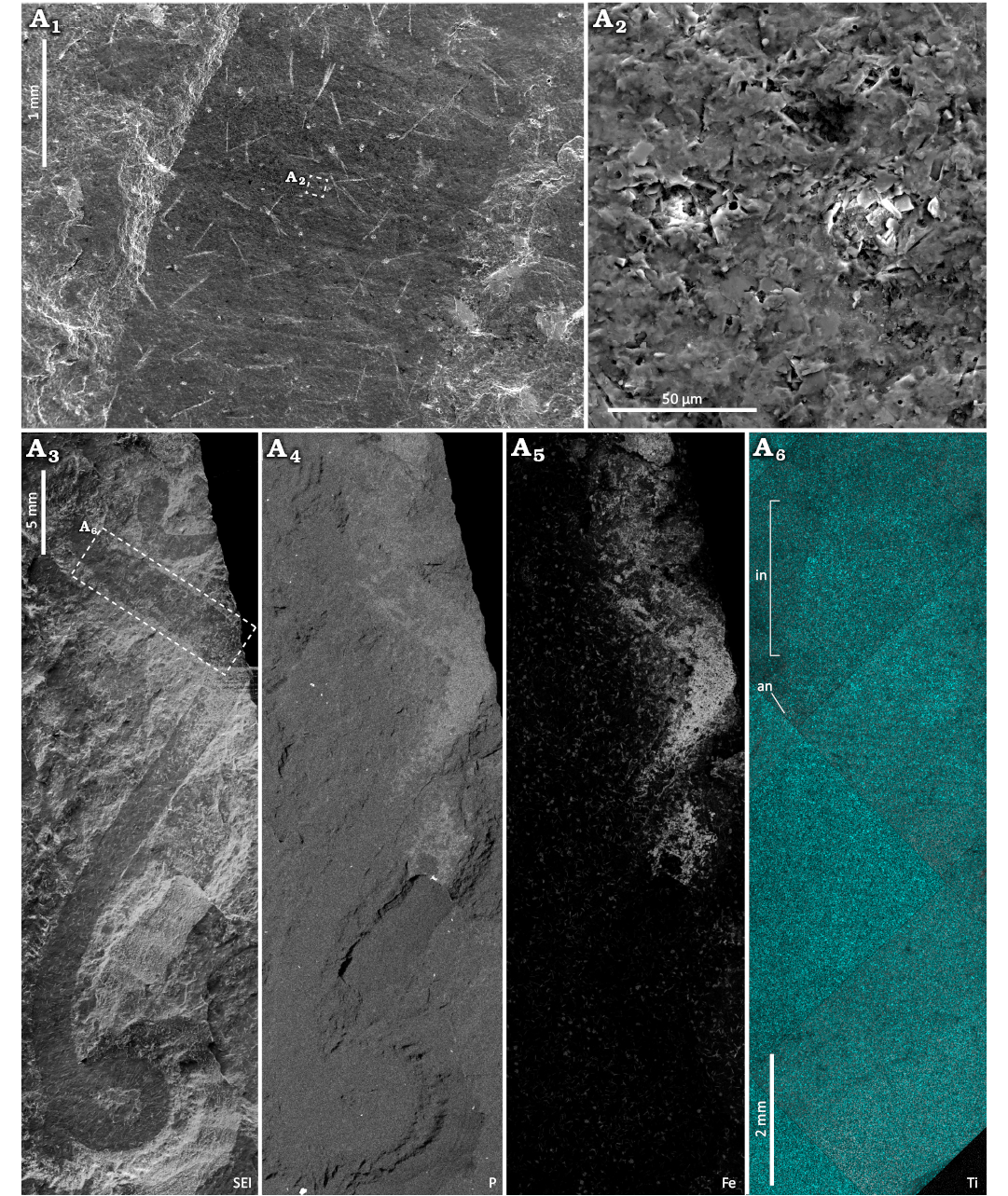
Fig. 6. Trunk cuticle lacking sclerites in palaeoscolecidomorph worm Avannaascolex apalos gen. et sp. nov. paratype NHMD002051392, Sirius Passet, North Greenland, Cambrian Stage 3. A1, SEM micrograph of trunk (box in Fig. 2A2); A2, annuli are visible but no sclerites are present; detail of scattered voids left by dissolved pyrite during weathering; A3, SEM micrograph of whole specimen; A4, EDS phosphorus (P) map, showing elevated P concentration only in one anterior region; A5, EDS iron (Fe) map, showing the anterior region enriched in iron due to weathering products (see yellow crust in Fig. 2A1); A6, EDS titanium (Ti) map, showing a faint concentration corresponding to the introvert and annuli. Abbreviations: an, annuli; in, introvert.
Posterior termination: The trunk terminates in two lobes, each bearing two posteriorly directed, slightly recurved hooks, one larger than the other (Figs. 1, 2A, 7). Each hook is wider at the base, tapering to a sharp point (Figs. 1, 2A2, A3, 7). In the holotype, NHMD002051391, they are of maximum length 0.86 mm and maximum base width 0.43 mm (Figs. 1, 2A, 7). In NHMD002051391 a distinct groove is identifiable within each hook, which may indicate that they were hollow (Fig. 7A).
Gut: The gut is preserved in relief or as a reflective film. Both forms of preservation can appear in the same specimen, usually with little overlap (Figs. 1, 2A, 3). It is uniform in width, around 25% the width of the trunk (Figs. 1, 2A), and is generally straight. The gut runs the length of the proboscis, shown by the reflective film extending from the trunk through the head and into the pharynx in NHMD002051391 and NHMD002051394 (Figs. 1, 3).
Ventral nerve cord: In the holotype, a thin, longitudinal structure 19.6 mm long and uniformly 60 μm wide is preserved in relief in the posterior half of the specimen (Figs. 1, 8) representing the ventral nerve cord (VNC). As this structure presents a distinct, uniform boundary with no evidence of pairing, we interpret the VNC as unpaired.
Stratigraphic and geographic range.—Type horizon and locality only.
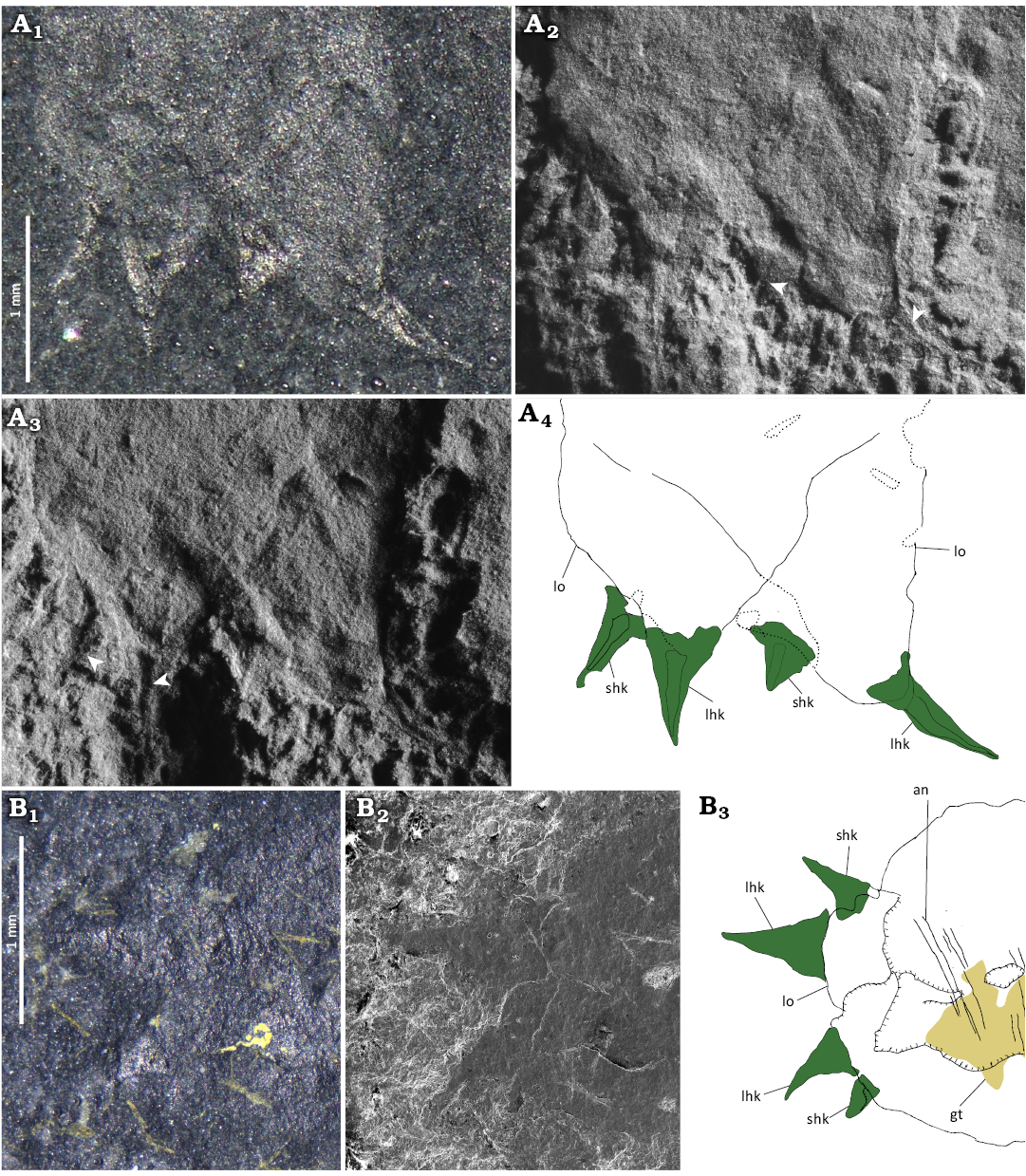
Fig. 7. Posterior lobes and hooks in palaeoscolecidomorph worm Avannaascolex apalos gen. et sp. nov., Sirius Passet, North Greenland, Cambrian Stage 3. The posterior trunk was divided into two lobes, each bearing one large and one small posterior hook. A. Holotype NHMD002051391 (box in Fig. 1A2): photograph under high angle illumination, specimen submerged in water, with polarizer (A1); under low angle illumination from northwest, specimen coated with magnesium oxide (A2), arrowheads indicate central grooves within the posterior hooks; under low angle illumination from east, specimen coated with magnesium oxide (A3), arrowheads indicate central grooves within the posterior hooks; interpretative drawing (A4). B. NHMD002051392 (box in Fig. 2A2), photograph under high angle illumination, specimen submerged in water (B1); SEM secondary electron image (B2); interpretative drawing (B3). Abbreviations: an, annulus; gt, gut; lhk, large hook; lo, lobe; shk, small hook.
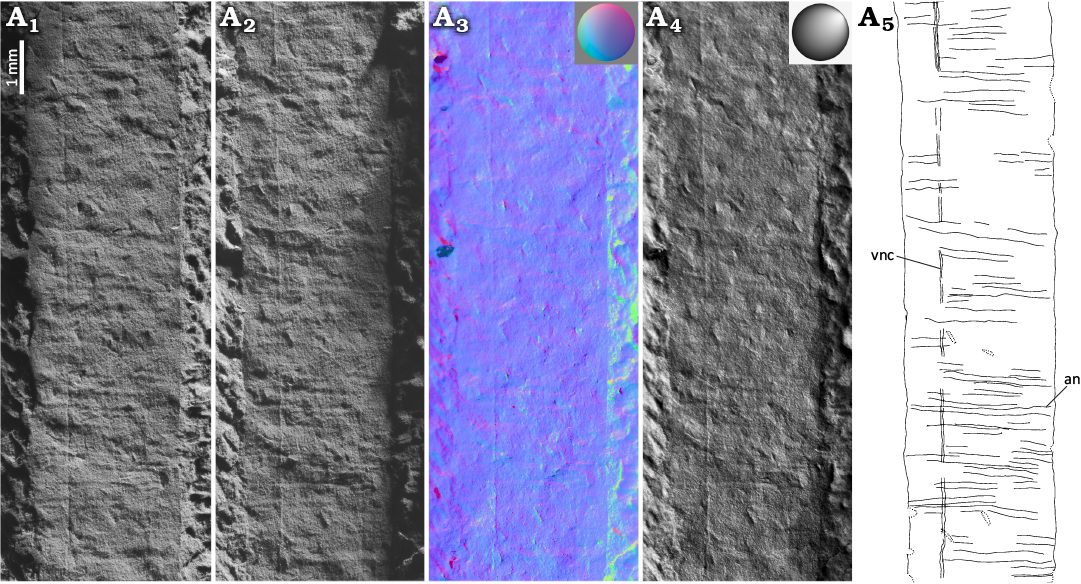
Fig. 8. Ventral nerve cord in palaeoscolecidomorph worm Avannaascolex apalos gen. et sp. nov. holotype NHMD002051391, Sirius Passet, North Greenland, Cambrian Stage 3 (box in Fig. 1A2). Photograph under low angle illumination from northwest, specimen coated with magnesium oxide (A1); under low angle illumination from northeast, specimen coated with magnesium oxide (A2); RTI normals visualisation (A3); RTI specular enhancement visualisation (A4); interpretative drawing (A5). Spheres indicate virtual illumination directions. Abbreviations: an, annulus; vnc, ventral nerve cord.
Results
Taphonomy.—We interpret the absence of sclerites on the trunk of Avannaascolex apalos gen. et sp. nov. as primary, rather than taphonomic. Palaeoscolecidan sclerites were biomineralized and primarily phosphatic (Harvey et al. 2010). In other Konservat-Lagerstätten, palaeoscolecidan sclerites can be identified through SEM and element mapping, where they maintain their phosphatic composition (Huang 2005; Hu 2005; García-Bellido et al. 2013; Smith 2015; Whitaker et al. 2020; Leibach et al. 2021; Howard et al. 2024). Extensive metamorphic remobilisation of phosphate has occurred in Sirius Passet that, along with weathering, has produced mineralogical equilibrium between fossils and matrix sometimes resulting in the total loss of phosphorus in primarily phosphatised tissues (Nielsen et al. 2021). Meanwhile, non-mineralised sclerotized structures on the scale of palaeoscolecidomorph plates, (e.g., 50–100 μm in diameter, García-Bellido et al. 2013), are preserved in Sirius Passet (pharyngeal teeth, Figs. 4, 5; Stein 2010: fig. 3; Peel 2017: fig. 2B).
WDS and EDS analysis of Avannaascolex apalos gen. et sp. nov. indicates no difference in phosphorus concentration between the fossils, their immediate vicinity and the surrounding matrix suggesting an absence of primary phosphate that could have been remobilised during metamorphism (Fig. 6 and SOM 5). Instead, elevated phosphorus is only present when associated with orange-yellow ferrous weathering products (Figs. 2A1, 6A3–A5). A faint elevation of titanium is visible associated with the fossil cuticle, particularly the annuli, but shows no evidence of sclerites (Fig. 6A6). The association of titanium with primarily chitinous structures is known elsewhere in Sirius Passet, particularly in annelid chaetae (JV, personal observation).
Two sclerite-bearing ecdysozoan worms are known from Sirius Passet: Chalazoscolex and Xystoscolex. While the positions of these taxa within Ecdysozoa have not been rigorously tested, sclerites of unknown primary composition ornamenting their trunks are preserved in prominent relief (Conway Morris and Peel 2010). We therefore expect that if Avannaascolex apalos gen. et sp. nov. bore trunk sclerites, some evidence of them would be preserved, and hence conclude that this taxon lacked biomineralized or sclerotised trunk sclerites in life.
Phylogeny.—Under maximum likelihood (ML) and equal and implied weights maximum parsimony, Avannaascolex apalos gen. et sp. nov. is consistently resolved within a monophyletic Palaeoscolecidomorpha clade within total-group Priapulida (Fig. 9). In the ML analysis it is resolved as the sister taxon to Markuelia in a polytomy with Maotianshania and Cricocosmiidae, which together form the sister group to Palaeoscolecida (Fig. 9A). When k = ∞, the internal relationships of Palaeoscolecidomorpha are less well resolved: Avannaascolex apalos gen. et sp. nov. forms a polytomy with Palaeoscolecida, Tylotites + Cricocosmia and the remaining palaeoscolecidomorphs (Fig. 9B). When k = 3, the topology is the same, except that Palaeoscolecida is the sister clade to all other palaeoscolecidomorphs (Fig. 9C).
Under Bayesian inference and inapplicable-aware parsimony (k = ∞, k = 3), palaeoscolecidomorphs form a paraphyletic grade in a polytomy with Nematoida and Panarthropoda (Fig. 10). Palaeoscolecida is resolved as monophyletic in all cases (Fig. 10). The cricocosmiids form a paraphyletic grade to Panarthropoda under inapplicable-aware parsimony, but which taxa are more closely related to the panarthropods varies between concavity constants (Fig. 10B, C).
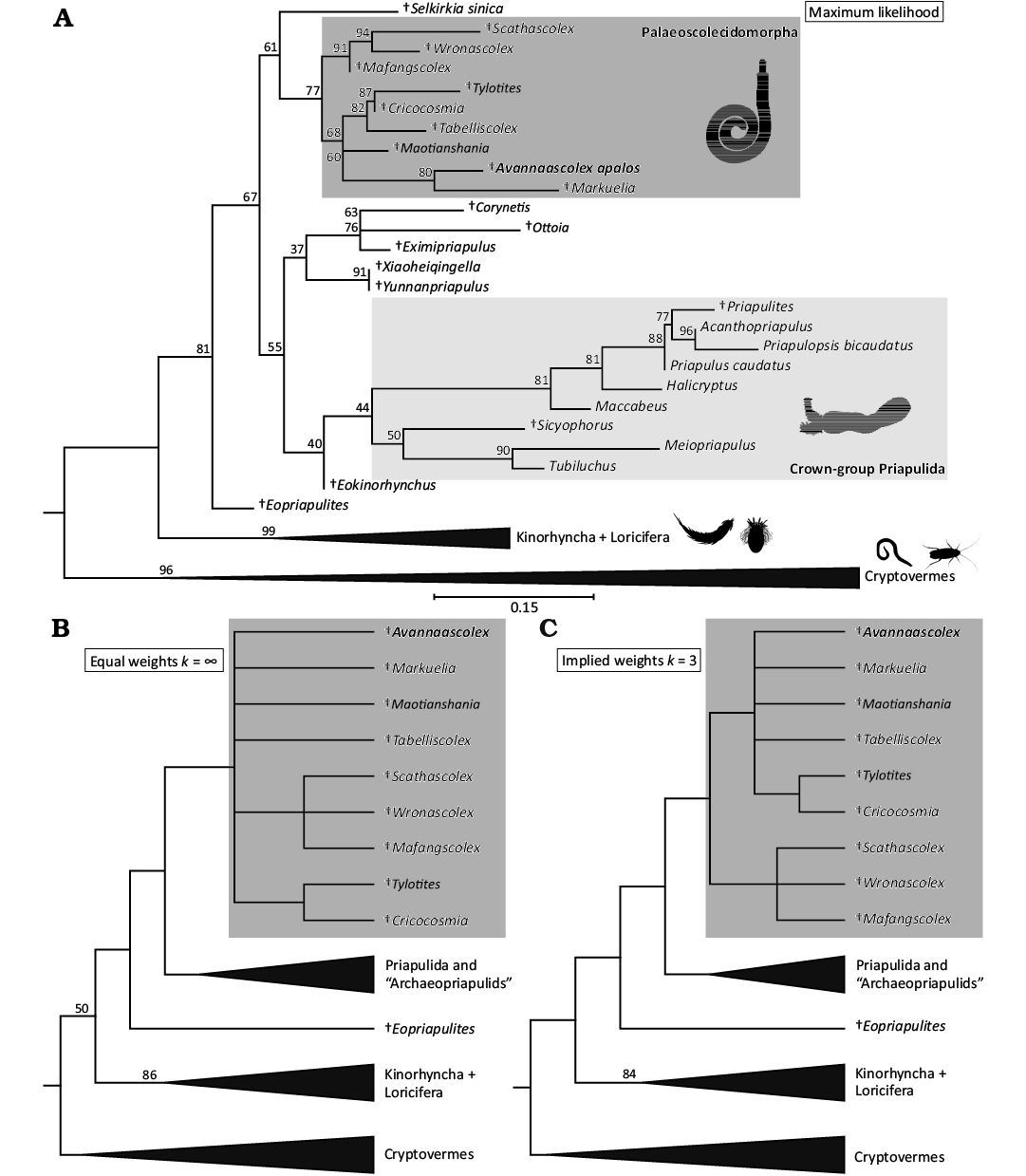
Fig. 9. Phylogenetic analyses under maximum likelihood and standard maximum parsimony optimality criteria. All analyses resolve Avannaascolex apalos gen. et sp. nov. within a monophyletic Palaeoscolecidomorpha clade, within total-group Priapulida. All trees were rooted on the branch leading to Nematoida + Panarthropoda (= Cryptovermes). A. Maximum likelihood, log-likelihood -2401. Numbers on nodes represent bootstrap support. B. Equal weights parsimony, strict consensus of 37 most parsimonious trees, length 359. Numbers on nodes represent jackknife support ≥ 50. C. Implied weights, k = 3, parsimony, strict consensus of 17 best fit trees, score 25.3. Numbers on nodes represent symmetrical resampling frequency differences (G/C) ≥ 50. Kinorhynch silhouette by Michelle Site, reused under Attribution-NonCommercial 3.0 Unported license, no changes made. Dagger denotes extinct taxa. The name in bold is the taxon described in this paper.
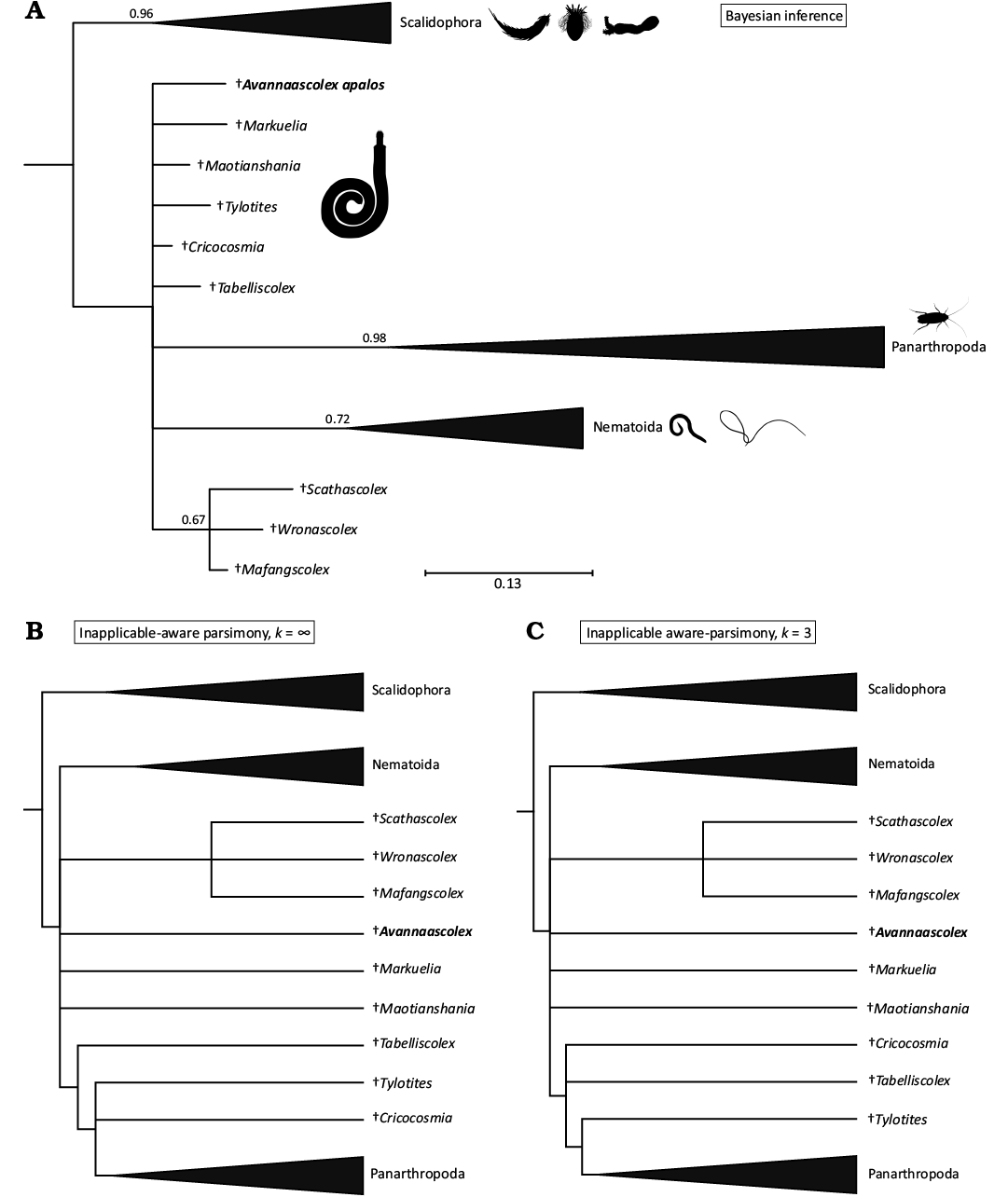
Fig. 10. Phylogenetic analyses under Bayesian inference and inapplicable-aware parsimony optimality criteria. All trees were rooted on the branch leading to the clade which includes Nematoida and Panarthropoda. A. Bayesian inference majority rule consensus tree. Numbers at nodes represent posterior probabilities. B. Equal weights inapplicable-aware parsimony, strict consensus of 170 most parsimonious trees, length 377. C. Implied weights, k = 3, inapplicable-aware parsimony, strict consensus of 170 best fit trees, score 27.6. Kinorhynch silhouette by Michelle Site, reused under Attribution-NonCommercial 3.0 Unported license, no changes made. The name in bold is the taxon described in this paper. Dagger denotes extinct taxa.
Discussion
The phylogenetic position of Avannaascolex apalos.—The resolution of Avannaascolex apalos gen. et sp. nov. within a monophyletic palaeoscolecidomorph clade (Fig. 9) or among a paraphyletic palaeoscolecidomorph grade (Fig. 10) reflects ongoing uncertainty regarding the phylogenetic position and monophyly of Palaeoscolecidomorpha (Shi et al. 2021; Smith and Dhungana 2022). It should be noted that statistical support for almost every relevant node is low under all optimality criteria (Figs. 9, 10), making any conclusions drawn from these analyses uncertain. However, membership of Avannaascolex apalos gen. et sp. nov. in Palaeoscolecidomorpha is compatible with the group being either a clade or a grade.
Recent studies have highlighted the occurrence of paired ventral projections in cricocosmiids and palaeoscolecidans and have argued for or against their homology with the paired ventral appendages of panarthropods (Shi et al. 2021, 2026). We did not identify similar structures in Avannaascolex apalos gen. et sp. nov., but their rarity in other taxa means this could be an artefact of our small sample size or due to preservational conditions in Sirius Passet, as paired ventral projections in compression fossils have only been identified in the Chengjiang and Guanshan Lagerstätten (Shi et al. 2021, 2026).
Under maximum likelihood (Fig. 9A) and implied weights (k = 3) standard parsimony (Fig. 9), the cricocosmiids, Maotianshania, Markuelia, and Avannaascolex apalos gen. et sp. nov. form a clade to the exclusion of Palaeoscolecida, reflecting a division between those palaeoscolecidomorphs with a tessellating phosphatic scleritome and fully armed introvert and those without. Cricocosmiidae, Maotianshania, and Avannaascolex apalos gen. et sp. nov. all share an unarmed posterior introvert while the condition in Markuelia is unclear (Dong et al. 2010; Shi et al. 2021). Where a sister-taxon is resolved for Avannascolex apalos gen. et sp. nov. (under maximum likelihood), it forms a clade with Markuelia (Fig. 9A). Both taxa lack a scleritome and are the only non-Palaeoscolecida palaeoscolecidomorphs with more than one pair of posterior hooks in the present taxon sample (two pairs in Avannascolex apalos gen. et sp. nov., three in Markuelia) (Dong et al. 2010; Smith 2015; Shi et al. 2021). Markuelia, as a fossil embryo, represents an ontogenetic mismatch compared to the adult specimens of Avannascolex apalos gen. et sp. nov. presented here (Dong et al. 2010), but is interpreted as a direct developer, suggesting that it is unlikely to have undergone significant anatomical changes in its transition to adulthood (Duan et al. 2012).
Under all topologies the lack of trunk sclerites in Avannascolex apalos gen. et sp. nov.—whether paired as in Cricocosmiidae or in tessellating annular rings as in Palaeoscolecida—is resolved as plesiomorphic and does not result from secondary loss. The armoured trunks of Cricocosmiidae and Palaeoscolecida may have provided enhanced defensive and/or locomotory functions: their absence in Avannascolex apalos gen. et sp. nov. may result from a different evolutionary response to these challenges, perhaps reflecting local environmental conditions in Cambrian Stage 3 Laurentia.
The detailed preservation of introvert spines in Sirius Passet.—The exceptional preservation of the introvert spines allows us to elucidate their morphology in detail. This pattern is consistent across ecdysozoan worms known from Sirius Passet (Fig. 9). Most specimens lack the high-fidelity kerogenous films known in similar taxa from the Burgess Shale (Conway Morris 1977; Smith 2015) due to the much higher temperatures incurred during metamorphism at Sirius Passet (Topper et al. 2018), instead retaining detailed morphological information in topographical relief. This can be more difficult to interpret, illustrate and compare to other Burgess Shale type localities, especially due to chloritoid porphyroblasts that constantly cross-cut fossils (Ineson and Peel 2011; Nielsen et al. 2021), but it still yields equally detailed anatomical information (Fig. 11). In trying to draw out more phylogenetically relevant characters from fossil ecdysozoan worms, most recent work has focused on the arrangement of their introvert spine, rather than the anatomy of the spines themselves (Yang et al. 2020; Wang et al. 2023). However, detailed assessment of fossils with well-preserved introvert spines may bring to light anatomical patterns relevant for resolving the position of palaeoscolecidomorphs and their relatives (see Mussini and Butterfield 2025, for example). The triangular collar spines of Avannaascolex apalos gen. et sp. nov. are unknown from other Cambrian ecdysozoan worms but are reminiscent of the median ring proboscis spines in extant gordiid nematomorph larvae (Schmidt-Rhaesa 2013a). This is relevant because palaeoscolecidomorphs have previously been suggested to have affinities with nematomorphs (Hou and Bergström 1994; Harvey et al. 2010; Wills et al. 2012). Future work should attempt sufficiently detailed illustration and reconstruction of these potentially phylogenetically informative features.
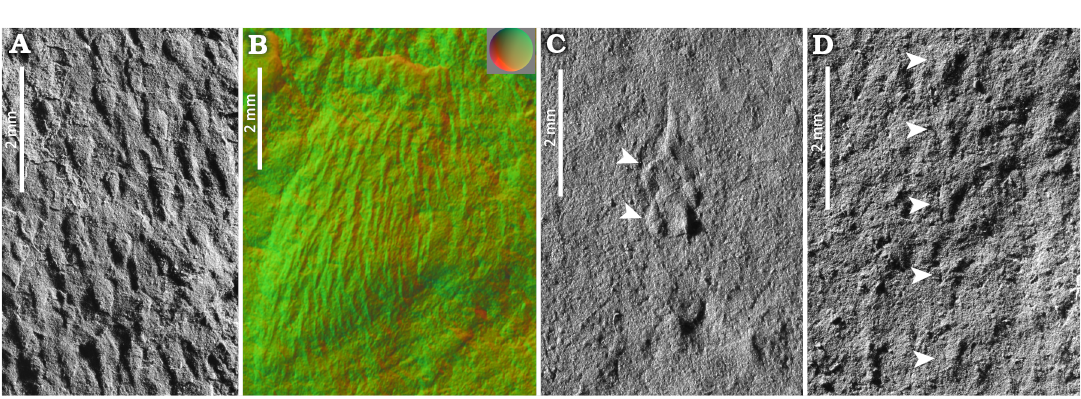
Fig. 11. Exceptional relief preservation of shape information in introvert elements of ecdysozoan worms from Sirius Passet, North Greenland, Cambrian Stage 3. A. Inverted teardrop-shaped introvert spines of an Xystoscolex boreogyrus Conway Morris & Peel, 2010, JV-2025-0008 under low angle illumination from northeast. B. RTI normals image (colours inverted) of partial introvert of Chalazoscolex pharkus Conway Morris & Peel, 2010, MGUH 29134 showing elongate triangular spines. C. Two superimposed denticles of Sirilorica carlsbergi Peel, 2010, SP-2017-234 under low angle illumination from northwest. Arrowheads indicate the bases of the two denticles. Note the finely preserved papillated cuticle surrounding the denticles. D. Triangular scalids in an undescribed priapulidan, SP-2016-331 under low angle illumination from northwest. Sphere indicates virtual illumination direction. Arrowheads indicate individual scalids. A, C, and D specimens coated with magnesium oxide.
Ventral nerve cord.—The longitudinal structure in the posterior half of the holotype of Avannaascolex apalos is striking because of its high relief and off-centre position. There are no other longitudinal structures in this region, as would be expected if it represented preservation of a longitudinal muscle, and it does not correspond to the gut, which runs centrally down the trunk (Fig. 1). Muscle preservation in Sirius Passet primarily occurs through phosphatisation and silicification (Nielsen et al. 2021; Park et al. 2024), of which there is no evidence in these specimens (see SOM 5), making it unlikely to represent a longitudinal or introvert retractor muscle. The consistent width and parallel borders of the structure argue against it representing a post-mortem fold in the decaying cuticle (Fig. 1A2, C, 8). This structure is interpreted as a fragment of the unpaired ventral nerve cord.
In extant nematoids and scalidophorans, the VNC is entirely intraepidermal (Schmidt-Rhaesa 2007, 2013a, b). Despite the labile nature of nervous tissue, decay experiments on extant priapulidans have shown that the VNC can imprint its morphology on the overlying cuticle during decay (Wang et al. 2025). Wang et al. (2025) proposed two modes of VNC preservation in fossil Scalidophora: three-dimensional preservation in phosphatised specimens in Orsten-type preservation and two-dimensional preservation as a carbonaceous film in Burgess Shale-type preservation. In NHMD002051391 collapse of the cuticle during decay may have caused it to take on the shape of the VNC, likely due to the thickened epidermis surrounding it. This relief was maintained following compression of the organism during decay and diagenesis. A carbonaceous film may have originally been present, as with other preserved nervous systems in this locality (Park et al. 2018, 2024; Vinther et al. 2025), but subsequently lost due to weathering or incomplete splitting. While only one specimen preserves this feature, we note that among many hundreds of Mafangscolex yunnanensis (Hou & Sun, 1988) and Ottoia prolifica Walcott, 1911a, specimens known, only one specimen of the former and two of the latter are reported with preserved VNCs (Conway Morris 1977; Wang et al. 2025).
In Priapulida and Nematoda the VNC is entirely unpaired (Schmidt-Rhaesa 2007). In Nematomorpha the VNC is unpaired in the trunk, but is paired where it emerges from the brain (Schmidt-Rhaesa 2013a). Mafangscolex yunnanensis also has an unpaired VNC in the trunk, but data are unavailable on the nature of its attachment to the brain (Wang et al. 2025). Markuelia hunanensis Dong & Donoghue in Dong et al., 2004, presents paired projections from the aboral side of its brain (Dong et al. 2022) but it is unclear whether these projections represent a paired origin of the VNC or unpaired dorsal and ventral nerve cords. Avannaascolex apalos gen. et sp. nov. supports the reconstruction of the general palaeoscolecidomorphan VNC as unpaired and therefore lends further supports this as the plesiomorphic condition for Ecdysozoa.
Conclusions
Palaeoscolecidomorphs are known from many localities and preservational modes from the Cambrian to the Silurian. Previously, only the putative palaeoscolecidans Xystoscolex boreogyrus and Chalazoscolex pharkus were known from the Sirius Passet Lagerstätte, but these taxa do not fulfil the diagnosis of Palaeoscolecidomorpha and were not explicitly included in the erection of that clade (Shi et al. 2021). Our description of Avannaascolex apalos gen. et sp. nov. confirms the presence of this characteristic early Palaeozoic clade in Sirius Passet and demonstrates the exceptional preservation of sclerotized cuticular armament among ecdysozoan worms in this locality. Avannaascolex gen. nov. is unusual in lacking trunk sclerites, the presence of which is shared by all other palaeoscolecidomorphs except the fossil embryo Markuelia. The holotype specimen preserves an unpaired ventral nerve cord, supporting this as the plesiomorphic condition for Ecdysozoa.
Acknowledgements
We thank Yuning Yang (Northwest University, Xi’an, China) and Julien Kimmig (Staatliches Museum für Naturkunde Karlsruhe, Germany) for their helpful reviews. Stuart Kearns and Benjamin Buse (both School of Earth Sciences, University of Bristol, UK) assisted with production of the titanium map in Fig. 6. Joseph Keating (School of Biological Sciences, University of Bristol, UK) assisted with running inapplicable-aware parsimony analyses. This work was carried out using the computational facilities of the Advanced Computing Research Centre, University of Bristol (http://www.bristol.ac.uk/acrc/). The fieldwork was supported by Korea Polar Research Institute (KOPRI) grant funded by the Ministry of Oceans and Fisheries (KOPRI project No. PE26060). TF is supported by the Natural Environment Research Council GW4+ Doctoral Landscape Training Partnership (grant number NE/S007504/1) and KOPRI. LAP is supported by by a Natural Environment Research Council Independent Research Fellowship (grant number NE/W007878/2). T-YSP is supported by National Research Foundation of Korea, RS-2024-00350730.
Editor: Andrzej Kaim
References
Abràmoff, M.D., Magalhães, P.J., and Ram, S.J. 2004. Image processing with ImageJ. Biophotonics international 11 (7): 36–42.
Aguinaldo, A.M.A., Turbeville, J.M., Linford, L.S., Rivera, M.C., Garey, J.R., Raff, R.A., and Lake, J.A. 1997. Evidence for a clade of nematodes, arthropods and other moulting animals. Nature 387: 489–493. Crossref
Bather, F.A. 1920. Protoscolex latus, a new “worm” from Lower Ludlow beds. Annals and Magazine of Natural History 5 (25): 124–132. Crossref
Bengtson, S. 2004. Early skeletal fossils. The Paleontological Society Papers 10: 67–78. Crossref
Bianchini, G. and Sánchez-Baracaldo, P. 2024. TreeViewer: Flexible, modular software to visualise and manipulate phylogenetic trees. Ecology and Evolution 14 (2): e10873. Crossref
Blaker, M.R. 1988. A new genus of nevadiid trilobite from the Buen Formation (Early Cambrian) of Peary Land, central North Greenland. In: J. Peel (ed.), Cambrian–Jurassic Fossils, Trace Fossils and Stratigraphy from Greenland, 33–41. Grønlands Geologiske Undersøgelse Rapport, Copenhagen. Crossref
Brazeau, M.D., Guillerme, T., and Smith, M.R. 2019. An algorithm for morphological phylogenetic analysis with inapplicable data. Systematic Biology 68: 619–631. Crossref
Briggs, D.E.G. and Williams, S.H. 1981. The restoration of flattened fossils. Lethaia 14: 157–164. Crossref
Budd, G.E. 2011. Campanamuta mantonae gen. et. sp. nov., an exceptionally preserved arthropod from the Sirius Passet Fauna (Buen Formation, lower Cambrian, North Greenland). Journal of Systematic Palaeontology 9: 217–260. Crossref
Butterfield, N.J. and Harvey, T.H.P. 2012. Small carbonaceous fossils (SCFs): A new measure of early Paleozoic paleobiology. Geology 40: 71–74. Crossref
Caron, J.-B., Smith, M.R., and Harvey, T.H. 2013. Beyond the Burgess Shale: Cambrian microfossils track the rise and fall of hallucigeniid lobopodians. Proceedings of the Royal Society B: Biological Sciences 280: 20131613. Crossref
Chen, J.-Y. and Zhou, G.Q. 1997. Biology of the Chengjiang fauna. Bulletin of the National Museum of Natural Science 10: 11–105.
Conway Morris, S. 1977. Fossil priapulid worms. Special Papers in Palaeontology 20: 1–95.
Conway Morris, S. 1997. The cuticular structure of the 495-Myr-old type species of the fossil worm Palaeoscolex, P. piscatorum (? Priapulida). Zoological Journal of the Linnean Society 119: 69–82. Crossref
Conway Morris, S. and Peel, J.S. 2010. New palaeoscolecidan worms from the Lower Cambrian: Sirius Passet, Latham Shale and Kinzers Shale. Acta Palaeontologica Polonica 55: 141–156. Crossref
Conway Morris, S. and Robison, R.A. 1986. Middle Cambrian priapulids and other soft-bodied fossils from Utah and Spain. University of Kansas Paleontological Contributions Papers 117: 1–22.
Dong, X.-P., Bengtson, S., Gostling, N.J., Cunningham, J.A., Harvey, T.H., Kouchinsky, A., Val’Kov, A.K., Repetski, J.E., Stampanoni, M., and Marone, F. 2010. The anatomy, taphonomy, taxonomy and systematic affinity of Markuelia: Early Cambrian to Early Ordovician scalidophorans. Palaeontology 53: 1291–1314. Crossref
Dong, X.-P., Donoghue, P.C.J., Cheng, H., and Liu, J.-B. 2004. Fossil embryos from the Middle and Late Cambrian period of Hunan, south China. Nature 427: 237–240. Crossref
Dong, X.-P., Duan, B., Liu, J., and Donoghue, P.C.J. 2022. Internal anatomy of a fossilized embryonic stage of the Cambrian–Ordovician scalidophoran Markuelia. Royal Society Open Science 9 (10): 220115. Crossref
Duan, B., Dong, X.P., and Donoghue, P.C.J. 2012. New palaeoscolecid worms from the Furongian (upper Cambrian) of Hunan, South China: is Markuelia an embryonic palaeoscolecid? Palaeontology 55: 613–622. Crossref
Dzik, J. and Krumbiegel, G. 1989. The oldest “onychophoran” Xenusion—a link connecting phyla? Lethaia 22: 169–181. Crossref
Farris, J.S., Albert, V.A., Källersjö, M., Lipscomb, D., and Kluge, A.G. 1996. Parsimony jackknifing outperforms neighbor-joining. Cladistics 12: 99–124. Crossref
García-Bellido, D.C., Paterson, J.R., and Edgecombe, G.D. 2013. Cambrian palaeoscolecids (Cycloneuralia) from Gondwana and reappraisal of species assigned to Palaeoscolex. Gondwana Research 24: 780–795. Crossref
Goloboff, P.A., Farris, J.S., Källersjö, M., Oxelman, B., Ramıacute, rez, M., J, n., and Szumik, C.A. 2003. Improvements to resampling measures of group support. Cladistics 19: 324–332. Crossref
Goloboff, P.A. and Morales, M.E. 2023. TNT version 1.6, with a graphical interface for MacOS and Linux, including new routines in parallel. Cladistics 39: 144–153. Crossref
Hammarlund, E.U., Smith, M.P., Rasmussen, J.A., Nielsen, A.T., Canfield, D.E., and Harper, D.A. 2019. The Sirius Passet Lagerstätte of North Greenland—A geochemical window on early Cambrian low‐oxygen environments and ecosystems. Geobiology 17: 12–26. Crossref
Harper, D.A.T., Hammarlund, E.U., Topper, T.P., Nielsen, A.T., Rasmussen, J.A., Park, T.Y.S., and Smith, M.P. 2019. The Sirius Passet Lagerstätte of North Greenland: a remote window on the Cambrian Explosion. Journal of the Geological Society 176: 1023–1037. Crossref
Harvey, T.H.P., Dong, X., and Donoghue, P.C.J. 2010. Are palaeoscolecids ancestral ecdysozoans? Evolution & Development 12: 177–200. Crossref
Hoang, D.T., Chernomor, O., Von Haeseler, A., Minh, B.Q., and Vinh, L.S. 2018. UFBoot2: improving the ultrafast bootstrap approximation. Molecular Biology and Evolution 35: 518–522. Crossref
Hou, X. and Bergström, J. 1994. Palaeoscolecid worms may be nematomorphs rather than annelids. Lethaia 27: 11–17. Crossref
Hou, X. and Sun, W.-G. 1988. Discovery of Chengjiang fauna at Meishucun, Jinning, Yunnan. Acta Palaeontologica Sinica 27: 1–12.
Hou, X., Bergstrom, J., Chen, A., Feng, X., and Wang, H. 1999. The Chengjiang Fauna: Exceptionally Well-Preserved Animals From 530 Million Years Ago. 170 pp. Yunnan Science and Technology Press, Kunming.
Hou, X., Siveter, D.J., Siveter, D.J., Aldridge, R.J., Pei-Yun, C., Gabbott, S.E., Xiao-Ya, M., Purnell, M.A., and Williams, M. 2017. The Cambrian Fossils of Chengjiang, China: The Flowering of Early Animal Life. 326 pp. John Wiley & Sons, Malden. Crossref
Howard, R.J., Giacomelli, M., Lozano-Fernandez, J., Edgecombe, G.D., Fleming, J.F., Kristensen, R.M., Ma, X., Olesen, J., Sørensen, M.V., and Thomsen, P.F. 2022. The Ediacaran origin of Ecdysozoa: integrating fossil and phylogenomic data. Journal of the Geological Society 179 (4): jgs2021–107. Crossref
Howard, R.J., Parry, L.A., Clatworthy, I., D’Souza, L., and Edgecombe, G.D. 2024. Palaeoscolecids from the Ludlow Series of Leintwardine, Herefordshire (UK): the latest occurrence of palaeoscolecids in the fossil record. Papers in Palaeontology 10 (3): e1558. Crossref
Hu, S. 2005. Taphonomy and palaeoecology of the Early Cambrian Chengjiang biota from eastern Yunnan, China. Berliner Paläobiologische Abhandlungen 7: 182–185.
Huang, D. 2005. Early Cambrian Worms From SW China: Morphology, Systematics, Lifestyles and Evolutionary Significance. 247 pp. Unpublished Ph.D. Thesis, University Claude Bernard, Lyon.
Ineson, J.R. and Peel, J.S. 2011. Geological and depositional setting of the Sirius Passet Lagerstätte (Early Cambrian), North Greenland. Canadian Journal of Earth Sciences 48: 1259–1281. Crossref
Kalyaanamoorthy, S., Minh, B.Q., Wong, T.K., Von Haeseler, A., and Jermiin, L.S. 2017. ModelFinder: fast model selection for accurate phylogenetic estimates. Nature methods 14: 587–589. Crossref
Kimmig, J. and Schiffbauer, J.D. 2024. A modern definition of Fossil-Lagerstätten. Trends in Ecology & Evolution 39: 621–624. Crossref
Le Boudec, A., Ineson, J., Rosing, M., Døssing, L., Martineau, F., Lécuyer, C., and Albarède, F. 2014. Geochemistry of the Cambrian Sirius Passet Lagerstätte, Northern Greenland. Geochemistry, Geophysics, Geosystems 15: 886–904. Crossref
Leibach, W.W., Lerosey-Aubril, R., Whitaker, A.F., Schiffbauer, J.D., and Kimmig, J. 2021. First palaeoscolecid from the Cambrian (Drumian, Miaolingian) Marjum Formation of western Utah, USA. Acta Palaeontologica Polonica 66: 663–678. Crossref
Leslie, S.A. and Mitchell, J.C. 2007. Removing gold coating from SEM samples. Palaeontology 50: 1459–1461. Crossref
Lewis, P. 2001. A likelihood approach to estimating phylogeny from discrete morphological character data. Systematic Biology 50: 913–925. Crossref
Ma, X., Aldridge, R.J., Siveter, D.J., Siveter, D.J., Hou, X., and Edgecombe, G.D. 2014. A new exceptionally preserved Cambrian priapulid from the Chengjiang Lagerstätte. Journal of Paleontology 88: 371–384. Crossref
Maas, A., Huang, D., Chen, J., Waloszek, D., and Braun, A. 2007. Maotianshan-shale nemathelminths—morphology, biology, and the phylogeny of Nemathelminthes. Palaeogeography, Palaeoclimatology, Palaeoecology 254: 288–306. Crossref
Maddison, W.P. and Maddison, D.R. 2026. Mesquite: a modular system for evolutionary analysis, Version 4.03, https://www.mesquiteproject.org
Martin, E.L., Lerosey-Aubril, R., and Vannier, J. 2016. Palaeoscolecid worms from the Lower Ordovician Fezouata Lagerstätte, Morocco: palaeoecological and palaeogeographical implications. Palaeogeography, Palaeoclimatology, Palaeoecology 460: 130–141. Crossref
Müller, K.J. and Hinz-Schallreuter, I. 1993. Paleoscolecid worms from the Middle Cambrian of Australia. Palaeontology 36: 549–592.
Mussini, G. and Butterfield, N.J. 2025. Exotic cuticular specializations in a Cambrian scalidophoran. Proceedings of the Royal Society B: Biological Sciences 292 (2040): 20242806. Crossref
Nielsen, M.L. 2023. Understanding Biases in Reconstructing Ancient Marine Ecosystems Through the Early Cambrian Sirius Passet Lagerstätte, North Greenland. 226 pp. Ph.D. Dissertation, University of Bristol, Bristol.
Nielsen, M.L., Lee, M., Ng, H.C., Rushton, J.C., Hendry, K.R., Kihm, J.-H., Nielsen, A.T., Park, T.-Y.S., Vinther, J., and Wilby, P.R. 2021. Metamorphism obscures primary taphonomic pathways in the early Cambrian Sirius Passet Lagerstätte, North Greenland. Geology 50: 4–9. Crossref
Palma, G., Corsini, M., Cignoni, P., Scopigno, R., and Mudge, M. 2010. Dynamic shading enhancement for reflectance transformation imaging. Journal on Computing and Cultural Heritage (JOCCH) 3 (2): 1–20. Crossref
Park, T.-Y.S., Nielsen, M.L., Parry, L.A., Sørensen, M.V., Lee, M., Kihm, J.-H., Ahn, I., Park, C., de Vivo, G., and Smith, M.P. 2024. A giant stem-group chaetognath. Science Advances 10: eadi6678. Crossref
Park, T., Kihm, J., Woo, J., Park, C., Lee, W., Smith, M., Harper, D., Young, F., Nielsen, A., and Vinther, J. 2018. Brain and eyes of Kerygmachela reveal protocerebral ancestry of the panarthropod head. Nature Communications 9 (1): 1019. Crossref
Parsley, R.L. 1989. Latex casting of macroinvertebrate fossils. The Paleontological Society Special Publications 4: 275–281. Crossref
Peel, J.S. 2017. Feeding behaviour of a new worm (Priapulida) from the Sirius Passet Lagerstätte (Cambrian Series 2, Stage 3) of North Greenland (Laurentia). Palaeontology 60: 795–805. Crossref
Peel, J.S. 2010. A corset-like fossil from the Cambrian Sirius Passet Lagerstatte of North Greenland and its implications for cycloneuralian evolution. Journal of Paleontology 84: 332–340. Crossref
Ponchio, F., Corsini, M., and Scopigno, R. 2019. RELIGHT: A compact and accurate RTI representation for the web. Graphical Models 105: 101040. Crossref
R Core Team. 2025. R: A Language and Environment for Statistical Computing. R Foundation for Statistical Computing, Vienna. [available online, https://www.R-project.org/].
Rasetti, F. 1947. Notes on techniques in invertebrate paleontology. Journal of Paleontology 21: 397–399.
Ronquist, F., Teslenko, M., van der Mark, P., Ayres, D., Darling, A., Hohna, S., Larget, B., Liu, L., Suchard, M., and Huelsenbeck, J. 2012. MrBayes 3.2: Efficient Bayesian phylogenetic inference and model choice across a large model space. Systematic Biology 61: 539–542. Crossref
Schmidt-Rhaesa, A. 2007. The Evolution of Organ Systems. 396 pp. Oxford University Press, Oxford. Crossref
Schmidt-Rhaesa, A. 2013a. Nematomorpha. In: A. Schmidt-Rhaesa (ed.), Handbook of Zoology: Gastrotricha, Cycloneuralia and Gnathifera. Volume 1. Nematomorpha, Priapulida , Kinorhyncha, Loricifera, 29–145. De Gruyter, Berlin. Crossref
Schmidt-Rhaesa, A. 2013b. Priapulida. In: A. Schmidt-Rhaesa (ed.), Handbook of Zoology: Gastrotricha, Cycloneuralia and Gnathifera. Volume 1. Nematomorpha, Priapulida, Kinorhyncha, Loricifera, 147–180. De Gruyter, Berlin. Crossref
Sheremetevskij, A. 1974. Kinorhynchs of the Black Sea. Zoologičeskij žurnal 53: 974–987.
Shi, X., Howard, R.J., Edgecombe, G.D., Hou, X., and Ma, X. 2021. Tabelliscolex (Cricocosmiidae: Palaeoscolecidomorpha) from the early Cambrian Chengjiang Biota, and the evolution of seriation in Ecdysozoa. Journal of the Geological Society 179 (2): jgs2021–060. Crossref
Shi, X., Howard, R.J., Zhang, G., and Ma, X. 2026. Palaeoscolecids from the early Cambrian Guanshan biota, Yunnan Province, China. Papers in Palaeontology 12 (1): e70058. Crossref
Smith, M.R. 2015. A palaeoscolecid worm from the Burgess Shale. Palaeontology 58: 973–979. Crossref
Smith, M.R. 2023. TreeSearch: morphological phylogenetic analysis in R. R Journal 14: 305–315. Crossref
Smith, M.R. and Caron, J.-B. 2015. Hallucigenia’s head and the pharyngeal armature of early ecdysozoans. Nature 523: 75–78. Crossref
Smith, M.R. and Dhungana, A. 2022. Inapplicable data and the position of palaeoscolecids within Ecdysozoa. Journal of the Geological Society 179 (3): jgs2021–111. Crossref
Soper, N. and Higgins, A. 1987. A shallow detachment beneath the North Greenland fold belt: implications for sedimentation and tectonics. Geological Magazine 124: 441–450. Crossref
Sørensen, M.V., Dal Zotto, M., Rho, H.S., Herranz, M., Sánchez, N., Pardos, F., and Yamasaki, H. 2015. Phylogeny of Kinorhyncha based on morphology and two molecular loci. PLoS One 10 (7): e0133440. Crossref
Steiner, M., Hu, S., Liu, J., and Keupp, H. 2012. A new species of Hallucigenia from the Cambrian Stage 4 Wulongqing Formation of Yunnan (South China) and the structure of sclerites in lobopodians. Bulletin of Geosciences 87: 107–124. Crossref
Strang, K.M., Armstrong, H.A., Harper, D.A., and Trabucho‐Alexandre, J.P. 2016. The Sirius Passet Lagerstätte: silica death masking opens the window on the earliest matground community of the Cambrian explosion. Lethaia 49: 631–643. Crossref
Sun, W.-G. and Hou, X. 1987. Early Cambrian worms from Chengjiang, Yunnan, China: Maotianshania gen. nov. Acta Palaeontologica Sinica 26: 299–305.
Topper, T.P., Greco, F., Hofmann, A., Beeby, A., and Harper, D.A. 2018. Characterization of kerogenous films and taphonomic modes of the Sirius Passet Lagerstätte, Greenland. Geology 46: 359–362. Crossref
Val’kov, A., Khomentovsky, V., Yakshin, M., and Karlova, G. 1983. Distribution of the oldest skeletal organisms and correlation of the lower boundary of the Cambrian in the southeastern part of the Siberian Platform [in Russian]. In: V.V. Khomentovsky, M.S. Yakshin, and G.A. Karlova (eds.), Pozdnij dokembrij i rannij paleozoj Sibiri, Vendskie otloženiâ, 37–48. Institut Geologii i Geofiziki, SO AN SSSR, Novosibirsk.
Vinther, J., Parry, L.A., Lee, M., Nielsen, M.L., Oh, Y., Park, C., Kihm, J.-H., DeVivo, G., Harper, D.A.T., Nielsen, A.T., and Park, T.-Y.S. 2025. A fossilized ventral ganglion reveals a chaetognath affinity for Cambrian nectocaridids. Science Advances 11 (30): eadu6990. Crossref
Vinther, J., Smith, M.P., and Harper, D.A. 2011. Vetulicolians from the Lower Cambrian Sirius Passet Lagerstätte, North Greenland, and the polarity of morphological characters in basal deuterostomes. Palaeontology 54: 711–719. Crossref
Walcott, C.D. 1911a. Middle Cambrian annelids. Cambrian Geology and Paleontology II. Smithsonian Miscellaneous Collections 57: 109–144.
Walcott, C.D. 1911b. Middle Cambrian Holothurians and Medusae. Cambrian Geology and Paleontology II. Smithsonian Miscellaneous Collections 57: 41–68.
Wang, D., Vannier, J., Martín-Durán, J.M., Herranz, M., and Yu, C. 2025. Preservation and early evolution of scalidophoran ventral nerve cord. Science Advances 11 (2): eadr0896. Crossref
Wang, D., Vannier, J., Sun, J., Yu, C., and Han, J. 2023. A New Chengjiang Worm Sheds Light on the Radiation and Disparity in Early Priapulida. Biology 12 (9): 1242. Crossref
Whitaker, A.F., Jamison, P.G., Schiffbauer, J.D., and Kimmig, J. 2020. Re-description of the Spence Shale palaeoscolecids in light of new morphological features with comments on palaeoscolecid taxonomy and taphonomy. PalZ 94: 661–674. Crossref
Whittard, W.F. 1953. Palaeoscolex piscatorum gen. et sp. nov., a worm from the Tremadocian of Shropshire. The Quarterly Journal of the Geological Society of London 109: 125–135. Crossref
Wills, M.A. 1998. Cambrian and recent disparity: the picture from priapulids. Paleobiology 24: 177–199. Crossref
Wills, M.A., Gerber, S., Ruta, M., and Hughes, M. 2012. The disparity of priapulid, archaeopriapulid and palaeoscolecid worms in the light of new data. Journal of Evolutionary Biology 25: 2056–2076. Crossref
Wong, T.K., Ly-Trong, N., Ren, H., Baños, H., Roger, A.J., Susko, E., Bielow, C., De Maio, N., Goldman, N., and Hahn, M.W. 2026. IQ-TREE 3: Phylogenomic Inference Software using Complex Evolutionary Models. Molecular Biology and Evolution 43 (5): msag117. Crossref
Yang, J., Smith, M.R., Zhang, X.-G., and Yang, X.-Y. 2020. Introvert and pharynx of Mafangscolex, a Cambrian palaeoscolecid. Geological Magazine 12: 1–7. Crossref
Zelinka, K. 1928. Monographie der Echinodera. 396 pp. Verlag von Wilhelm Engelmann, Leipzig.
Acta Palaeontol. Pol. 71 (3): 619–636, 2026
https://doi.org/10.4202/app.01387.2026